

WASHINGTON–One day after an announcement of the largest-ever purchase of a bank by a credit union, several members of Congress had questions for the chairs of NCUA and the FDIC during testimony before the House.
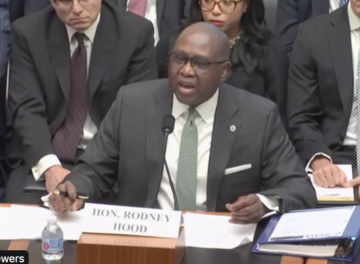
One representative also indicated he believes the largest credit unions should be subject to the Community Reinvestment Act, while another had questions around the CU tax exemption.
NCUA Chairman Rodney Hood and FDIC Chair Jelena McWilliams were both appearing before the House Financial Services Committee during a regular appearance by financial institution regulators. Following their prepared remarks, during questions by members of the committee, Rep. Blaine Leutkemeyer (R-MO) asked both Hood and McWilliams about their “concerns” over credit unions buying banks.
“These are voluntary, market-based transactions,” responded Hood.
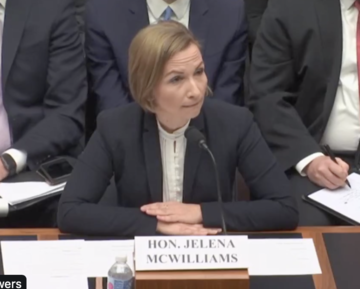
“There have been 28 acquisitions to date and others are pending,” answered McWilliams. “Yes, we have concerns and are looking at this…” McWilliams was then interrupted when Leutkemeyer’s five minutes of allotted time expired.
As CUToday.info reported here, Tampa-based Suncoast CU said it intends to buy the $746-million Miami-based Apollo Bank, the largest-ever acquisition of a bank by a credit union.
Rep Continues With Question
The question was picked up by Rep. Bill Huizenga (R-MI) during his time when he asked Hood and McWilliams whether they see any “problem” with the bank acquisitions by CUs. Hood began by again repeating his earlier response “These are voluntary, market-…” but was interrupted by Huizenga, who said Hood had already said that. “So, no problem. That’s fine if that’s your answer,” the representative said.
McWilliams answered by saying, “There is a great consolidation in the banking (industry) and I am concerned about these communities that are losing a banking presence. With respect to credit unions, Congress set up credit unions in a certain way, they are not subject to taxation and they do not have CRA…”
“I think you are getting to that there might be a problem,” stated Huizenga.
“I think there might be a problem,” answered McWilliams.
Not a ‘Capricious’ Decision
Rep. Trey Hollingsworth (R-IN) said he has had discussions with both Hood and his constituents related to CU acquisitions of banks and has heard both positive and negative views on the issue. Hollingsworth pressed Hood for his view on the issue.
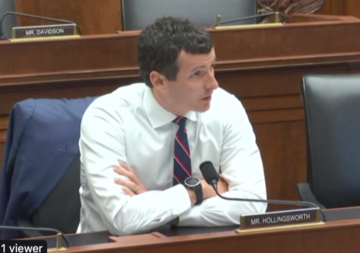
“There have been 32 credit unions that have acquired bank assets since 2013. There have been 250 bank on bank acquisitions over the last year alone,” said Hood. “These are voluntary, market-based transactions. In approving these transactions we at NCUA look to ensure that the bank’s customers qualify for the FOM, and that other statutes of FCU Act are met…And I would note that if not for credit unions acquiring some of these banks, some communities would be left without a financial institution. And at the end of the day, the bank does get to choose who that acquiring institution is. It’s not arbitrary or capricious.”
CU Growth & The Tax Exemption
Later in the hearing, Rep. Al Lawson (D-FL) asked Hood about concerns expressed by community banks over the growth of credit unions.
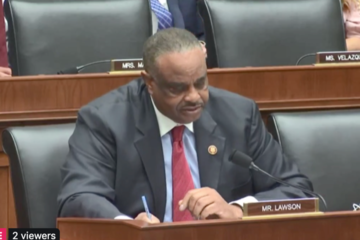
Hood responded by saying “in today’s dynamic marketplace, at the end of the day (consumers) are getting access to affordable financial services. I would much rather have both banks and CUs growing…I don’t want to pit banks against credit unions. Credit unions now serve a third of the American public and I think that is due to their commitment to providing access.”
Lawson then asked Hood if there should be limits on credit union membership.
“We do have field of membership restrictions. Almost everyone in this room can join a credit union, but maybe not the same one,” said Hood, noting that originally most CUs’ fields of membership were based on individual companies or certain fields of employment. “In some instances, those companies have left markets and those credit unions have gone to a community charter. At the end of the day those credit unions are governed by certain restrictions.”
Lawson then asked whether Hood believes membership in individual credit unions should be capped.
“I think that is up to the free market. As a regulator, I can’t impose (a cap),” said Hood, saying the regulator’s primary role is safety and soundness.”
Should the credit union tax exemption be removed for larger credit unions? asked Lawson.
Hood repeated NCUA’s primary concern is safety and soundness, but whether it is a “$100-billion credit union or a million-dollar credit union, it’s up to Congress to decide the tax exempt status.”
CUs & CRA
Later during the Q&A, Rep. Steve Stivers (R-OH) said he understands credit unions do not need to comply with the Community Reinvestment Act, but added he believes some of the largest credit unions should be.
“Credit unions are based on a mission of people helping people,” said Hood. “They are serving low-income people through their products and services they already offer. I don’t think credit unions need government fiat to encourage them to do the right thing.”