

WASHINGTON–In testimony before the House Committee on Financial Services, NCUA Chairman Rodney Hood provided an overview of a host of recent and longer-term actions taken by the agency. Ahead of Hood's testimony, CUNA sent a letter to the committee outlining areas where it believes the agency can "improve."
During the hearing on oversight of financial regulators, Hood initially focused on what he described as the “strong state” of credit unions and the NCUSIF, outlined the agency’s strategic plan for the next several years, and spoke to NCUA’s efforts around financial inclusion.
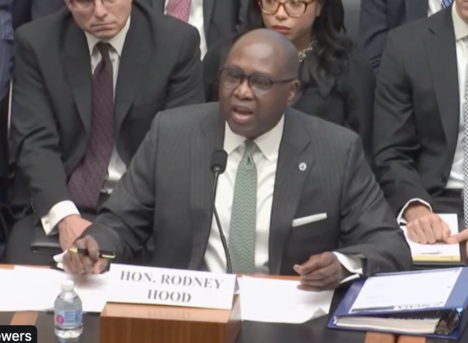
NCUA Chairman Rodney Hood testifies before the House on Wednesday.
Hood said assets in the credit union system have increased to $1.53 trillion with an aggregate net worth ratio at 11.39%. Hood told the committee distributions from the Share Insurance Fund have gone back into “communities to support small businesses, promote economic growth, and improve the financial well-being of credit union members across the country.”
Other points touched on by Hood during his prepared remarks:
Examination & Supervision
- Hood said the frequency with which the NCUA conducts examinations is consistent with the approach of the federal banking agencies and that the agency has a three-tiered exam program based on a credit union’s asset size and risk profile. Hood sad the largest CUs are subject to “continuous” supervision, including enhanced off-site monitoring and data analysis.
Cybersecurity & Technology
- Hood said NCUA is “bringing fresh thinking to our regulatory approach to ensure that the credit union system remains safe and sound” and that cybersecurity is a “priority.”
- Hood said the agency has adopted key cybersecurity initiatives and has provided to credit unions information and resources to improve their preparedness and resiliency, including the creation of an Assisted Information Security Maturity Self-Assessment Programfor credit unions, and a specialized Automated Cybersecurity Examination Toolbox (ACET). As part of ACET, Hood said in 2019 all scheduled institutions that have between $250 million and $1 billion in assets have been assessed, and in 2020, all scheduled institutions that have between $100 million and $250 million in assets will be assessed. NCUA will not conduct an ACET maturity assessment of those credit unions that have $100 million or less in assets.
Information Security Examination Program
- Hood told the committee NCUA is in the process of updating its cybersecurity examination capabilities by leveraging the Information Technology Risk Examination (InTREx) solution utilized by the Federal Deposit Insurance Corporation, the Federal Reserve System, and the State Liaison Committee members of the Federal Financial Institutions Examination Council. The first phase of the InTREx pilot will focus on statements and questions, examination procedures, and associated job aids.
Risk/Threat Profile Management
Hood said NCUA is enhancing the collection of information on cybersecurity threats and risks to “ensure we obtain and analyze actionable data and collaborate with the credit union industry to the fullest extent possible. We are doing this by distilling trends and tactics used by hostile actors into generic root causes. These root causes are typically in the form of critical security controls and they allow us to begin identifying the critical security controls that contribute to an array of nefarious activities. We can then develop best practice resources credit unions can use to combat the threat of cyberattacks.
Recent NCUA Rulemakings
- Hood said NCUA has reduced, streamlined and eliminated outdated or overly burdensome regulations where possible, In September, the NCUA Board issued a final rule to update, clarify, and simplify the federal credit union bylaws. This final rule reflects an extensive, collaborative effort with the credit union industry dating back to 2013.
- Hood said among NCUA’s most “significant” changes has been to change bylaws to allow federal credit unions to conduct hybrid annual and special meetings, which he said is especially beneficial to federal credit unions that serve active-duty members of the armed forces and who may be unable to participate in credit union meetings without virtual access.
Public Unit and Nonmember Shares
- Hood said the vote by the NCUA Board to raise the threshold on the amount of public unit and nonmember shares a federally insured credit union can receive provides regulatory relief and gives greater flexibility to eligible credit unions to determine the funding structure most appropriate to support their operations. “Many small credit unions have net worth levels high enough to take full advantage of this proposed new authority,” Hood said. “So, while this final rule provides relief to all federally insured credit unions, it will likely benefit small and low-income-designated credit unions the most.”
Commercial Real Estate Appraisals
- Hood told Congress the decision to raise the commercial real estate threshold from $250,000 to $1 million and to amend regs to include the rural exemption for residential appraisals will help address issues related to a scarcity of certified property appraisers in some communities and reduce regulatory burden without increasing risk.
Field of Membership
- Hood said changes approved by the board to FOM rules increase flexibility to applicants for community charters increase the likelihood of providing financial services for low- and moderate-income individuals.
Diversity and Inclusion
- As he has in other remarks, Hood told the committee he views “financial inclusion as the civil rights issue of our era. By inclusion, I mean not only broader access to affordable financial services, but also to employment and business opportunities. Our country is going through a period of profound demographic change, and our financial system should be leading efforts to respond to that change. Credit unions are growing stronger, and they serve their members and communities better when they promote greater diversity, equity, and inclusion as part of their business model.”
- In terms of supplier diversity, Hood said NCUA has integrated supplier diversity principles into our own procurement process, and as a result grown to 45% from 6% the contract dollars awarded to minority- and women-owned businesses over an eight-year period.
Second Chance Initiative
- Hood described for the committee the agency’s recently approved “second-chance” rules allowing people with old criminal records for minor, non-violent offenses to be eligible for a job at a credit union.
Hood’s full testimony can be found in CUToday.info’s The Gov here. Hood will appear before the Senate with other regulators on Thursday.
CUNA Letter to Committee
In a letter to the House committee ahead of Hood's testimony, CUNA said there are a number of areas in which NCUA can "improve," including:
- The risk-based capital rulemaking, which CUNA continues to believe is a solution in search of a problem
- Employing a more pro-active and collaborative strategy with industry stakeholders to better ensure credit unions are prepared for the current expected credit loss (CECL) standard
- Creating and providing a concrete, public plan to achieve regulatory relief
- Extending the credit union asset threshold for the 18-month examination cycle to $3 billion (from the current $1 billion)
- Phasing down the National Credit Union Share Insurance Fund Normal Operating Level to 1.30% by 2021.
- CUNA said it also encourages NCUA to issue additional share insurance fund distributions whenever possible, with the expectation that the initial increase in the NOL was temporary.
The letter also noted that NCUA board member Todd Harper’s proposed expansion of NCUA’s Office of Consumer Protection is not warranted.