NEW HAVEN, Conn.–The first quarter of 2018 saw “historically low regulatory activity,” according to the just-released Banking Compliance Index.
“While discussions around regulatory reform continued in Congress, little concrete action was taken last quarter, causing uncertainty about the regulatory environment for many financial institutions,” noted an analysis released with the BCI, which is published by Continuity.
“This regulatory pause is likely just an intermission; Congress continues to buzz with talk of reducing regulatory burden, pointing to the potential for substantial change in the coming months,” said Donna Cameron, Continuity’s director of regulatory I/O, in a statement. “Institutions should avoid claiming victory prematurely, as there will be much work to do if rules are modified.”
How BCI Works
The Banking Compliance Index, published quarterly by Continuity’s Regulatory Operations Center (ROC), quantifies the incremental burden on financial institutions in keeping up with regulatory changes, according to the company.
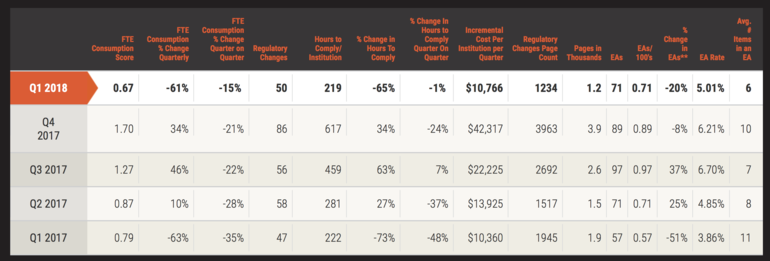
While the first quarter of each calendar year is always the slowest in terms of the pace of regulatory activity, Continuity noted that last quarter’s BCI dropped 15% from the same quarter of 2017, and reflected a sharp drop of 61% from the fourth quarter of 2017. In Q1 2018, the typical community financial institution needed just over one half-time employee (0.67) to keep pace with regulatory changes.
According to Continuity, the 50 issuances between Jan. 1 and March 31, 2018 were on par with previous first quarter volumes. But, according to Cameron, they were less complex–only 1,234 pages of new regulation. Compliance costs also held steady, at $10,766 for the statistically average-sized financial institution, the company reported.
“It is not unusual to see a regulatory slowdown in the first quarter, because fourth quarters are typically full of activity to close out the year end with housekeeping issues and technical updates. This trend held true for Q1 2018,” Cameron verified. “While the number of issuances remained steady, they were generally less complex than we’ve seen in previous quarters.”
One Significant Change
Continuity noted that an adjustment to the Prepaid Accounts Rule was a significant change during Q1 2018. While the rule was supposed to take effect this month, the effective date has been pushed back another year to April 1, 2019. Another noteworthy change was an update to the status of the Payday Lending Rule. In January, the Consumer Financial Protection Bureau (CFPB) announced that it planned to open a rulemaking process to reconsider the Payday rule.
“This will be an important process for financial institutions to watch,” said Continuity.
Cameron added, “The current CFPB posture suggests that several of its previous enforcements might be repealed or amended; in fact, there have been no enforcement actions issued by the Bureau since director (Mick) Mulvaney assumed his position. However, it’s critical for financial institutions to realize that even if regulations are rolled back and burden is reduced, that still represents a significant change that requires a shift in procedures, training and software. Financial institutions must remain proactive in their regulatory monitoring and management to prepare for the changes ahead.”