

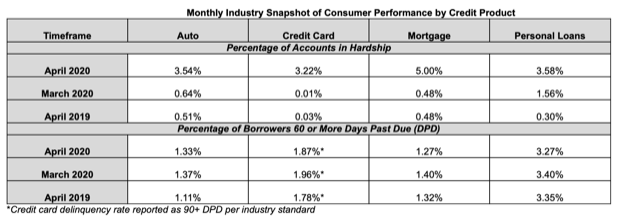
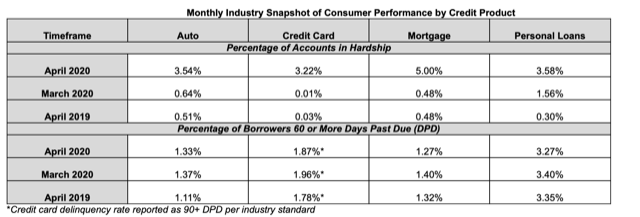
CHICAGO–A new report from TransUnion has found the percentage of accounts entering “financial hardship” status has risen dramatically for credit products such as auto loans, credit cards, mortgages and personal loans.
The report, which said financial hardship status is defined by factors such as a deferred payment, frozen account or frozen past due payment, was produced as part of what the company said is an effort to get greater insight into the payment behaviors of consumers during the first two months of the COVID-19 pandemic.
The new analysis supplements TransUnion’s quarterly Q1 2020 Industry Insights Report with a newly created “Monthly Industry Snapshot Report,” which it said highlights the consumer credit market for April.
Despite growing financial hardship within the consumer credit market, the analysis found that consumers are paying down their credit card balances with the average balance per consumer decreasing from $5,645 to $5,437 between March and April 2020.
Paying Down Balances
“Consumers may be potentially paying down balances to ensure further access to liquidity until there is more clarity as to when shuttered businesses begin to reopen,” TransUnion said. “This also reflects a slowdown in spending behavior, as uncertainty about the future has impacted consumer sentiment and confidence. This trend is significant because credit cards are the most widely used credit product in the U.S. As of Q1 2020, there were 457.6 million credit cards with balances of $814 trillion.”
The company said a similar phenomenon is occurring in the personal loan market as the aggregate excess payment (AEP) of consumers between March and April increased from $194 to $215. AEP measures, on average, how much consumers are paying over their respective minimum payments.
In parallel, TransUnion said it has been conducting consumer research to learn more about the impacts of COVID-19 on consumer finances. The most recent survey from early May found that of the 59% of Americans who said their household income has been negatively impacted by COVID-19, two in three (66%) say they are concerned about paying their current bills and/or loans. Of this population, 12% state that they are using accommodations offered by their lenders such as forbearance. In addition, 31% of impacted consumers plan to pay a partial amount on their next loan payment. Approximately 44% of impacted consumers also state that they have reached out recently to companies where they have accounts to discuss payment options, TransUnion said.
Below are highlights from TransUnion’s Q1 2020 Industry Insights Report and Monthly Industry Snapshot Report across multiple categories, with commentary from TransUnion representatives.
Record Number of Consumers Have Access to a Credit Card
Q1 2020 IIR Credit Card Summary: TransUnion said the first quarter of 2020 saw continued growth in the credit card industry with 184.7 million consumers now having access to a credit card. There are 457.6 million credit cards in the U.S. – up nearly 25 million from one year ago. Following seven consecutive quarters of origination growth, Q4 2019 was another record-setting quarter for originations with 18.9 million new accounts – the second straight quarter of originations over 18 million and a growth rate of 14.9% year-over-year. Average credit card debt per borrower rose to $5,653 while consumer delinquency continued to increase to 1.97% in Q1, which is the highest level since 2011.
Analysis
“Since the World Health Organization declared the COVID-19 outbreak a pandemic in mid-March, the credit card sector has not yet seen the true economic impacts of the virus,” said Paul Siegfried, senior vice president and credit card business leader at TransUnion. “At the start of this year the industry was poised for another strong quarter as there was record growth in originations and consumer access to credit. Along with this growth, delinquencies remained relatively stable – in part due to accounts moving into deferment as a result of new COVID-19 legislation. However with rising unemployment and growing consumer debt, we expect lenders to recalibrate their underwriting strategies to mitigate risk.”
Personal Loan Market to Transition out of Prolonged Period of Growth
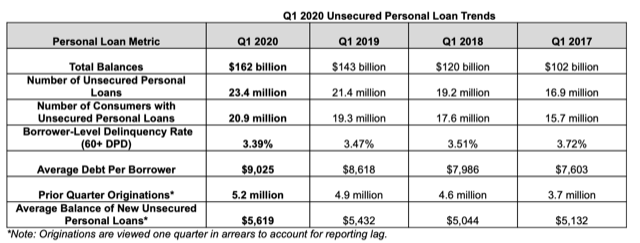
Q1 2020 IIR Personal Loan Summary. Despite total personal loan balances reaching a high of $162 billion, balance growth in the personal loan industry slowed toward the end of Q1 2020 as the COVID-19 pandemic started to take hold in the U.S, TransUnion reported. The average new account balance secured by consumers has largely remained stable year-over-year. With the onset of COVID-19, lenders started to pull back late in the quarter and origination growth in the personal loan market hit its slowest rate of growth in 10 straight quarters, increasing 4.7% year-over-year in Q4 2019. Comparatively, originations grew 9.7% year-over-year during the same period in 2018. While delinquencies have largely remained stable over the past few years, the COVID-19 driven financial crisis will likely trigger an uptick in delinquencies over the next few quarters; however forbearance programs will temper the severity of this impact in the near term.
Analysis
“Prior to the impacts of COVID-19, the personal loan market was well-positioned for another strong quarter. However in response to the pandemic, lenders began to deploy new strategies to stabilize their portfolios,” Liz Pagel, senior vice president and consumer lending business leader at TransUnion. “Several lenders instituted stricter underwriting guidelines and pulled back on marketing and prescreen campaigns to limit their exposure during the expected downturn. As a result, we expect originations to start declining following several years of significant growth. Forbearance programs may help keep delinquencies in check for the near-term, but as consumers start rolling off these forbearance programs over the coming months, we will likely start to see delinquencies tick up.”
Forbearance Programs Take Hold of Mortgage Industry
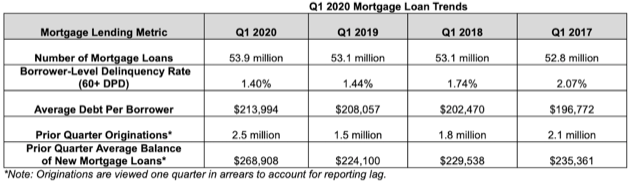
Q1 2020 IIR Mortgage Loan Summary. According to TransUnion, serious delinquency rates declined in Q1 2020 to 1.40%, down four basis points from the same period last year – reversing the delinquency uptick from the past few quarters. According to the TransUnion credit database, 5% of all mortgages are currently in financial hardship, which includes forbearance programs as of April 2020. Mortgage forbearance programs, which started in March, have allowed consumers enrolled in those programs to avoid being labeled as delinquent.
According to TransUnion, this has kept delinquency rates at manageable levels in Q1 and is expected to continue into Q2. Prior to the financial impacts of COVID-19, the mortgage industry experienced significant origination growth, primarily due to refinancing in Q4 2019. Volumes reached its highest level in 10 years with 2.5 million originations, a growth rate of 63% year-over-year and nearly one-million more originations than the same period last year.
Analysis
“Over the past few years we have seen home prices steadily climb, especially in large MSAs and urban centers. A historically low interest rate environment helped drive exceptionally high origination volumes in these high-priced areas as consumers in more expensive homes have a greater incentive to refinance. COVID-19 will have a major impact on the mortgage markets but expect to see strong refinance volumes continue as interest rates remain low,” said Joe Mellman, senior vice president and mortgage business leader at TransUnion. “In a survey conducted by TransUnion, at least 11% of consumers are relying on refinancing as a means to help pay for current bills or loans during COVID-19. We expect impacted consumers to continue to take advantage of mortgage forbearance programs, which will keep mortgage delinquency levels reported to a consumer’s credit file low in the near-term.”
Following Recent Growth, Auto Industry Expected to Face Challenges
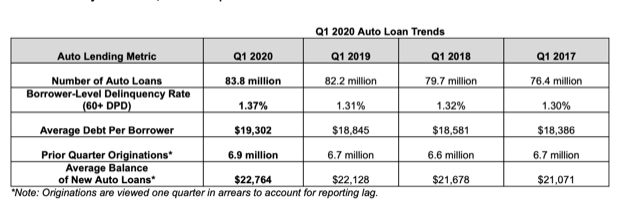
Q1 2020 IIR Auto Loan Summary. According to TransUnion, delinquencies remained stable in Q1 2020 at 1.37% 60+ DPD, a slight uptick over the same period last year and within a delinquency variation of 10 basis points for 11 straight quarters. The average new account balance continued to grow and reached an average of $22,764 per consumer – a 2.9% year-over-year increase. This was largely due to consumers moving toward larger and more expensive vehicles such as trucks and SUVs. While the average amount financed continued to rise, the average monthly payment grew at a slower rate due to lengthening loan terms and a recent decline in APR, the company said. In fact, APRs experienced their first year-over-year decline in Q4 2019 after 10 consecutive quarters of growth. Despite concerns around auto affordability, originations grew 3.1% year-over-year in the fourth quarter, compared to 1.7% year-over-year in Q4 2018.
Analysis
“Last quarter the auto market exhibited strong year-over-year origination growth and steady delinquencies, highlighting the underlying health of the market pre-COVID-19. In the current environment, external pressures such as high unemployment rates and low consumer confidence will exacerbate affordability challenges and impact future growth in the auto finance market,” Satyan Merchant, senior vice president and automotive business leader at TransUnion. “We anticipate the auto market will continue to face challenges in the wake of COVID-19 as dealers will be forced to transition away from brick and mortar operations. However, we can expect digital innovation to help transform the space with an increasing number of consumers looking to such channels to initiate and complete the car buying process.”