

SNELLVILLE, Ga.–The African American Credit Union Coalition (AACUC) and the MD|DC Credit Union Association co-hosted a town hall the organizations said was designed to explore the “human and economic toll of systemic racism and how the movement can effect change.” Approximately 200 people participated in the “Commitment to Change Through Action” virtual town hall.
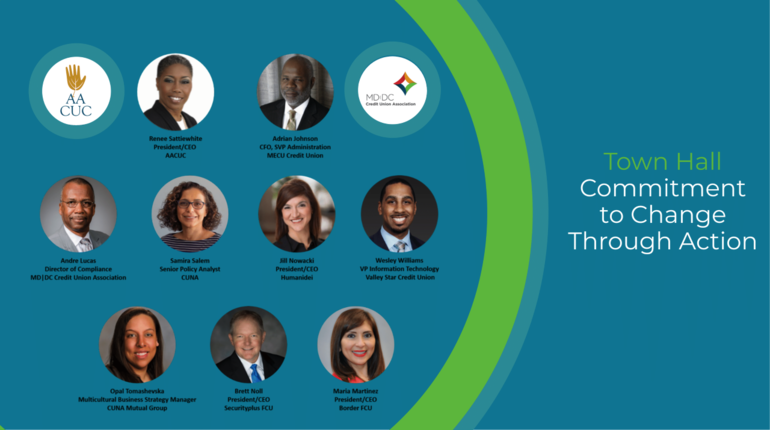
AACUC President and CEO Renee Sattiewhite, along with AACUC Chair and MECU Credit Union EVP/CFO Adrian Johnson, served as moderators. A panel of credit union leaders and industry partners shared their personal experiences with racism and engaged in a broader discussion of how systemic racism has created a legacy of economic inequality for Blacks in America, according to the association. Panelists also talked about the role diversity, equity and inclusion practices play in bringing about change.
The organizations shared the following synopsis of the Q&A:
Q: How did we get here?
“To find out how we got here, Samira Salem, Senior Policy Analyst for CUNA, says you have to go back nearly a century ago to the practice of redlining which used color-coded maps to determine where it was safe to insure mortgages. African American neighborhoods were colored red to indicate they were too risky,” the organizations reported. “Salem says barriers to home ownership prevented Blacks from achieving economic stability.”
“Black people were not able to accumulate wealth, they weren’t able to send their kids to college with their home equity or bequeath wealth,” Salem said. “This was the practice of redlining. Really a systematic policy of mortgage discrimination and segregation.”
According to the report of the Q&A, “While redlining was banned more than 50 years ago, its legacy is still felt. Salem said while home ownership accounts for two-thirds of the wealth of a typical U.S. household, 75% of Whites own their own home, but according to the U.S. Census Bureau just 44% of Blacks and 49% of Hispanic/Latinx are homeowners. As a direct result, the net worth of White households is now 10 times greater than Black households according to the most recent Survey of Consumer Finances by the Federal Reserve Bank.”
Q: Where do we go from here? What are the solutions?
Sattiewhite said she believes that being intentional is a good first step. “I believe that if we share our stories and we have conversations, if we’re open and honest and we agree to be open and honest, then things can change.”
Q: What is the role of leadership?
According to the organizations, the panelists agreed leadership has a vital role to play in addressing racial issues and creating opportunities for advancement.
“I have a duty, I have a responsibility to folks who are coming behind me,” said Adrian Johnson, CFO/SVP-administration at MECU Credit Union and chair of AACUC. “I stand on the shoulders of those who have come before me. The folks that are coming behind me, I owe them and have a duty to help them be their sponsor, be their advocate, be their influence. Help them into that C-suite or help them into that CEO office.”
Based on his experiences, Andre Lucas, compliance director at the MD|DC Credit Union Association told the meeting the key to real progress comes from the top. “Leadership has to be onboard so we can bring this racism to an end and all of us are looked at not by color, but by who we are as individuals as people, as human beings,” he said. “We need to keep this momentum going and don’t stop.”
The organizations noted Brett Noll, President/CEO of Securityplus FCU urged leaders to be an active participant in finding solutions. “Become aware and acknowledge the problem. It’s got to be an ongoing effort and you have to commit to it,” Noll said. “Make it part of your strategic plan. Get people onboard with the effort top down and do it and don’t stop doing it. And don’t be scared.”
Added Maria Martinez, CEO/President of Border FCU, “I think everyone in a leadership role should be an ally in helping to create a safe and more welcoming and inclusive environment. Show off your staff, brag about them, praise them for their accomplishments and make them feel part of the team.”
Q: How do you know if progress is being made?
According to the organizations, gathering data is critical to measuring progress. Sattiewhite said there are just six African Americans leading the 314 U.S. credit unions with assets over $1 billion. “We need that data to see who is in the C-suites, who is in the boardroom, to see if we are making progress. If we don’t know – we can’t tell you if we are making a difference or if change is happening.”
Added Jill Nowacki, CEO of Humanidei, “Setting those metrics that actually align with and reflect the community and then holding people accountable for that is critically important.”
Q: What is the role of diversity, equity & inclusion? and how can it make a real impact?
“When you think about input, if everything is the same, your innovation is going to be limited, you are not going to have the perspective that you need,” said Opal Tomashevska, Multicultural Business Strategy Manager, CUNA Mutual Group. “We also know that the population is getting more diverse so younger generations like millennial and Gen Z are already more than 50% people of color. By 2040 it’s predicted to be a minority majority, so if you don’t have that representation on your teams, you’re not able to be of service to the population as it’s changing as well.”
Salem told the town hall it’s important to use the DEI lens to assess products and services to determine who is benefitting and who is being burdened. “You have to know their pain points. And understand who your members are. In order to understand them, we need to become more equitable, we need to become more inclusive and we need to become more diverse as organizations,” Salem said.
Added Wesley Williams, VP of Information Technology at Valley Star CU, “Don’t just do diversity to check a box. Go the next step and include them and give them the resources and tools to prop them up. Put them around people who can help them and that’s how I really think we will see a change.”
Noll told the meeting credit unions should be leading the way toward to greater financial equity and inclusion. “We have a platform, we have the ability to change our country, change our world. It’s going to take all of us,” he said. “It’s not something we can look at other organizations and say they are handling that, the politicians are handling that, it’s on each and every one of us.”
The town hall can be viewed here.