CHICAGO––The financial services industry is “rebounding strongly” from the early impacts of the COVID-19 pandemic, according to TransUnion’s Q2 2021 Quarterly Credit Industry Insights Report (CIIR).
The auto, credit card, mortgage and personal loan industries exhibited renewed signs of strength at the mid-point of 2021, TransUnion said.
“In the initial months of the pandemic, many lenders struggled with making credit available to consumers in the face of branch closures and a remote workforce,” TransUnion said in releasing the findings. “One year later, lenders have adapted and shifted to a digital-first origination strategy and enhanced their capabilities to originate new accounts virtually. Signs of this origination growth were observed in Q2 2021, with originations increasing 76% YoY in the mortgage industry and 16% in the auto industry. The personal loan and credit card industries are expected to show YoY origination growth in the coming quarter.”
TransUnion noted financial institutions are returning to lending and extending credit due to the greatly improved view of consumer credit health since the start of the COVID-19 pandemic. To provide greater insight on the financial standing of consumers and the health of the overall consumer credit market, TransUnion said it unveiled the Credit Industry Indicator (CII) to better monitor consumer and lender behaviors and provide a comprehensive look at credit activity and performance.
‘Measured Improvement’
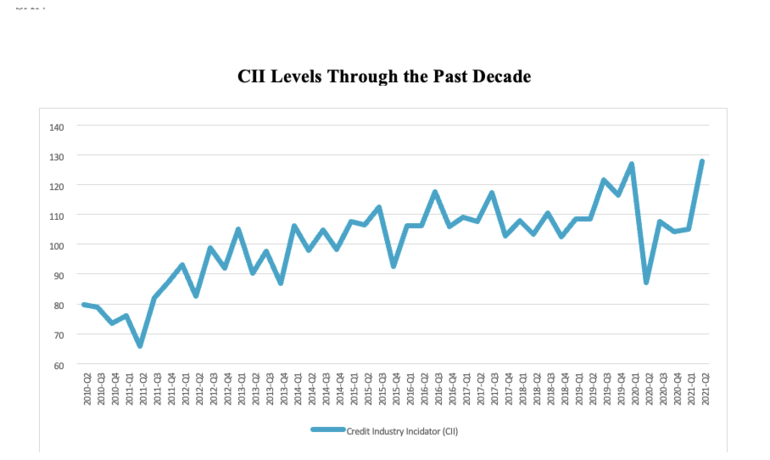
The company said the new CII has shown “measured improvement” and is reflecting increased lender confidence, with the indicator most recently reaching a high of 128 in Q2 2021, up from 87 in Q2 2020.
“This significant jump demonstrates that consumers are rebounding from the pandemic and surpasses the 127 CII observed pre-pandemic in Q1 2020,” TransUnion said.
“COVID-19 upended the way consumer credit health has been looked at traditionally. To gain a more complete picture on the status of consumers, we are expanding our traditional Credit Industry Insights Report to show a comprehensive measure of credit market health,” said Matt Komos, vice president of research and consulting. “The latest CII indicates that we are well on the road to recovery, and we expect CII levels to continue to grow over the course of the year, so long as COVID cases drop, reopening plans continue, and consumer spending levels remain robust.”
Rising CII
TransUnion said the CII offers a comprehensive view of consumer credit health and provides new insights on credit activity and financial performance for consumers in the United States.
The indicator accomplishes this by aggregating consumer credit data to show the pronounced impact of economic and market events on consumer credit health,” Transunion explained, adding that data elements are summarized on a quarterly basis to analyze changes in credit health and are categorized under four pillars: demand, supply, consumer behavior and performance.
These are combined into a single, comprehensive measure that reflects the current state of consumer credit health, TransUnion added.
“As could be expected, the greatest impact on consumer credit health in recent years was observed during the first few months of the COVID-19 pandemic,” TransUnion said. “From Q1 2020 to Q2 2020 the CII fell 40 points to 87, the largest quarter-over-quarter drop in the past 10 years. Prior to this dramatic decline the CII had been on a continuous rise, reaching as high as 127 in Q1 2020. The CII’s all-time low of 66 occurred in Q2 2011 as the nation was still struggling in the aftermath of the Great Recession.”