CHICAGO–Serious delinquency rates remain mostly down and loan originations continue to rise from COVID-19 lows, but future growth in what is expected to be a robust auto lending market may be dependent upon subprime borrowers, according to TransUnion.
But overall, the company said, the consumer credit market is strongly positioned as many parts of the country prepare to enter new phases of re-opening this summer, according to new data from TransUnion.
The just-released Q1 2021 TransUnion (NYSE: TRU) Industry Insights Report noted the improvements are occurring against a backdrop of a pandemic that caused one of the greatest shocks in the history of the American economy. In March 2020, the unemployment rate stood at 4.4%. In April 2020, it jumped to 14.7% -- the highest reading since 1940.
Improvements Ahead
“A consequence of this dramatic rise was an equally immense slowdown in loan originations,” TransUnion stated. “Some lenders tightened their standards and consumers held back on opening loans in the first months of the pandemic. For instance, unsecured personal loan originations dropped from 3.9 million in Q1 2020 to 2.6 million in Q2 2020. Credit card originations declined at an even faster rate – from 15.5 million to 8.6 million in the same timeframe.”
But TransUnion said several early 2021 signs point to more improvements ahead. Government programs and improving employment helped spur the University of Michigan Consumer Sentiment Index to move up from 76.8 in February 2021 to 84.9 in March 2021. A report from the Commerce Department’s Bureau of Economic Analysis (BEA) found that personal consumption expenditures increased 4.2% in March. And Oxford Economics anticipates real consumer spending growth of 9.6% in 2021.
“The continued improvements in the economy have led to more loan activity. In the last two quarters, credit card originations have risen to 12.3 million (Q3 2020) and 15.5 million (Q4 2020) from the lows observed in Q2 2020 (8.6 million),” TransUnion said. “As demand for credit rises, serious delinquency rates stand near record lows. Lending and credit use slowed in Q2 2020, but government stimulus and forbearance programs caused an interesting dynamic to play out where serious delinquency levels have mostly dropped despite elevated unemployment.”
Serious Delinquency Rates Mostly Down From the Beginning of the Pandemic
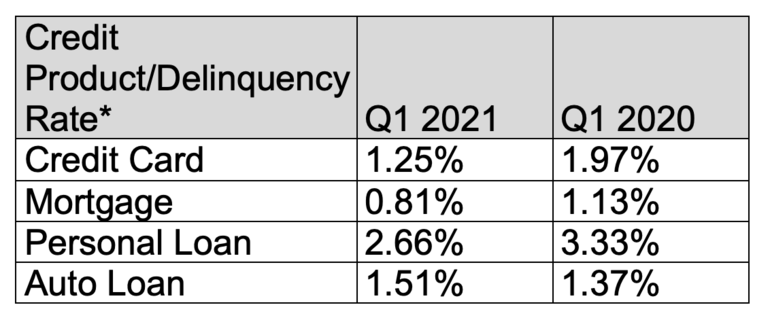
Delinquency rates are measured at the consumer level as 60+ days past due for auto and unsecured personal loans and 90+ days past due for credit cards. They are measured at 90+ days past due on the account level for mortgages.
“This last year has been like no other, but in many respects it has highlighted the wherewithal of the U.S. consumer to persevere under the most extreme conditions,” said Matt Komos, vice president of research and consulting at TransUnion. “Consumers and lenders, alike, took more prudent measures with their credit use. Buoyed by government stimulus programs, many consumers used their benefits to remain current on accounts. As we near the first half of the year and more of the country opens, there is a strong sense that pent up demand for new loans will lift the consumer credit market even higher.”
Credit Card Balances Continue Declining in 2021
According to TransUnion, credit card balances continued to decline in Q1 2021 with total balances dropping to $688 billion from $814 billion in Q1 2020. Average consumer credit card debt per borrower dropped to $4,791, the lowest level since at least 2009 when TransUnion first began measuring this variable. Total credit card originations fell nearly 18% year over year across all credit risk tiers with average lines on new accounts declining 28% in the same timeframe.
Despite this decline, consumers with access to a credit card increased 2.1% in the last year to 188 million. This is a continuation of a 10-year growth trend. Serious consumer-level delinquency rates (90+ days past due) dropped to 1.25% in Q1 2021, down 72 basis points from one year ago. This immense drop is likely due to a combination of consumers having more liquidity due to the various government stimulus programs and borrowers protecting this particular credit product during the pandemic, TransUnion said.
Card Analysis
“We observed a continuation in the decline in credit card balances to begin 2021 as many consumers used stimulus payments and income tax returns to pay down these debts,” said Paul Siegfried, senior vice president and credit card business leader at TransUnion. “New account originations activity continued its uptrend and return to ‘normal’ levels. For those consumers opening new credit cards, the lines have been relatively low as lenders are controlling for the uncertainties still in the market. As more issuers ramp up their acquisition marketing efforts with new and sophisticated approaches, we anticipate originations and credit lines to move closer to levels seen in recent years.”
Mortgage Originations Continue to Spike
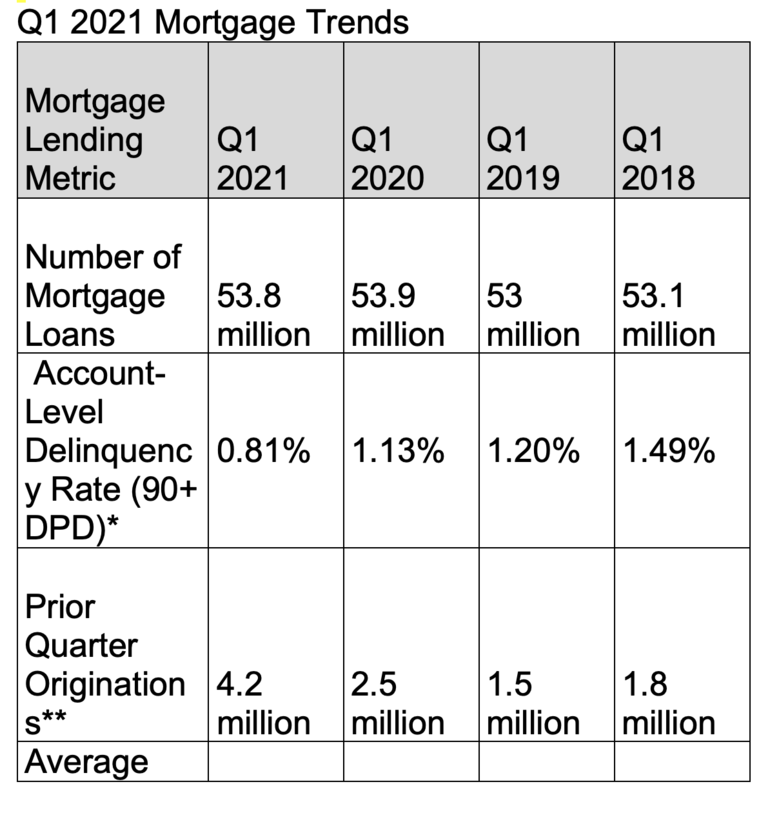
As many CU mortgage lenders are aware, TransUnion noted the surge in mortgage originations continued in Q4 2020 (viewed one quarter in arrears) as serious delinquencies headed lower in Q1 2021. Mortgage origination volume increased to more than four million in Q4 2020, 73% higher than at the same time last year and the highest quarterly volume recorded since TransUnion began tracking the metric in 2011, the company said.
Refinancing made up 53% of the share compared to 47% from purchase. One year earlier, refinance constituted 43% of share compared to 57% for purchase. Both purchase and refinancing rose significantly in the last year with purchase up 42% and rate and term refinance increasing 160%. Cash out refinancing also increased 64% from the previous year.
Serious mortgage delinquency rates continued to decline, falling from 1.13% in Q1 2020 to 0.81% in Q1 2021 – the lowest level observed in at least 10 years. The number of mortgage accounts in accommodation status remained elevated, TransUnion reported.
Mortgage Analysis
“The low interest rate environment and rising home values are driving the mortgage market. Housing demand is outweighing housing supply, which is causing the rise in home values,” said Joe Mellman, senior vice president and mortgage business leader at TransUnion. “At the same time, higher home values are giving more consumers opportunities to refinance and conduct cash out refinancing. Serious delinquency rates are at near record lows, partly driven by the percentage of accounts in accommodation status. While we anticipate delinquency rates to move higher once these accounts come out of accommodation, we also expect many of these consumers to do all they can to make payments and protect the equity in their homes.”
Originations Continue a Slow Recovery
The TransUnion data show personal loan originations began to recover in the Q4 2020, steadily growing after the market contracted nearly 50% in Q2 2020, and 30% in Q3 2020. Originations were still 20% below Q4 2019 levels.
“Fintechs and bank lenders continue to see more significant year-over-year declines. In Q1 2021, total balances fell for the fourth consecutive quarter – led by 10%+ declines in the below prime tiers,” TransUnion reported. “Interestingly, super prime borrowers experienced a 6.3% increase in balance growth during the same timeframe. Serious delinquency rates dropped 73 basis points in the last year and now stand at 2.66% as of Q1 2021, even as the number of accounts in accommodation declines.”
Government stimulus and higher savings rates continue to contribute to lower delinquency, the analysis added.
Personal Loans Analysis
“While many lenders are looking to return to growth in the coming quarters, we anticipate consumer demand for personal loans to grow more slowly. Personal loans are often used for debt consolidation, and credit card balances were down significantly in 2020 and will take time to rebuild,” said Liz Pagel, senior vice president and consumer lending business leader at TransUnion. “As more states re-open their economies, we expect to see more activity as consumers seek to finance vacations, home improvements and other large purchases. We also expect that lenders will continue to gain confidence in the economy and open their buy-boxes to higher risk consumers, which could drive growth.”
Subprime Activity May be Key to Future Growth
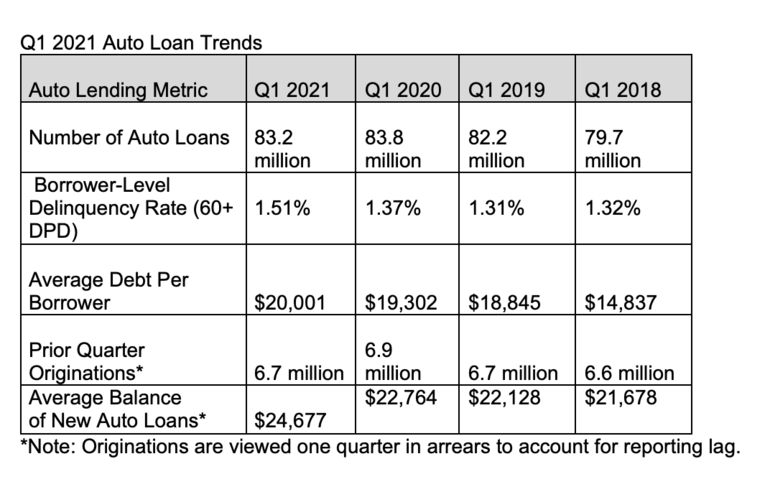
The broader auto finance market continued to largely recover in Q1 2021 with average debt per borrower topping $20,000 for the first time since TransUnion began tracking the metric, the company said.
“Originations continued to increase in Q4 2020, though at a slower rate than Q3. The slowdown is primarily due to fewer loans originated to subprime borrowers,” TransUnion said. “However, early counts in Q1 2021 point to some recovery happening for this subset of the population. Serious delinquency rates for auto loans increased in Q1 2021, moving to 1.51% from 1.37% one year earlier. The slight rise in aggregate delinquency rates is, in part, driven by lower subprime originations.”
Vintage analysis is showing that auto portfolios across all risk tiers remain healthy, the analysis added.
Auto Market Analysis
“The auto finance market continues its recovery after encountering the depths of the pandemic last year. The strength of originations, balances and loan performance point to a market where lenders have continued to make credit available to borrowers; while government stimulus, falling unemployment and tax refund season have all helped strengthen household balance sheets,” said Satyan Merchant, senior vice president and automotive business leader at TransUnion.
All of these factors point to rebound in subprime originations in Q1 2021 and beyond. While overall delinquency rates continue to rise, they appear to be at manageable levels. At the onset of the pandemic, there was a fear that we might see a major spike in auto delinquency rates, especially as most consumers were locked down in their homes. That fear never materialized and we anticipate more auto loan growth and continued good performance in the near future.”