WASHINGTON—In what will be no surprise to buyers, sellers and credit unions making mortgage loans, the single-family housing market was particularly strong in 2020. A new survey of consumers also offers new insights into how they view the housing market.
As of Q4 2020, home prices appreciated 10.8% year over year, according to the FHFA Home Price Index, and the National Association of Realtors reported that monthly sales of existing homes were more than 20% higher, year over year, in Q4 2020.
“We attribute much of housing’s strength to the response of policymakers and consumers to the truly unique circumstances of the COVID-19 pandemic,” Fannie Mae stated in its review of the market. “Thus far, the pandemic has contributed to historically low mortgage rates, higher savings for many households, and even stronger demand for homes relative to supply, as many households searched for homes with additional features, including more space, home offices, and the ability to safely ‘nest’ with their families. Even in the years prior to the pandemic, consumers reported that they believed housing, as an asset class, was a safe investment with high potential, a perception which, if it persists, will likely further support demand even as pandemic-related factors recede.”
The Rankings
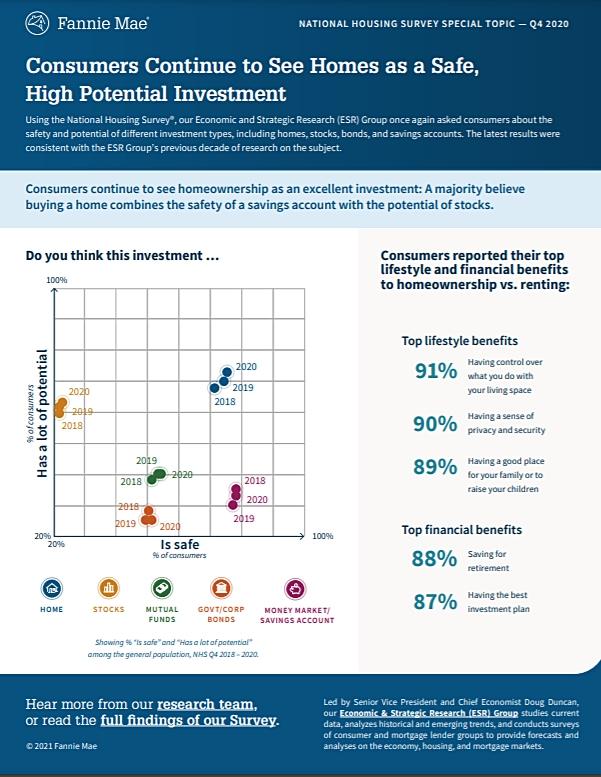
As part of its Q4 2020 National Housing Survey, Fannie Mae said it again asked consumers about various investment types, including stocks, bonds, homes, and savings accounts. Seventy-five percent of respondents indicated that homes are a “safe” investment, ranking in safety just slightly below a savings/money market account. Additionally, 73% of consumers felt that investing in a home has “a lot of potential” – by comparison, 63% of consumers believe that stocks have “a lot of potential.”
‘Relatively Consistent’
“These numbers have remained relatively consistent over the last 10 years of NHS data collection, including during the pandemic,” Fannie Mae said. “Americans appear to have an ingrained belief that housing investments are almost as safe as a money market or savings account, but also that they have the growth potential of a stock investment. Looking a little deeper, all demographic groups surveyed had a high, positive perception of housing as an investment, but there were slight differences; one is that Black and Hispanic consumers tend to have a slightly stronger belief that housing has a ‘a lot of potential’ compared to White and Asian consumers. Meanwhile, White and Asian consumers tend to have a slightly stronger belief that housing is a ‘safe’ investment compared to Black and Hispanic survey respondents.”
Fannie Mae said it understands the perception of housing as a “safe” investment with “a lot of potential” does “not necessarily align with reality.”
“Housing prices can experience steep declines or fluctuations depending on the holding period (see FHFA Home Price Appreciation Chart since 1991); the timeline of when someone buys and sells their home is an important factor in the overall return,” Fannie Mae said. “Additionally, transaction costs are generally higher for housing than other assets. However, when comparing homeownership to other investments, consumers may be factoring in the rent they may otherwise have to pay, and for some consumers the tax benefits of owning a home remain meaningful. Finally, the availability and extent to which consumers can leverage their down payment by purchasing a home, as opposed to placing those funds in alternate investments, such as a mutual fund or a savings account, is unique. One often overlooked feature of a fixed-rate self-amortizing mortgage is that it acts as a forced savings mechanism as the principal balance on the loan is gradually reduced by funds that would otherwise have gone to rent payments.”
The Long-Term Potential
Holding period and other caveats aside, Fannie Mae said its latest survey reminds the nation that consumers remain focused on the long-term potential of housing.
“In fact, 85% of consumers in our survey believe homeownership leads to wealth-building and better financial health, numbers that have been consistent over time. There is support for that view in the literature,” Fannie Mae said. “According to two studies in particular, Homeownership and the American Dream and The Rate of Return on Everything, after ‘imputed rent’ is included in a home’s financial return (i.e., the rent one would have to pay if they did not own their home), the rate of return on owning a home has historically been similar to other asset classes such as stocks.”
Consumers’ assessment of the benefits of homeownership and their belief in a home as a solid investment have not changed much over the years, despite recent adverse events including the Great Recession and the current pandemic, Fannie Mae explained.
‘Longstanding Beliefs’
“While some may believe this stems from the American psyche of ‘individualism’ and wanting to own personal property, it may also simply be a reasonable belief, given comparisons to other assets and the emotional, non-monetary benefits that clearly factor into homeownership perceptions,” Fannie Mae said. “It may take a large increase in the relative returns of other asset classes, or fewer favorable financial incentives for homeownership, for consumer attitudes of housing as an investment to change. For now, we expect these longstanding beliefs in the benefits of homeownership to continue to provide demand-side support in the housing market.”