

WASHINGTON–An “online experiment” conducted by the CFPB has found consumers would pay down credit card debt with savings–but not all the debt, preferring to keep some as a safety cushion.
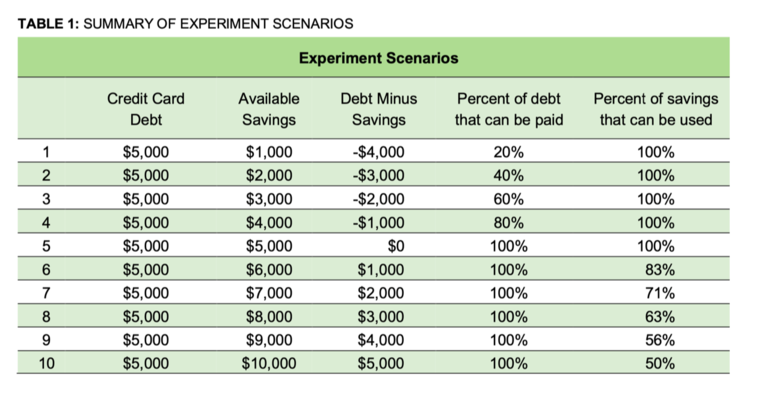
“In nine of the ten hypothetical savings scenarios, fewer than half of participants put the maximum amount of savings toward debt reduction,” the CFPB stated in releasing its findings. ”Only in the hypothetical scenario where savings was double the size of the debt ($10,000 versus $5,000), did even a majority of participants – 77% – eliminate credit card debt.”
According to the CFPB, more than 90% of participants indicated they would use at least some of the savings to pay down credit card debt, with the Bureau stating it shows people how to reduce debt. The online exercise found, on average, participants allocated more than half of the savings they could to debt reduction, even among those assigned to the scenario with the lowest amount of savings.
‘Valuable First Step’
“This study provides a valuable first step to understanding how consumers balance goals of preserving a savings cushion and pursuing debt reduction,” the CFPB said. “Our results suggest that the savings-debt trade-off is a balancing act, with most participants in the hypothetical scenarios allocating some of the savings to debt reduction (50 to 85%) while preserving the rest as a savings cushion.”
In conducting the experiment, the CFPB said it was probing the choices that must be made by consumers in holding savings and debt simultaneously and in deciding how to act on each.
“This tension can exist even when the cost of holding the debt (i.e., accrued interest) is higher than the interest produced by savings,” the CFPB said. “One prominent case is credit card debt, where the interest paid on credit card debt is substantially higher than interest earned on most savings vehicles. One in three U.S. consumers has credit card debt that they carry from month to month (i.e., are credit card “revolvers”), and many of these consumers—about half—also have relatively low-interest savings that could be used to reduce their debt. This phenomenon—concurrent holding of high-interest credit card debt and low-interest savings—is commonly referred to as the ‘credit card debt puzzle’.”
The Questions Explored
Among the questions the CFPB said its online experiment sought to explore were:
- Why do consumers choose to hold savings and credit card debt simultaneously, rather than using their savings to pay down debt?
- Is the security offered by a savings cushion a driver?
- Does the desire for the cushion nonetheless compete with a desire to pay down debt?
- Does a lack of understanding about relative costs—that the interest paid on credit card debt is much higher than the interest earned on savings accounts—play a role?
“The benefit of an experimental approach using hypothetical scenarios is that it allows researchers to explore possible explanations for behavior,” the CFPB said. “Our study is among the first to use an experimental design to explore the extent to which preserving savings and paying down debt may be competing goals.”
How Experiment Worked
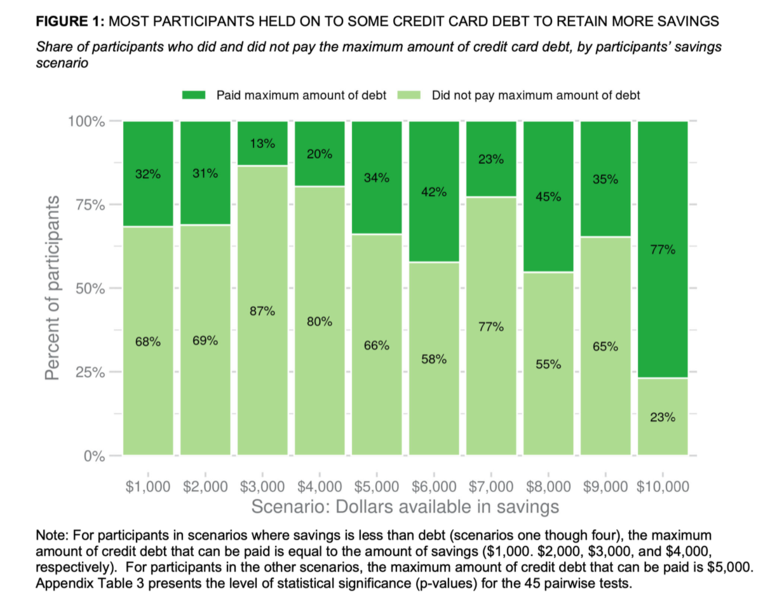
In the CFPB experiment, participants were presented with a scenario that assigned them a savings amount for a hypothetical person named Mr. Green. Participants were then asked how much savings they wanted to apply toward reducing Mr. Green’s $5,000 in credit card debt. For the savings amounts, the CFPB randomly assigned participants to one of 10 amounts ranging between $1,000 and $10,000.
“Because we set the credit card debt at $5,000 for all scenarios, but varied the savings amounts such that they were either not enough, just enough, or more than enough to cover Mr. Green’s debt, our design provides insight into whether the amount of savings and the gap between savings and debt may influence the decision to use that savings to pay down debt,” the CFPB said.
For the full report, go here.