

WASHINGTON–Noting credit cards are “central to the lives” of 170 million Americans, the CFPB has released its fourth biennial report on the state of the credit card market for the period 2017-2018, finding new accounts have also leveled off even as total credit line across all consumer credit cards reached $4.3 trillion in 2018, nearly equal to its pre-recession high.
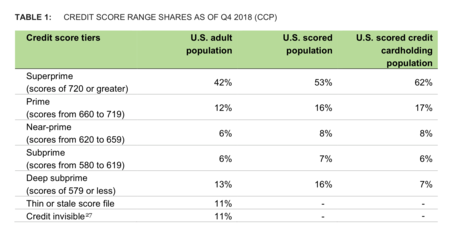
That figure is largely due to the growth in unused lines on accounts held by consumers with superprime scores, the CFPB said.
The agency reported payment and default rates have risen modestly over this period but remain below pre-recession levels, and that in general credit card issuers continue to generate profitable returns consistent with historical levels. Innovation has continued to reshape the market, for both users and providers.
The Credit Card Accountability Responsibility and Disclosure Act was enacted 10 years ago. Since its passage, researchers, including the CFPB, have studied the effects of the CARD Act on the cost and availability of credit to consumers.
The Findings
A summary of the core findings from each section of the report includes:
- Total outstanding credit card balances have continued to grow and at year-end 2018 were nominally above pre-recession levels. “Throughout the post-recession period, including the period since the Bureau’s 2017 report, purchase volume has grown faster than outstanding balances. After falling to historical lows in the years following the recession, delinquency and charge-off rates have increased over the last two years. Late payment rates have increased for new originations of general purpose and private label cards, both overall and within different credit tiers.”
-
The total cost of credit (TCC) on revolving accounts has increased over the last two years and in 2018 stood at 18.7%, which is the highest overall level observed in the Bureau’s biennial reports. “Recent TCC increases are largely the result of increases in the indices underlying variable rates, such as the prime rate. General purpose cards, which generally have interest rates linked to the prime rate, have driven the increase across every credit tier. TCC has fallen over the last two years for private label cards, in part because relatively fewer of these cards have rates linked directly to index rates, offset by a decline in fees as a share of balances.”
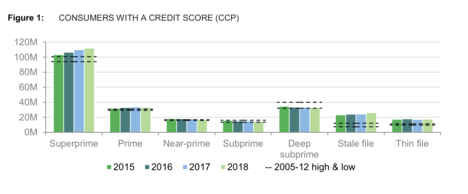
- Most measures of credit card availability—overall and across credit score tiers—have remained stable or decreased slightly since the Bureau’s 2017 report. “Measured by application volume, consumer demand for credit cards peaked in 2016. Approval rates have also declined slightly since 2016. Driven by lower approval rates, annual growth in the number of credit card accounts opened and the amount of credit line on new accounts has also leveled off. Even so, total credit line across all consumer credit cards reached $4.3 trillion in 2018, nearly equal to its pre-recession high, largely due to the growth in unused line on accounts held by consumers with superprime scores.”
- Cardholders have increased their use of rewards cards, thereby driving up the cost to industry to fund these products. “The level and consumer cost of balance transfer and cash advance use remains largely unchanged.”
- In the 10 years since the CARD Act was passed, social scientists have examined the Act’s effects on consumers and the credit card market as a whole. “Using a range of theoretical and empirical approaches, scholarship has looked at a range of potential direct and indirect effects of the CARD Act, including pricing, credit availability, consumer repayment behavior, and cardholding.”
- Since the 2017 report, issuers have lowered the range of their daily limits on debt collection phone calls for delinquent credit card accounts. “In addition, over that same period, the volume of balances settled through for-profit debt settlement companies (DSCs) grew at a faster rate than issuers’ overall accounts receivable did.”
- New technologies further enhance consumers’ interactions with and control over their credit cards—from originating one card rather than another, to ways of transacting and paying. “Cardholders increasingly use and service their cards through digital portals, including those accessed via mobile devices. New technologies such as artificial intelligence and machine learning, as well as new data sources, are changing how providers are able to manage risk and provide customer service.”
The complete report can be found here.