

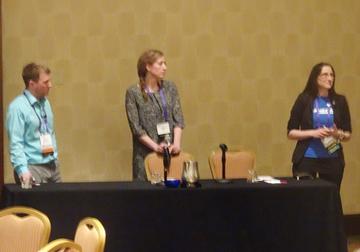
SAN ANTONIO–Here’s what three small credit unions say they are doing to make themselves appear much larger in their communities.
In an open discussion session at the CUNA Marketing and Business Development Council meeting here, executives with the three credit unions shared how they effectively stretch their dollars. Sharing their thoughts were Stephanie Sievers, CEO of the $105-million Aneca Credit Union in Shreveport, La.; Laura Miller of the $190-million cPort CU in Maine, and Chris Miller of the $85-million Chesterfield Credit Union in Virginia.
Below is the Q&A:
Q: How do you get noticed in media?
Chris Miller: For us, you have to have a great relationship with the news media. Membership with us is limited to students and teachers and county employees in our county. While it’s great to have coverage on TV stations, we’re focused on local newspapers. One of our local newspapers has eligibility for membership with us, so we have a dialogue with them. If there is a financial article, we are available for quotes, for instance.
Stephanie Sievers: We do cool stuff. We do TV and newspapers and it isn’t always ‘If it bleeds it leads.’ We also do cool stuff in the community and we look for community partners doing cool stuff, like National Lemonade Day. We’ve become known for doing cool things. Our value proposition is all about economic growth in our community. The media is also all about that. We use Facebook to see what others are doing. If someone is doing something cool at a park near us, we ask how can we support you in that. It’s not about cutting checks and walking away. If we are going to cut a check for a 5K, then we also want to work a water stand or be there with pom-poms cheering people on. We want to be more than a logo on a shirt with everyone else’s logo.
Laura Miller: We talk to our staff about what their causes are, so we can overcome that hurdle of interest. And then we build upon that. I have also found that our league is helpful in telling our story when we have a good story to tell.
Q: How about dealing with pushback from staff?
Laura Miller: We get it too, but we also are considering a requirement that everyone be involved in at least one event to participate in. This also leads people to pitch something they are interested in.
Chris Miller: Even if it’s not a credit union-sponsored event, if you are providing staff with paid time to volunteer, there are causes that are important to everyone. The caveat is you have to wear a Chesterfield FCU shirt. You can turn every employee into a walking billboard.
Sievers: We only have one event that is mandatory, and that is our Easter event in which we have 20,000 Easter eggs and 3,000 people show up, and we helicopter in the Easter Bunny. But for everything else we fake it. I don’t want to have to go to the staff every single time. So, you can get with local schools where high school kids have to have service hours to graduate, and they wear our shirts, and they are super-jazzed. It guarantees us cheerleaders, but it’s not about being out there, it’s about being OUT THERE.
Q: What if someone asks a financial question of someone in your shirt?
Sievers: Mostly it’s just about being there for us and being seen in the community.
Miller: I can’t think of a time at an event we’ve been at that someone wants to ask a question or open an account. This is really more about community events. Getting four or five staff out there and paying them isn’t really worth it. We can use students and also get that engagement.
Q: The challenge we have at our CU with PTO is at the branch level. It shrinks the pool of available. Are there any ways to help address this?
Chris Miller: You can get creative with that. It doesn’t have to be something where they get time off that week; maybe because they volunteered on a Saturday afternoon, they get comp time to use at a later time that you can schedule in.
Audience member: We are restructuring our PTO so everyone gets one day off per year scheduled to do community service. The biggest issue, we have found, is the scheduled time. If everyone knows they have one day they are more apt to use it.
Audience member: Two years ago, we were struggling to get volunteers. So, we have a points-based system where for every hour they volunteer they get a point that they can use for logo wear or a gift card. Now people are fighting to get the hours.
Q: As a small CU, we are competing with a lot of big FIs, and we can’t compete dollar for dollar. What do you do to differentiate?
Sievers: We looked at our community and asked, ‘What is our community digging right now?’ Now we go to the mayor and ask, ‘What can we do to help make the city better, which in turn makes you better?’ We got in touch with someone to do a South X Southwest in our community. Now we have the largest cash prize in the world for any short film and it’s a $50,000 prize. That turned into the startup (business) prize. (It requires the movie be shot in the area using local actors and other resources.) We have an angel fund and companies come and pitch to us. Then it became a music prize and food prize and it’s kind of taken off. Our actual contribution to this is much smaller than everybody’s else’s coming in, because we were there from the beginning and we do much more than just write a check; we get involved. Plus, we’re consistent. Every month we give something weird. Every month is weird month. People know to look to us every month for something.
Laura Miller: Our biggest community program is C-Port University, a college scholarship program. We got together with a college and decided to do something with the college aspirations in local elementary schools with a program for third, fourth and fifth graders. They now write essays about where they want to go to college and do with their career. It has now grown to nine schools in four towns. Now we are a staple in those schools.
Chris Miller: We all have big credit unions in our area. But they also have everyone coming to them for donations. There are four major school systems in our area; we serve one of them. If they are doing something for a school system, our school system is going to want that. We try to get engagement through a lot of Facebook campaigns. We do one where we pit Chesterfield high schools against each other. In one, we make a $2,500 prom donation. That not only got our name out there in a much more organic way; students are sharing the post with our name. Every time they vote for their school they are putting in their name and email addresses. And then we can promote our high school debit cards to them. We have Chesterfield County high school logos on the debit cards, a portion of the interchange goes back to the schools. Suddenly, you’ve talked the community into people who are talking about the program.
Audience member: Challenge yourself to do an audit on where you are spending your money. I do not take a sponsorship request at face value. I always ask, ‘But what about if…’ with every sponsorship request. I will sometimes create my own sponsorship level.
Chris Miller: I will take that one step further. If you get a really, really good opportunity, ask if you can sign on for multiple years. What if I sign on as a presenting sponsor for five years? We save money because we’re locked in, and another financial institution isn’t going to come in and take that opportunity.
Audience member: We never take a sponsorship at face value, ever. We have positioned ourselves as the solutions-oriented financial institution in our community. And we have built a strong reputation on that. Organizations now contact us. If you have a foundation it is also a really good opportunity, too. It opens you up for a raffle license.
Sievers: We got the loan for a local aquarium being built. We have no business getting that loan, but we got to it because we keep saying we’re all about economic growth and development, economic growth and development, economic growth and development.
Q: It’s not a tradition to have a strong marketing culture at our credit union. We have a financial culture. How do you get (management) in touch with a marketing culture, knowing some things are tangible and some things are not? How do you change that conversation?
Laura Miller: I’m lucky to have a CEO who is super-supportive of marketing. For me the most important thing is to be very friendly with our front-line so they know they are critically important and stay engaged. That’s a big focus for us.
Chris Miller: I think you have to develop that baseline somewhere, and there is work involved. If you can find out somehow what that benefit of that event is, have front line staff ask how did you hear about us? If you can ID that every event we go to it generates two new accounts, for instance, and each account generates X number of dollars, then you have something. You need to be able to quantify the value of each new account.
Sievers: As CEO, it was a challenge when I got there. We were not that way. Our credit union was failing—let’s be honest about it—that’s how I got the job. NCUA said we had maybe five more years. We had horrible everything. So how do you justify in a credit union that’s losing money and loans budgeting for marketing. It was about sitting down and really defining who we are. You have to know this. Everyone in your organization has to know it. Everyone outside your organization has to know it. Once you do that, it becomes clear. You can SPEND the money or you can do what we did which was to focus on one massive thing that reinforces our message and story. What is the story your credit union is selling? You have to know that.