

ALEXANDRIA, Va.—Kyle Hauptman claimed his place in NCUA history Thursday by leading an open board meeting as the sole board member.
The only other chairman to take the same step was Dennis Dollar in early 2002.
As CUToday.info reported, NCUA determined that following the dismissal of its two Democratic board members—Todd Harper and Tanya Otsuka—a one-person board constitutes a quorum, allowing the meeting to proceed.
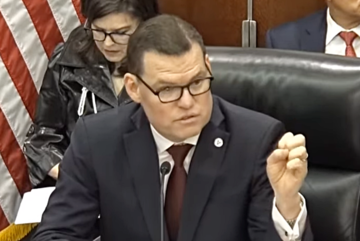
Kyle Hauptman discussing NCUA efficiency efforts Thursday.
The agency cancelled its April board meeting.
The agency has listed all of its remaining 2005 open board meeting as tentative on its website. Harper and Otsuka have filed a lawsuit seeking reinstatement, arguing their removal violated the Federal Credit Union Act. The two former board members stated they would not present a legal challenge to NCUA holding Thursday’s meeting, since both board items were simply briefings.
“It's been over 20 years since a sole NCUA board member shared this seat and ran the board meeting,” said Hauptman, referring to the meetings Dollar ran in early 2002. “The change in board composition has understandably raised questions from stakeholders and media. But no matter what the board looks like the agency will continue to fulfill its core mission, as well as continually seek ways to improve our effectiveness.
"The NCUA leadership team, and myself, are equipped with the required authorities to continue protecting the system of cooperative credit and its member owners through effective chartering, supervision and regulation," continued Hauptman. "Nobody has ever lost a dollar with federal deposit insurance. We're coming up on 100 years of that and nobody's going to lose any money anytime soon.”
The agency shared that same message—that it will run effectively throughout all levels of the organization—as it laid out its cost savings/staff reduction efforts. As CUToday.info reported, the Trump Administration has charged every government agency with reducing expenses, and has been discussing combining federal regulators. Previously, CUToday.info reported NCUA was considering an early retirement program as a means to reduce staff. The agency Thursday outlined those plans—which it said will bring an estimated $75 million in gross savings in 2026—that have been underway at NCUA.
NCUA said its voluntary separation programs, by the close of 2025, will have achieved a 24.1% reduction in positions and a 21.5% reduction in headcount (see slide below).
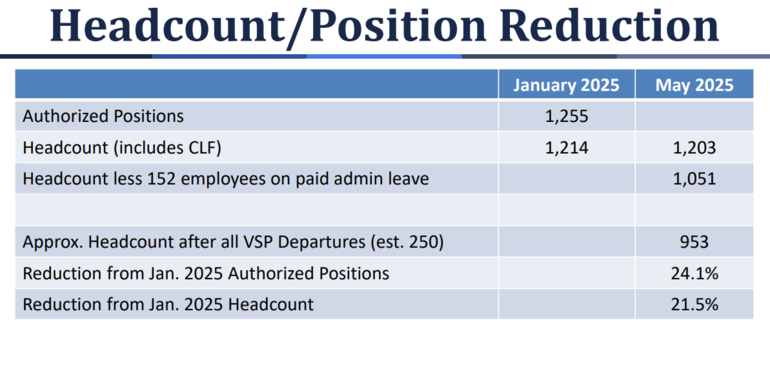
NCUA added it expects approximately 250 employees will depart as part of the programs. To date, 152 employees have been placed on paid administrative leave under the NCUA Deferred Resignation Program (NDRP) until they officially separate from the agency no later than Dec. 31, 2025.
The remaining NDRP participants will start their administrative leave in the weeks and months ahead, the agency said. The NCUA’s Voluntary Separation Program (VSIP) option offered a separation incentive payment of $50,000 to employees who are, or will become, regular retirement eligible and who separate from the agency by Dec. 31, 2025.
Hauptman emphasized the reductions were achieved through the voluntary programs.
The agency stated it is still under the Administration’s hiring freeze. Hauptman emphasized the agency would be able to rehire in 2026, assuming the hiring freeze had been lifted and enough VSPs officially separated from employment at NCUA so it can meet the 4:1 ratio associated with rehire.
A portion of the savings, Hauptman said, will hopefully be returned to credit unions. The amount returned may vary based on investments in technology, improvements, and even--if possible--rehiring.
“Credit unions should get some of these savings,” Hauptman said. “That is only right and fair.”
Hauptman noted the majority of staff choosing to leave the agency came from the central office, adding it is common for federal agencies to become “top heavy.”
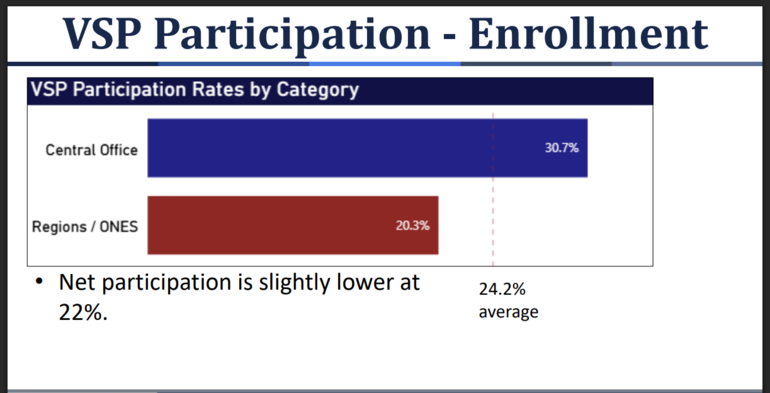
Throughout Thursday’s meeting, Hauptman and staff emphasized the safety and soundness of credit unions and protecting the Share Insurance Fund are the top priorities as the agency slims down.
To reduce the field staff’s workload, NCUA said it carefully made some risk-based decisions, relaxing examination cycles.
Credit unions with assets greater than $1 billion and less than $15 billion that are well run and well capitalized will be examined every 12 to 18 months—even up to 20 months for those with net-worth ratios greater than 10%, the agency explained. Well-run, well-capitalized federal credit unions with assets less than a billion dollars will receive an examination every 18 to 24 months. Smaller federally insured state-chartered credit unions will receive an NCUA exam as needed.
“That's going to be in coordination between the region and the state supervisory authority so that we can maximize our resources between the two agencies,” NCUA stated.
CUs with less favorable composite CAMELs ratings and lower net worth, or those that have been chartered for less than 10 years, will receive annual examinations, or every eight months.
Hauptman stressed the importance of field staff.
“When we can hire those one-for-every-four people who left back once the hiring freeze is lifted. And the priority is going to be what everyone guesses—examiners out in the field examining credit unions,” Hauptman said, noting that good examiners are not easy to find.
DCUC, ACU Respond
The Defense Credit Union Council “commended Hauptman for his “professionalism and steady leadership” Thursday.
“Chairman Hauptman’s commitment to transparency and stability has been instrumental in maintaining confidence within the credit union system,” said DCUC Chief Advocacy Officer Jason Stverak.
Stverak noted, however, the reduction in NCUA staffing raises concerns among some credit unions regarding the agency’s capacity to effectively supervise and support credit unions.
“DCUC will closely monitor the impact of these changes and collaborate with the NCUA to identify and address any challenges our member credit unions may encounter,” said Stverak. adding DCUC has consistently advocated for a strong and independent NCUA as a cornerstone of the credit union movement. “Ensuring that the NCUA retains the necessary resources to fulfill its mission is paramount to the continued health of the credit union sector.”
America’s Credit Unions Chief Advocacy Officer Carrie Hunt said the trade association appreciates the briefing held by Hauptman Thursday and "his stewardship of the agency. Hauptman’s goal of rethinking agency functions and providing an estimated $75 million in cost savings for credit unions will ensure credit unions can use their resources to remain focused on serving their members. We will continue to work with the NCUA through its changes, to ensure a vibrant industry.”
- For full details on the agency’s efforts to reduce staff, including details of the voluntary separation programs, click here.
- For information on the quarterly SIF update provided Thursday, click here.