

WASHINGTON–During an appearance before the Senate Banking Committee, NCUA Chairman Todd Harper offered an update on the performance of CUs, outlined the industry response to the pandemic, responded to questions related to climate change, and made four requests of Congress, including again asking for third-party oversight authority and again mentioning risks posed by CUSOs.
Harper was given five minutes to offer oral comments before the committee, but also submitted a much longer statement for the record to the committee.
Questions related to climate change and risk were the subject of questions from both Republicans and Democrats on the committee, as CUToday.info reported separately.
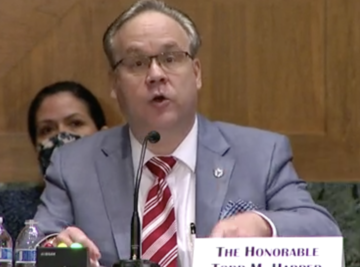
Todd Harper testifies before Senate Banking Committee.
Harper said his “regulatory philosophy” is guided by being:
- Fair and forward-looking
- Innovative, inclusive, and independent
- Risk-focused and ready to act expeditiously when necessary
- Engaged appropriately with all stakeholders to develop effective regulation and efficient supervision
On Solid Footing
In his prepared remarks, Harper told the committee, “Although the pandemic and its associated contraction in economic activity influenced credit union performance throughout 2020 and into the first quarter of 2021, the credit union system, as a whole, has remained on a solid footing.”
Harper noted the number of federal credit unions declined 2.7% in the year ending March 31 to 3,167, and the number of state-chartered credit unions declined 2% to 1,901. Overall membership at all federally insured credit unions increased 3.6% to 125.7 million, he said.
Performance Update
Similarly, he noted that in the year ending March 31:
- Total assets in federally insured credit unions rose by $311 billion to $1.95 trillion
- Credit union shares and deposits rose by $318 billion to $1.69 trillion
- The credit union system’s net worth increased by $14.9 billion, or 8.3%, over the year to $195.3 billion in the first quarter of 2021
- Strong asset growth led to a decline in the aggregate net worth ratio from 11% in the first quarter of 2020 to 10.01% in the first quarter of 2021, a decrease of 99 basis points
- The growth in assets and insured shares has led to an increase in liquidity, with cash and short-term investments as a percentage of assets increasing to 20% from 15%
Factors Affecting the Industry in 2021
Harper told the Senate the Share Insurance Fund and NCUA prepared to weather any economic fallout related to the pandemic, and that the agency is “actively monitoring” certain segments of the system, including credit unions closely connected to the oil and gas, travel and leisure, and agricultural sectors, among others.
The agency is also focusing on credit unions with elevated risks, such as those with large concentrations of commercial real estate loans relative to assets, he said.
“While the economic outlook is improving, credit unions could face a difficult environment for some time, as there are a number of risks on the horizon that could impede the economy’s recovery,” Harper said. “For example, the recession hit the lower end of the income distribution the hardest, and recovery could take longer for these households. System-wide delinquency rates, which remained low throughout 2020 and into the first quarter of 2021, could begin to rise as pandemic relief programs end. We are closely monitoring these metrics.”
In addition, he said NCUA is watching the spread of the Delta variant and the risk of rising inflation, as well as the risk of short-term rates rising more than long-term rates, which would put downward pressure on credit union net interest margins.
“The ability to manage interest rate risk will remain a crucial determinant of credit union performance going forward,” Harper said. “To remain on a sound footing, credit unions will also need to continue to pay careful attention to capital, asset quality, earnings, and liquidity.
Declining NCUSIF Equity Ratio
In his statement to the Senate Banking Committee, Harper said that as of March 31 the Share Insurance Fund insured $1.56 trillion in member deposits, but it is feeling the pressure from the “dramatic rise” in insured shares, with the equity ratio continuing to decline to 1.22% in June 2021, less than two basis points away from the statutory minimum, and four basis points below the equity ratio reported at the end of 2020.
He noted that if the equity ratio falls below 1.20%, as the NCUA board projects it will within six months, the Federal Credit Union Act requires the board to establish and implement a restoration plan within 90 days.
“Based on the current interest-rate environment, even with a return to modest insured share growth levels and relatively low credit union failure losses to the fund, the agency expects the equity ratio to continue its downward trajectory,” Harper said in his statement. “As a result, it seems likely that the board will need to adopt a restoration plan at some point absent a sizable change in these underlying fundamentals.”
Phase One Return to Onsite Operations
Harper said NCUA began Phase One of its return to onsite operations on July 19, during which agency staff may only volunteer to work onsite in locations where public health data indicate that pandemic conditions have sufficiently moderated.
“To the extent possible, the NCUA will respect a credit union’s preference not to have examination staff onsite during this initial phase,” Harper said in his statement. “However, the NCUA reserves the right to conduct onsite work at a credit union, if necessary, to address severe and time-sensitive matters. Additionally, NCUA staff will coordinate with state supervisory authorities when working onsite in federally insured, state-chartered credit unions.”
Supervisory Priorities
Harper said some of the agency’s supervisory priorities are reviews of credit unions’ efforts to:
- Maintain sufficient loss reserves
- Comply with the Bank Secrecy Act and anti-money laundering laws and regulations
- Implement CARES Act provisions applicable to credit unions as well as those provisions that were extended through the Consolidated Appropriations Act, including the suspension of the requirement to categorize certain eligible loan modifications as troubled debt restructurings
- Comply with consumer financial protection laws and regulations
- Monitor and control credit risk
- Protect information systems and strengthen cybersecurity defenses
- Transition from the use of LIBOR
- Manage for the potential liquidity risk due to the economic impact of the pandemic
Over the last year, Harper said NCUA has also established priorities to focus examination and supervisory activities on credit unions posing the greatest risk to the credit union system.
Climate Financial Risk
In his submitted remarks, Harper addressed the issue of climate change-related risks to credit unions, a point one senator scrutinized in his remarks prior to Harper’s remarks (see related story).
“Extreme weather events are accelerating, and the number and costs of climate-related natural disasters are often hitting disadvantaged communities the hardest,” said Harper. “Financial regulators, like the NCUA, have a responsibility to foster resiliency to all material risks to financial institutions, including those related to climate change. By measuring, monitoring, and mitigating such risks, the NCUA can fulfill its core obligations of maintaining the safety and soundness of credit unions, protecting consumers, and safeguarding the Share Insurance Fund.
“Additionally, the agency must consider not only the macroeconomic impact of climate change, but also the microeconomic context. Most credit unions focus on mortgage, auto, and small business lending,” Harper continued. “Over time, climate change will affect the value of collateral like homes and commercial properties, especially in areas affected by extreme weather. Additionally, a credit union’s field of membership may be tied to communities or activities that may be dramatically affected by climate change, like farming or fossil fuels. Credit unions serving such populations must consider adjusting their fields of membership or altering their lending portfolios to remain resilient over the long term.”
Legislative Requests
During his spoken remarks to the committee, Harper outlined four legislative requests, including:
Vendor Authority
Harper again asked that Congress enact legislation to provide the agency examination and enforcement authority over third-party vendors, including CUSOs.
“While there are many advantages to using these service providers, the concentration of credit union services within CUSOs and third-party vendors presents safety and soundness and compliance risk for the credit union industry,” Harper said. “For example, the top five credit union core processor vendors provide services to approximately 87% of total credit union system assets. Additionally, the top five CUSOs provide services to nearly 96% of total credit union system assets. A failure of even one of these vendors represents a significant potential risk to the Share Insurance Fund and the potential for losses from these organizations are not hypothetical. Between 2008 and 2015, CUSOs contributed to more than $300 million in losses to the Share Insurance Fund alone.”
The comments marked the second time Harper has referenced the $300 million in losses caused by CUSOs. In May, as reported here, CUToday.info sought additional comment on the basis for that figure, but the agency declined comment beyond pointing to a report done by its Office of Inspector General, but that report provides few details.
NCUSIF Improvements
“Congress did not make…statutory changes to the Federal Credit Union Act’s provisions governing the Share Insurance Fund following the financial crisis more than a decade ago,” Harper said. “As a result, under current law, the NCUA does not have the appropriate flexibility necessary to manage the Share Insurance Fund in a manner consistent with the growing size and complexity of the credit union industry, as well as with broader national financial stability goals.
“To address these concerns, the NCUA seeks changes to the statutory provisions contained in the Federal Credit Union Act to enable the NCUA board to proactively manage the Share Insurance Fund.”
Specific changes Harper said he would like to see include:
- An increase the Share Insurance Fund’s capacity by removing the 1.50% statutory ceiling on its capitalization
- Removing the limitation on assessing premiums when the equity ratio exceeds 1.3%, granting the NCUA board more discretion on the assessment of premiums
- Instituting a risk-based premium system
Central Liquidity Facility
Harper repeated his request that a CARES Act provision enhancing NCUA’s Central Liquidity Facility be extended beyond its planned expiration at year-end.
Community Development Revolving Loan Fund
Saying demand for CDRLF grants regularly exceeds supply, Harper asked Congress to increase the CDRLF appropriations to $10 million.