

WASHINGTON–NCUA Chairman Todd Harper was among a half-dozen federal regulators to appear before the Senate during a hearing that largely mirrored a similar hearing in the House earlier this week, with nearly all of the scrutiny being applied to bank regulators in the wake of the failures of several banks.
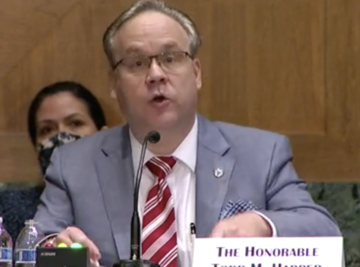
Todd Harper
Indeed, the hearing by the Senate Committee on Banking, Housing & Urban Affairs titled the hearing, “Oversight of Financial Regulators: Financial Stability, Supervision, and Consumer Protection in the Wake of Recent Bank Failures.”
As a result, for the most part, Harper and credit unions were not of much interest to the senators on hand for the hearing.
Unlike the earlier House hearing, the Senate hearing featured the state regulators from California (where Silicon Valley Bank was headquartered) and New York (where Signature Bank was headquartered).
The Witnesses
In addition to Harper, others testifying included:
- Michael S. Barr, vice chair for supervision, the Federal Reserve
- Martin J. Gruenberg, chair, FDIC
- Michael J. Hsu, acting comptroller, Office of the Comptroller of the Currency
- Adrienne A. Harris, superintendent, New York State Department of Financial Services
- Clothilde V. Hewlett, commissioner, California Department of Financial Protection & Innovation.
Was Anyone Fired?
The hearing came one day after an appearance before the same committee by Greg Becker, the former CEO of Silicon Valley Bank, who largely blamed everyone but himself for the bank's failure, the second-largest in U.S. history, as CUToday.info reported here. Becker especially blamed regulators. But federal banking regulators pushed back on the characterization during their testimony, saying several statements made by Becker were untrue, including whether anyone from the FDIC met with Becker ahead of the bank's sale once it was taken over by the government.
Similar to the House hearing, senators asked the bank regulators—who again stated there had been shortcomings in oversight—over who had been fired to date for not taking more direct action to head off the bank failures. All of the regulators said no one has been fired as a result, with Barr saying only that a “review” is under way.
The FDIC chairman was also asked by several senators over compensation practices and bonuses paid by the banks, particularly with Silicon Valley Bank, ahead of their respective failures and whether there will be any efforts to claw back some of the bonuses and comp. Gruenberg said the FDIC is exploring those options.
In addition, Barr and Gruenberg was told repeatedly that new rules aren’t needed; instead, what’s needed is for the regulators to enforce rules already in place.
Sen. Elizabeth Warren (D-MA) repeatedly pressed Hsu over what she said is increased risk to the banking system over allowing very large banks to get even larger by acquiring the failed banks, with scoring models indicating concentration risk.
Harper’s Key Points
Harper’s prepared remarks delivered in his statement to the committee were largely the same as those he gave to the House hearing.
The key points Harper made included:
- The overall performance of federally insured credit unions remains stable. Total loans, assets, insured shares, and deposits all increased during 2022, and the system’s aggregate net worth ratio also rose to 10.75%, representing a recovery of 73 basis points from its pandemic low
- 91% of total share deposits within the system are insured (vs. the 90% that were uninsured at the failed Silicon Valley Bank)
- The NCUSIF continues to perform well. Although the fund’s equity ratio is three basis points below the desired operating level, no premiums are expected at this time
- The agency is monitoring growing interest rate and liquidity risks within the system — including at several billion-dollar-plus institutions
- Aggregate cash positions have declined and are below pre-pandemic levels as well. Further, unrealized losses in securities limit their utility as a source of liquidity
- “The recent increase in these risks underscores the value of the NCUA’s Central Liquidity Facility. Otherwise known as the CLF, the facility acts as a shock absorber to contain or avert liquidity crises before they escalate. However, with the termination of the temporary CLF statutory enhancements last December, more than 3,000 credit unions with less than $250 million in assets lost access to the CLF, contracting the facility’s capacity by almost $10 billion. With risks rising within the financial system and at individual credit unions, now is not the time to cut a liquidity lifeline”
- Harper said NCUA defers to Congress on determining what statutory changes, if any, should be made to deposit insurance coverage levels and account types, as is being proposed for the FDIC. “But, if Congress does act in this area, the NCUA has two requests. First, we ask Congress to maintain parity between the share insurance coverage provided by the NCUA and the deposit insurance coverage provided by the FDIC,” Harper said. “Second, because an expansion in coverage will generally increase resolution costs, the NCUA requests greater flexibility for administering the Share Insurance Fund.”