Frank Nothaft
IRVINE, Calif.–A new analysis shows 548,000 U.S. homeowners regained equity in Q2 2016 compared with the previous quarter, increasing the percentage of homes with positive equity to 92.9% of all mortgaged properties, or approximately 47.2 million homes, according to CoreLogic.
Nationwide, home equity grew year over year by $646 billion, representing an increase of 9.9% in Q2 2016 compared with Q2 2015, the company said.
According to CoreLogic, in Q2 2016 the total number of mortgaged residential properties with negative equity stood at 3.6 million, or 7.1% of all homes with a mortgage. This is a decrease of 13.2% quarter over quarter from 4.2 million homes, or 8.2%, in Q1 2016 and a decrease of 19% year over year from 4.5 million homes, or 8.9%, compared with Q2 2015.
For homes in negative equity status, the national aggregate value of negative equity was $284 billion at the end of Q2 2016, decreasing approximately $20.4 billion, or 6.7%, from $305 billion in Q1 2016, CoreLogic reported. On a year-over-year basis, the value of negative equity declined overall from $314 billion in Q2 2015, representing a decrease of 9.5% in 12 months.
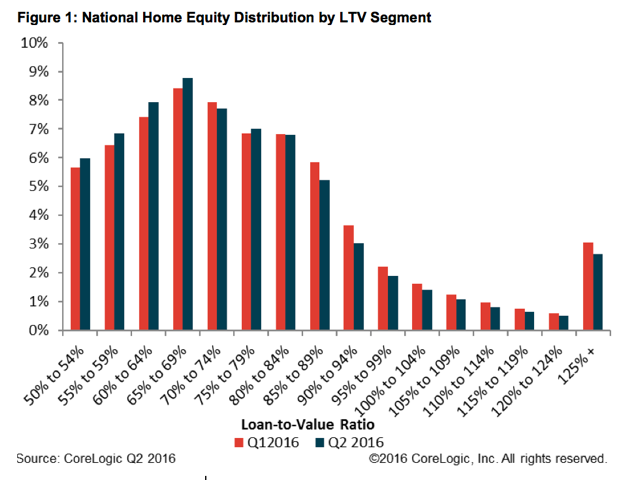
Of the more than 50 million homes with a mortgage, approximately 8.6 million, or 17%, have less than 20% equity (referred to as under-equitied) and approximately 965,000, or 1.9%, have less than 5% equity (referred to as near-negative equity), CoreLogic said.
“Home-value gains have played a large part in restoring home equity,” said Dr. Frank Nothaft, chief economist for CoreLogic, in a released statement. “The CoreLogic Home Price Index for the U.S. recorded 5.2% growth in the year through June, an important reason that the number of owners with negative equity fell by 850,000 in the second quarter from a year earlier.”
“We see home prices rising another 5% in the coming year based on the latest projected national CoreLogic Home Price Index,” said Anand Nallathambi, president and CEO of CoreLogic. “Assuming this growth is uniform across the U.S., that should release an additional 700,000 homeowners from the scourge of negative equity.”
Among the findings of the latest data, according to CoreLogic:
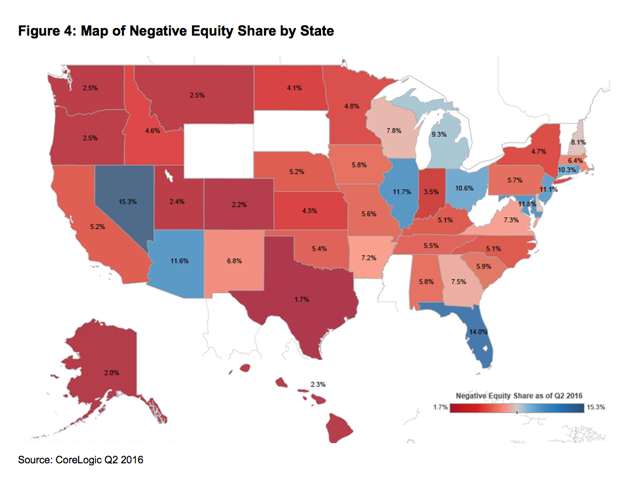
- Nevada had the highest percentage of mortgaged properties in negative equity at 15.3%, followed by Florida (14%), Maryland (11.8%), Illinois (11.7%) and Arizona (11.6%). These top five states combined accounted for 33.7% of negative equity in the U.S., but only 18.6% of outstanding mortgages.
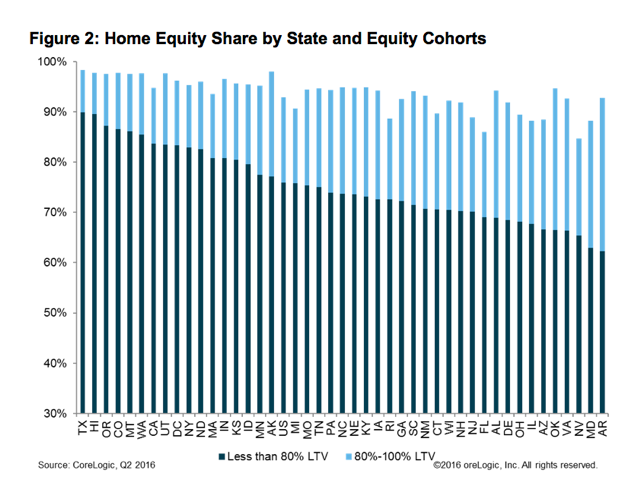
- Texas had the highest percentage of homes with positive equity at 98.3%, followed by Alaska (98%), Colorado (97.8%), Hawaii (97.7%) and Utah (97.6%).
- Of the 10 largest metropolitan areas by population, Miami-Miami Beach-Kendall, FL had the highest percentage of mortgaged properties in negative equity at 18.4%, followed by Las Vegas-Henderson-Paradise, NV (17.6%), Chicago-Naperville-Arlington Heights, IL (13.4%), Washington-Arlington-Alexandria, DC-VA-MD-WV (9.9%) and New York-Jersey City-White Plains, NY-NJ (5.9%).
- Of the same 10 largest metropolitan areas, San Francisco-Redwood City-South San Francisco, CA had the highest percentage of mortgaged properties in a positive equity position at 99.4%, followed by Denver-Aurora-Lakewood, CO (98.5%), Houston-The Woodlands-Sugar Land, TX (98.4%), Los Angeles-Long Beach-Glendale, CA (96.7%) and Boston, MA (95%).
- Of the total $284 billion in negative equity, first liens without home equity loans accounted for $159 billion aggregate negative equity, while first liens with home equity loans accounted for $125 billion.
- Among underwater borrowers, approximately 2.2 million hold first liens without home equity loans. The average mortgage balance for this group of borrowers is $252,000, and the average underwater amount is $73,000.
- Approximately 1.4 million of all underwater borrowers hold both first and second liens. The average mortgage balance for this group of borrowers is $314,000, and the average underwater amount is $88,000.
The bulk of positive equity for mortgaged residential properties is concentrated at the high end of the housing market. For example, 96% of homes valued at $200,000 or more have equity compared with 89% of homes valued at less than $200,000.