

WASHINGTON—The Fannie Mae Home Purchase Sentiment Index (HPSI) decreased 3.9 points to 75.8 in July, as consumers continue to report concerns related to high home prices and a lack of homes for sale.
While all six components declined month over month, the “Good Time to Buy” and “Good Time to Sell” components once again produced the most notable results, according to Fannie Mae.
On the buy-side, 66% of respondents said it’s a bad time to buy a home, up from 64% last month; while on the sell-side 75% of respondents said it’s a good time to sell, down slightly from 77% last month. Year over year, the overall index is up 1.6 points, Fannie Mae reported.
‘Increasingly Sensitive’
“Historically prime homebuying groups appear to be increasingly sensitive to the lack of affordability, as home prices continue to increase and homes for sale remain in short supply,” said Doug Duncan, Fannie Mae senior vice president and chief economist. “While all surveyed consumer segments have reported increased pessimism toward homebuying conditions over the past several months, two of the segments perhaps best positioned to purchase -- consumers aged 35-44 and those with middle-to-higher income levels – have indicated even more pessimism than other groups.”
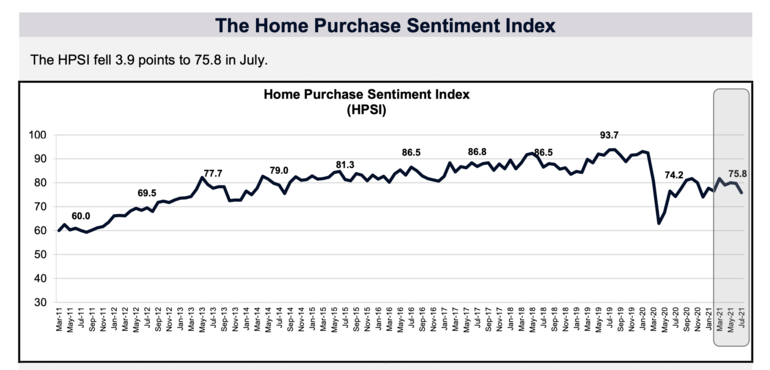
“Overall, the HPSI remains within a tight range established a few months after the onset of the pandemic in 2020. Consumer sentiment toward homebuying hit yet another survey low in July, continuing the sharp downward trend established in March,” stated Fannie Mae. “The percentage of respondents citing high home prices as the top reason for it being a ‘bad time to buy’ also reached an all-time high. On the flip side, selling sentiment remains extremely high, and well above pre-pandemic levels, for the same commonly cited reason: high home prices.”
Survey Highlights
Other survey highlights, with analysis by Fannie Mae, include:
- Home Price Expectations: The percentage of respondents who say home prices will go up in the next 12 months decreased from 48% to 46%, while the percentage who say home prices will go down remained unchanged at 21%. The share who believe home prices will stay the same increased from 25% to 27%. As a result, the net share of Americans who say home prices will go up decreased two percentage points month over month.
- Mortgage Rate Expectations: The percentage of respondents who say mortgage rates will go down in the next 12 months decreased from 6% to 5%, while the percentage who expect mortgage rates to go up remained unchanged at 57%. The share who believe mortgage rates will stay the same increased from 30% to 31%. As a result, the net share of Americans who say mortgage rates will go down over the next 12 months decreased one percentage point month over month.
- Job Concerns: The percentage of respondents who said they are not concerned about losing their job in the next 12 months decreased from 88% to 84%, while the percentage who say they are concerned increased from 11% to 13%. As a result, the net share of Americans who say they are not concerned about losing their job decreased six percentage points month over month, Fannie Mae said.
- Household Income: The percentage of respondents who say their household income is significantly higher than it was 12 months ago remained unchanged at 27%, while the percentage who say their household income is significantly lower increased from 13% to 14%. The percentage who says their household income is about the same remained unchanged at 56%. As a result, the net share of those who say their household income is significantly higher than it was 12 months ago decreased 1 percentage point month over month.
For additional info, click here.