NEW YORK–A new global survey of CEOs and C-suite executives has found most believe COVID-19’s fallout will result in leaner and more agile companies and reduced future business travel, but it has also found three notable disagreements.
The Conference Board surveyed more than 1,300 CEOs and C-suite executives about COVID-19’s long-term impacts, with executives saying the crisis is compelling them to accelerate their digital transformation plans and rethink their business models.
“In the short term, preparing for growth and recovery will require finding the right balance between conserving cash and investing in the innovations needed to succeed in a new commercial landscape – the next normal, if you will,” said Chuck Mitchell, a report author and director of Knowledge, Content, and Quality at The Conference Board. “Post-COVID-19, CEOs expect their organizations to emerge leaner and more agile, redefining how work gets done.”
Below is a look at some of the findings:
What Will the Economic Recovery Look Like?
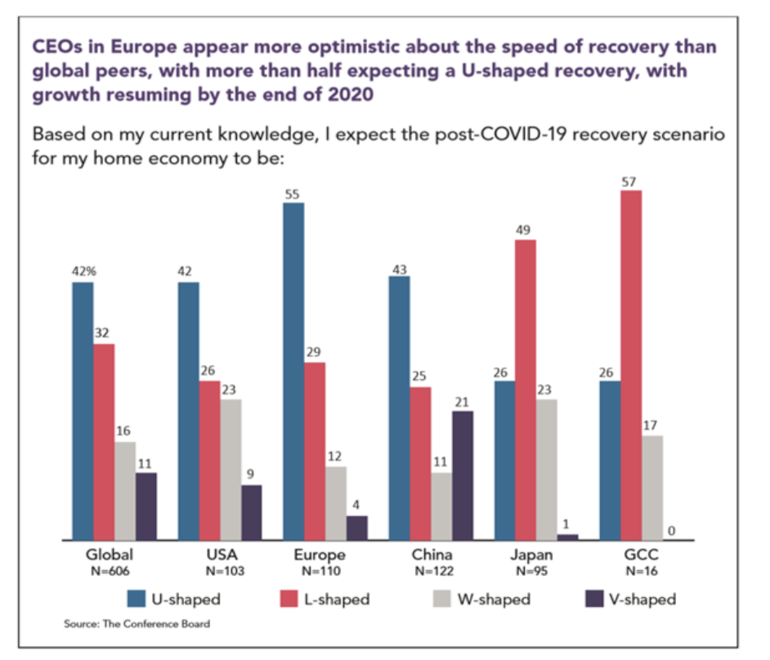
A plurality of CEOs globally anticipate a U-shaped recovery (extended contraction in Q3, growth resumes by Q4).
- Europe is most optimistic: 55% of CEOs in Europe see a U-shaped recovery as the likely scenario.
- United States and China: In both countries, slightly more than 40% anticipate a U-shaped recovery.
- Nearly a quarter of US and Japanese CEOs expect a W-shaped recovery (second contraction in latter half of 2020), while globally, just 16% of CEOs see this as likely.
- Globally, just 11% of CEOs expect a V-Shaped recovery (a fast recovery in Q3). But, China’s CEOs (21%) have more hope.
- China: Notably, 21% of CEOs there predict a V-Shaped recovery.
“While business leaders are navigating through the many disruptions and uncertainties brought on by the global pandemic, they are focusing on shaping long-term growth strategies in a post-pandemic world,” said Ataman Ozyildirim, a report author and global research chair of The Conference Board. “Even though they expect their business revenues to recover slowly and not fully before the end of 2021, their focus on accelerating digital transformation and innovating new business models to serve their customers could lay the groundwork for a sustainable growth path in the longer term.”
Human Capital, Management, and Talent
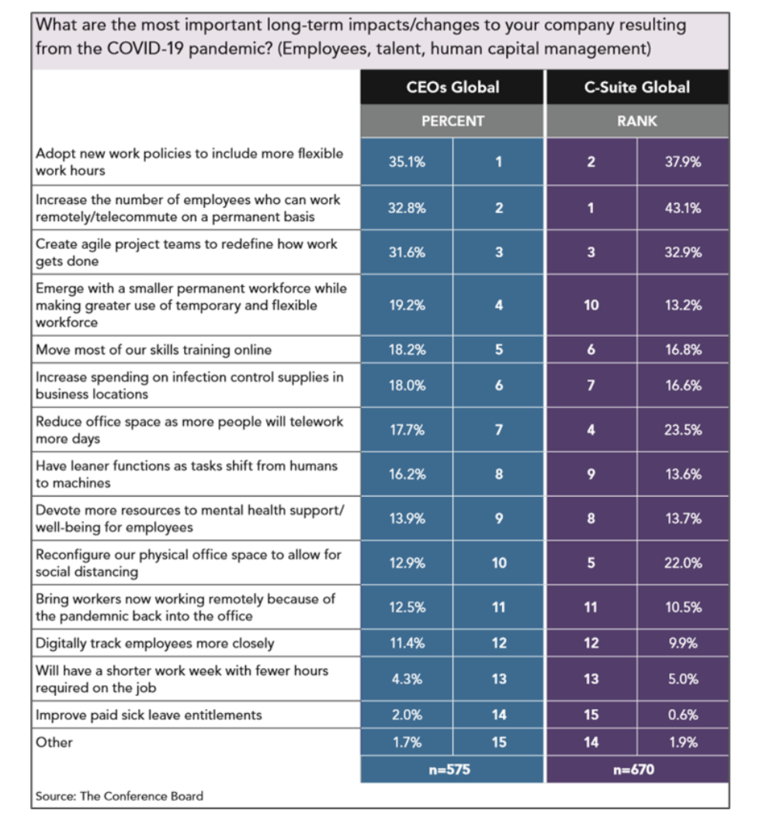
CEOs plan to emerge from the pandemic with more contract and gig workers and fewer permanent, in-house workers, according to the Conference Board.
- CEOs: They cite it as the fourth most important long-term impact in this category.
- C-suite: Notably, they put it far lower on the list, citing it as the 10th.
- When it comes to adopting new work policies to include more flexible hours, CEOs cite it as first, C-suite cites it as second.
- When it comes to permanently increasing the number of employees who can work remotely, CEOs cite it as second, C-suite cites it as first.
- In terms of creating agile project teams to redefine how work gets done, both CEOs and C-suite executives cite it as 3rd.
Company Operations
Companies will emerge from COVID-19 as leaner, more agile organizations.
- Accelerate cost management & budget reductions: CEOs cite it as the fourth-most important long-term impact, C-suite cites it as third.
- Reduced business travel since videoconferencing has been effective: CEOs cite it as third; C-suite cites it as second.
According to the Conference Board survey, COVID-19’s biggest legacy on operations: accelerated digital transformation, with both CEOs and the C-Suite cite as first.
A Mile Apart
According to the survey’s findings, the Conference Board said CEOs and the C-suite are a “mile apart” on three points.
- When it comes to a future with a smaller permanent workforce and greater use of a temporary and flexible workforce, CEOs cite it as the fourth most important long-term human capital change, while C-suite cites it as 10th.
- On reconfiguring physical office space to allow for social distancing, CEOs cite it as the 10th most important long-term human capital change, C-suite cites it as fifth.
- In terms of the economic recovery, 56% of CFOs expect a U-shaped recovery, but just 42% of CEOs agree.