

VANCOUVER, B.C.–If you consider yourself a leader, or aim to be one, stop telling people what to do.
Sandra McDowell said that is the primary, meaningful takeaway from a career both working in and studying leadership. The better strategy, she said, is the “coach approach.”
In remarks to a Global Women’s Leadership Network (GWLN) event held ahead of the World Council of Credit Unions’ World CU Conference, McDowell shared with attendees the big change she has made and the lessons she has learned since beginning her career.

Sandra McDowell addresses the meeting.
Learning to Play the Piano
“When I started my career, you did what everyone else did—you just went around and told people what to do,” said McDowell, CEO of the eLeadership Academy. But as she came to discover, that didn’t work.
For those leaders who have been through coaching training and now feel they are on top of the game, McDowell said coaching is kind of like learning to play the piano.
“We can all take some piano lessons, but do we really know how to play the piano? It takes time to hone and develop skills and the only way to do that is to practice,” said McDowell.
It Feels Good, But…
Why is it important to stop telling people what to do?
“It feels really good to tell people what to do,” answered McDowell. “It gives us a sense of value. It feels like we’re needed, that we’re serving a purpose and that we have the answers. But it is not the most effective tool in your toolbox.”
McDowell pointed to oft-cited research showing 66% of employees are disengaged at work, and 75% of change initiatives are unsuccessful.
“We need to think about leadership development differently,” said McDowell. “The coach approach really gives you the ability to make a difference with others and to make change happen.”
McDowell said she recognized earlier in her career when she looked to those who were following behind her and noticed she wasn’t really creating people who could “think for themselves.”
The Continuum
All of that, McDowell, said is part of the “leadership continuum,” as shown in the slide below.
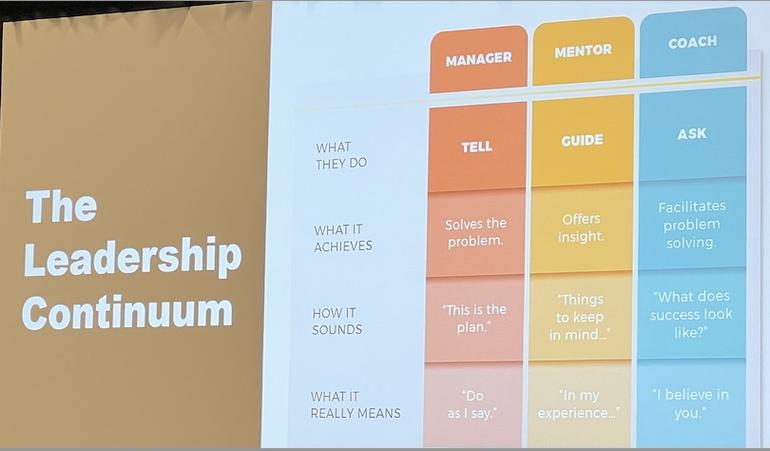
“We love the mentorship piece. We tell people what we think and that feels wonderful,” McDowell said.
The other end of the spectrum is the underutilized tool in most leaders’ toolbox, she said.
“Coaching is the tool that can help us to have an impact in an organization and to be an ally for others. It’s about asking what do you think? What is the next step? That takes discipline. The default is to mentor, to tell. It’s difficult,” she said.
The Advice Monster
McDowell shared with her audience a clip from the TED X Talk by Michael Bungay Stanier, who speaks to the challenge of the “advice monster.” That TED talk can be viewed here.
McDowell cited Bungay Stenier’s three personas of the “advice monster,” which are Tell It, Save It, Control It.
“The theory is easy, the practice is hard. So why don’t we coach more often?” asked McDowell. “The answer: time. It’s the number-one obstacle to what seemingly gets in the way to this great approach to leadership. Sure, in the short term it might seem like it takes more time, but long term you’re teaching people to think. You’re actually going to stop the bottleneck, stop being the one with the answers. Ask, ‘What do you think?’ Empower them to think. It will actually save you time if you invest the time to stop telling people what to do.”
Challenge Number Two
The second problem with being an Advice Monster is that when a leader tells people what they think, “We are effectively telling them we know the answer and they don’t. We are effectively undermining people when we give them advice. We have to be able to manage that. So, that gets in the way of us coaching.”
And all of that, she said, has its roots in the human ego.
“We all have an ego. It’s not a bad word. It can be. Ego goes back to the neuroscience piece,” McDowell told the meeting. “Why is this so important for humans? When we feel we belong, we are valued, we are a part of the group and we feel safe. When we don’t feel safe, the threat response activates in our brain. There is a neuroscience basis for why belonging and DEI and inclusion are so important. When you stop and help someone think that’s a different value proposition than when you help someone think.”
McDowell said that in a complex world and credit union system, no one person can have all the answers. But that’s OK.
“We don’t need experts in problem-solving, we need facilitators of problem-solving,” she said. “So, we have to pop the ego and get over ourselves and recognize our own advice has limitations.”
Don’t Duck the Silence Challenge
Another challenge to being an effective coach? Being silent, according to McDowell.
“Most people struggle with silence. If you are comfortable with silence, you already have an asset in coaching,” she said.
To remind people of the importance of being quiet, McDowell distributed pink duckies on each table in the room and urged everyone to take one as a reminder to “shut the duck up.”
“It’s the 80/20 rule. Twenty percent of a coach’s time should be speaking,” she said. “You have to make the questions good, succinct and impactful.”
According to McDowell, questions should:
- Orientate Focus
- Build Trust
- Prompt Thinking
- Prompt Action
Another Question to Ask
“As yourself: ‘Am I actually coaching? Am I actually asking people questions that lead them to think?’” McDowell said. “When we ask people what they think, we are saying, ‘I believe in you.’ Sounds great in theory. But our brains are often waiting for our turn to talk and we don’t zone in to be present.”
McDowell acknowledged that coaching can be exhausting, and she said 45 minutes is about the limit for coaching sessions.
“Focus on the solutions, not the problems,” McDowell advised. “Our natural instinct as humans is the negativity bias. We want to solve the problem and fix things. Coaching only works when people are open to solving the problems.”
Issues with Attention Density
McDowell said science shows that whatever people focus on—which is called “attention density”– shapes the brain.
“If we focus on worry, that grows in the brain,” said McDowell. “If we focus on opportunity, that’s what grows. As a coach you’re going to help people focus on the solutions and help people think about how they’re going to get there.”
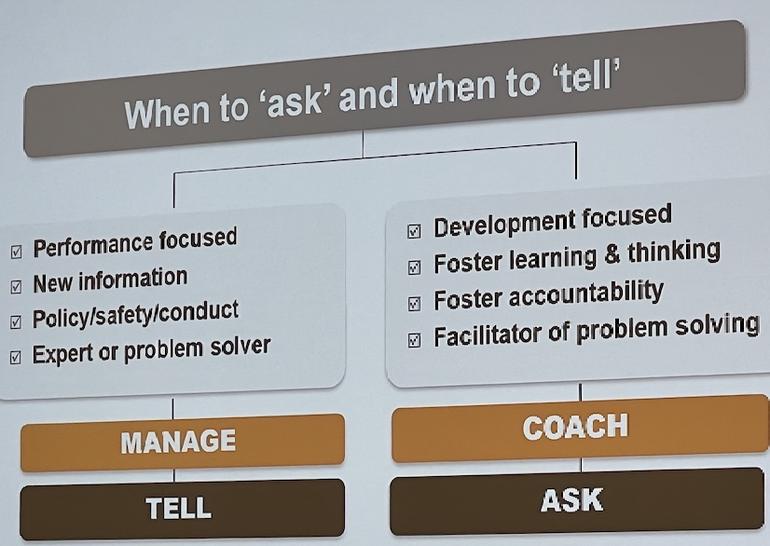
McDowell said that helping people become facilitators of problem solving is the skill she focuses on most.
Role of the Coach
According to McDowell, the role of the coach is to do these three things:
- Help establish a goal
- Raise awareness
- Facilitate thinking and an action plan
How to Get the Number-One Source of Daily News in Credit Unions In Your Inbox Each Day, For Free!
The biggest, best and freshest news reporting in credit unions remains free in ’23! Each morning CUToday.info delivers its daily Fresh Today news update offering the latest headlines and breaking news right to your email, with the easy-to-read headlines format allowing you to click on the stories that interest you most in order to learn more.
If you haven’t yet signed up for the new email solution on which CUToday.info has partnered with ResponseGenius, you can do so here. Signing up requires less than one minute of your time—and it’s free!
Please note that after signing up you may need to go to your Spam/Junk folder and mark the morning headlines email as safe. CUToday.info does not provide its list of readers and emails to outside parties, and we will not be contacting you to sell you an extended warranty or sending you any links so you may cash in on an inheritance you didn’t know was coming.
And did we mention it’s free?
Please note and/or make your IT department or email administrator aware the emails will be coming from the domains CUTodayinfo.com and CUTodayinfoReply.com