

VANCOUVER, B.C.–Four women from three different parts of the world talked about the issue of leadership, their experiences, the issues they have encountered in their careers and more during a panel discussion here.
As part of a session during a meeting of the Global Women’s Leadership Network titled “Women Leading: A Conversation With Changemakers,” the panelists responded to a half-dozen questions and shared their views.
Participating as panelists were Miriam de Dios Woodward, global CEO of Viclarity in the U.S.; Elissa McCarter-LaBorde, president and CEO of the World Council of Credit Unions in the U.S.; Scholastica Odhiambo, board member with the Cooperative Bank of Kenya and Hazina SACCO, and Elenita San Roque, CEO of the Association of Asian Confederation of Credit Unions, who is based in Thailand.
The panel was moderated by Dalia Mehiar, monitoring, evaluation and learning manager with WOCCU.
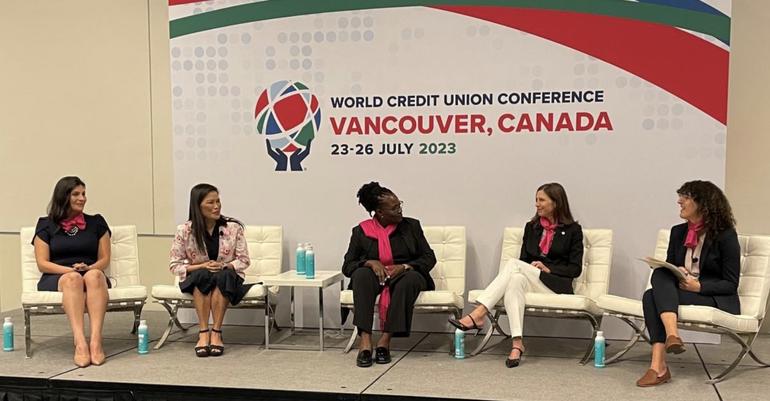
From left, Miriam de Dios Woodward, Elenita San Roque, Scholastica Odhiambo and Elissa McCarter-LaBorde.
Here is a look at some of what was discussed:
Mehiar: What type of approach do you use to lead others?
San Roque: It’s difficult for me to tell what is my leadership style. But what I hear from people, they say you are inspirational, you motivate us. I think the style of leadership is when you, yourself know the purpose of your leadership. From the time you discover that you can make a difference in the lives of people, the style of leadership comes out.
All of us are a work in progress. You might have the highest position in the credit union, but that is not important. The most important thing is the influence you can have on other people. I want to be remembered as the CEO who has the moral authority. When you do, people will lend you their hands and their hearts.
The next things you need are competence and character. Character is like a fingerprint; wherever you go your character will be there. The third thing you need is courage. Sometimes, as women, we worry what other people will think about us. But when the principle is correct, we can (lead). The last thing I work on is my consistency. We have to be good every day.
Mehiar: Can we talk about some of the barriers that women continue to face in leadership positions?
Odhiambo: One is biases and intimidation in offices. We have to work on ourselves to get the courage, which gets you the power, which lets you move beyond. If you don’t, you can’t make others connect. Leadership is an ongoing concern. We must work on our fears as ladies. We cannot get stuck.
If you don’t ask, don’t apply, and don’t go for it, then you can’t move. So, you must work on yourself first before you work on others. We need to be very, very transcendent in our leadership style. We must look at the biases inside the institutions where we are working.
Ladies are not included in the decision-making. The ladies are in HR, they are not in operations. This is the balance we must break.
Moderator: Talk about some examples of these barriers and how you have transcended some of them or have seen others transcend some of them?
Odhiambo: I was the only lady on the board for a long time. I felt I needed to bring other ladies onboard and now we have three. Most of our management is now ladies. At the cooperative bank, I was the only lady for a long time. I talked to the group CEO and said we need to balance this. I said we need to have non-executive and executive directors on this board to show we are a bank that cares about gender differences.
It was not easy at the beginning. But now many institutions are looking at us when it comes to gender balance.
De Dios Woodward: There are lots of opportunities in this area. From an individual perspective we can put some barriers on ourselves. Women can place a lot of criticism on themselves, be pretty hard on themselves. If we see a position that’s out there we read all the requirements of the job and say, ‘I don’t meet 100% of those I’m not going to apply.’
At the same time there is also another opportunity from an access standpoint. Thinking about our structures, are we making some of those opportunities available? As we think about hiring and recruiting, are we going to the same job boards to post jobs? Are we recruiting from the same groups of people?
I think there is an opportunity for leaders to examine our own practices. Are we too narrowly focused on what we have always done that we’re closing off opportunities in that area?
McCarter-LaBorde: I had a chance to the attend the annual general meeting (of the credit union association) in Kenya and it was not 100% surprising I was the only woman on the stage. To the chairman’s credit, he talked about the need for gender parity. When he was finished, no woman stood up. We ask why don’t more women step up? The answer is why should you if you feel there is no room for you?
To Miriam’s point, so many barriers and biases exist, and unfortunately we will be talking about these for many years. But where I see this changing is where you are in a position of influence, there is a level of awareness we have been able to build on the need for diversity.
On the recruiting side, one of the struggles I see is we recruit for positions. When you are the hiring manager you want a diverse pool of candidates. We either get people not applying or the hiring manager is seeking to get the best-qualified person. And I say I’m not looking for the best-qualified person, I’m looking for the person who helps diversify the pool. You may need to rewrite job specifications so it’s not so much of a barrier.
Putting yourself forward takes courage, just as it does as a hiring manager to bring on someone who may not be the most qualified, but who is going to round out the team. When you see that person delivering, that’s when you see the bias removed.
Mehiar: Once a person is in the organization what else can we do as leaders to make sure they continue to advance?
Odhiambo: I think first we need to look at our policies. In some cases they are rigid, not flexible. Women can also be enemies of their own, especially if vying for a position; they might not give you the support you need.
De Dios Woodward: I do believe mentorship is key. But we should also step it up a notch and look at sponsorship. What that means to me is elevating women and providing opportunities to elevate someone. When you see opportunities in the business, bring up their names and provide them with some practical experience to bring them up to that level.
We have personal development plans in our organization, including for myself. We talk about what are your strengths and what do you want to work on and get better at? Together, we come together on a plan on what I do to help you and what can you do to help yourself, as well.
Moderator: Let’s talk about balance between personal life and career. Do you have some tips?
De Dios Woodward: The way I interpret it and think about it for myself is how do I want to live my life. I say that because my work, my career, my community involvement are very important to me. My family is also very important to me and they must fit.
During the last five years I have been on maternity leave twice, and I had a five-week sabbatical in that time. During that same time I have probably learned the most. I’ve learned a lot about myself and my organization.
I have probably been out of the office the longest amount of time as I ever have in my career. I have two toddler girls, which really puts this question into perspective. I do have a very supportive husband and partner. Thank goodness for daycare and family support along the way. At work I have an amazing team that I trust and that trusts me. Being out of the office two, three weeks at a time has empowered them.
The work environment around me is also flexible in that way. We encourage sabbaticals. After a long period of time in the organization, it’s time for a break. We have flexible scheduling. I tell my team it’s your calendar, it’s up to you to design your day. I try to model some of that flexibility for my team, as well. I’ve had days when I have a board meeting and I get the call that I have a sick child. It comes back to you with an opportunity to shape that environment.
If you’re not in a good place, how is your family going to be in a good place, how is your team in a good place? Set some boundaries. My husband does drop off at daycare, and I do pick up. The beauty of that is it puts a hard stop for my day.
Odhiambo: It was not easy when I was young and married and had children and had to balance that. You have to take care of your children, your office, your husband, yourself. I would wake up at 4 a.m. and plan for my family first. If your family is not first, then you are not transcending in the right way. You make the plans for the children and the house manager (that is common in my country). You take care of your husband.
Then I plan for my work. We make very clear what our targets are and how we are going to do it. You must have trust. You delegate, but the responsibility stops with you.
Moderator: Many of us are afraid of failure. Have there been times when you failed and how did you move through it?
San Roque: I think whenever we fail or encounter difficulties in our leadership journey, it should not be a barrier for us to move forward. When we fail, I feel we need to fail forward. We need to learn from it, and we need to fail forward to gain a few more feet. Failing is not a bad thing.
How to Get the Number-One Source of Daily News in Credit Unions In Your Inbox Each Day, For Free!
The biggest, best and freshest news reporting in credit unions remains free in ’23! Each morning CUToday.info delivers its daily Fresh Today news update offering the latest headlines and breaking news right to your email, with the easy-to-read headlines format allowing you to click on the stories that interest you most in order to learn more.
If you haven’t yet signed up for the new email solution on which CUToday.info has partnered with ResponseGenius, you can do so here. Signing up requires less than one minute of your time—and it’s free!
Please note that after signing up you may need to go to your Spam/Junk folder and mark the morning headlines email as safe. CUToday.info does not provide its list of readers and emails to outside parties, and we will not be contacting you to sell you an extended warranty or sending you any links so you may cash in on an inheritance you didn’t know was coming.
And did we mention it’s free?
Please note and/or make your IT department or email administrator aware the emails will be coming from the domains CUTodayinfo.com and CUTodayinfoReply.com