

WASHINGTON–The prolonged conservatorships for Fannie Mae and Freddie Mac have prompted a need for reform, according to a new report from the Government Accountability Office.
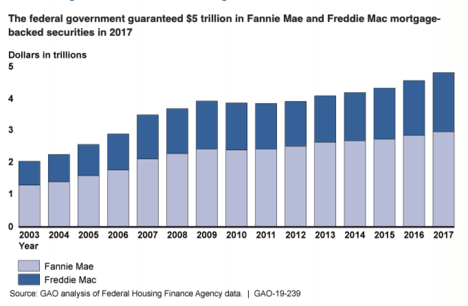
The federal government took over the two giants of the secondary housing market in the aftermath of the housing crisis and recession of a decade ago, but even though the market has returned to health the federal government still controls both organizations, as well as their profits. In 2017, the federal government directly or indirectly guaranteed about 70% of single-family mortgage originations, GAO noted.
“…Recent market trends pose risks to these entities and the housing finance system,” GAO said in its report. “For example, mortgage lending standards have loosened slightly in recent years, which could increase the risk of borrower default—especially in a recession or downturn in the housing market—and losses to federal entities. Nonbanks have increased their presence in mortgage lending and servicing, which involves collecting monthly mortgage payments, among other duties...The share of nonbank servicers of mortgages in enterprise MBS also grew from 25% in 2014 to 38% as of the third quarter of 2018. While nonbank lenders and servicers have helped provide access to mortgage credit, they are not subject to federal safety and soundness regulations.”
GAO said the Federal Housing Finance Agency (FHFA) has taken actions to lessen some of Fannie Mae and Freddie Mac's risk exposure, including reducing the size of the GSEs’ riskier retained mortgage portfolios, “which hold assets that expose them to considerable interest rate and other risks from a combined $1.6 trillion in 2008 to $484 billion in 2017.”
Transferring Risk
Since 2013, the enterprises also have transferred increasing amounts of risk on their guaranteed MBS to private investors and insurers through credit risk transfer programs, GAO said.
“However, federal fiscal exposure remains significant,” the GAO study states. “The Department of the Treasury's remaining funding commitment through the senior preferred stock purchase agreements—which provide financial support to the enterprises—leaves taxpayers exposed to risk, especially in the event of adverse market or other conditions and given the recent growth in the enterprises' guarantee business. The value of outstanding MBS on which the enterprises guarantee principal and interest payments to investors grew from about $2.1 trillion in 2003 to about $4.8 trillion in 2017.”
GAO said the long duration of the conservatorships also raises uncertainty among market participants. Several experts and stakeholders GAO interviewed said they have hesitated to make longer-term strategic plans and goals due to potential housing finance reforms that could markedly affect their industries, according to the agency.
GAO said it reviewed 14 housing finance reform proposals from Congress, agencies, industry groups, and think tanks. The proposals generally fit into four different models: reconstituted enterprises, a multiple guarantor system with an explicit federal guarantee, a government corporation, and a completely privatized market without an explicit federal guarantee, according to GAO.
Goals Are Lacking
“The 14 proposals generally meet key elements of GAO's framework for assessing potential changes to the housing finance system, such as addressing fiscal exposure, protecting investors, and considering the implications of the transition to a new system,” GAO said. “However, many proposals lack clearly defined and prioritized goals or do not address the role of other federal entities in the housing finance system, such as FHA and Ginnie Mae—two key elements in GAO's framework. By incorporating these elements, policymakers could facilitate a more focused and comprehensive transition to a new housing finance system and provide greater certainty to market participants.”
In the study GAO recommends Congress consider legislation for the future federal role in housing finance that addresses the structure of the enterprises, establishes clear and prioritized goals, and considers all relevant federal entities, such as FHA and Ginnie Mae.
For more on the report, go here.