

WASHINGTON—The Government Accountability Office (GAO) has released a new report that shows for at least one large credit union Bank Secrecy Act compliance costs are significantly higher than that of banks’.
The GAO report, on BSA compliance costs, also includes a number of recommendations, including that FinCEN develop written policies and procedures to promote greater use of BSA reports by law enforcement agencies without direct database access. In response, FinCEN said it concurs with GAO's recommendations.
According to GAO, it reviewed a nongeneralizable sample of 11 financial institutions that varied in terms of their total assets and other factors, and estimated that their total direct costs for complying with the BSA ranged from about $14,000 to about $21 million in 2018.
The highest cost as a percentage of operating expenses was found at “Credit Union A,” as can be seen in the chart below. Compliance costs for two “small” credit unions were still substantially higher than that of the largest banks as a percentage of operating expenses.
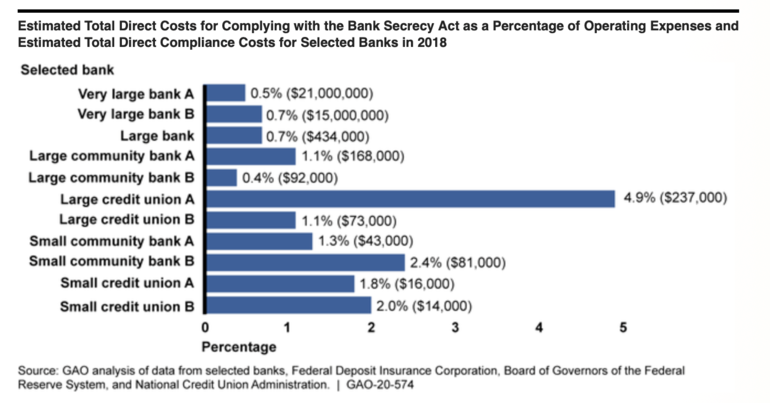
Not surprisingly, GAO said it found total direct BSA compliance costs generally tended to be proportionally greater for smaller FIs than for larger FIs.
“For example, such costs comprised about 2% of the operating expenses for each of the three smallest banks in 2018 but less than 1% for each of the three largest banks in GAO's review,” GAO said. “At the same time, costs can differ between similarly sized banks (e.g., large credit union A and B), because of differences in their compliance processes, customer bases, and other factors. In addition, requirements to verify a customer's identity and report suspicious and other activity generally were the most costly areas—accounting for 29% and 28%, respectively, of total compliance costs, on average, for the 11 selected banks.”
Usage of BSA Reports
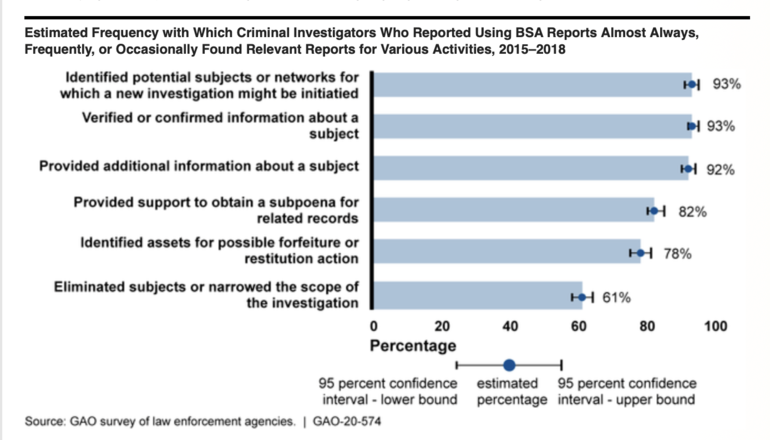
Meanwhile, the GAO survey of six federal law enforcement agencies found more than 72% of their personnel reported using BSA reports to investigate money laundering or other crimes, such as drug trafficking, fraud, and terrorism, from 2015 through 2018.
“According to the survey, investigators who used BSA reports reported they most frequently found information useful for identifying new subjects for investigation or expanding ongoing investigations,” GAO reported.
As of December 2018, GAO said it found the Financial Crimes Enforcement Network (FinCEN) granted the majority of federal and state law enforcement agencies and some local agencies direct access to its BSA database, allowing them to conduct searches to find relevant BSA reports. FinCEN data show that these agencies searched the BSA database for about 133,000 cases in 2018—a 31% increase from 2014, the GAO reported.
FinCEN created procedures to allow law enforcement agencies without direct access to request BSA database searches. But, GAO said it estimated that relatively few local law enforcement agencies requested such searches in 2018, even though many are responsible for investigating financial crimes.
GAO said it further found agencies without direct access may not know about BSA reports or may face other hurdles that limit their use of BSA reports.
“One of FinCEN's goals is for law enforcement to use BSA reports to the greatest extent possible. However, FinCEN lacks written policies and procedures for assessing which agencies without direct access could benefit from greater use of BSA reports, reaching out to such agencies, and distributing educational materials about BSA reports,” GAO stated. “By developing such policies and procedures, FinCEN would help ensure law enforcement agencies are using BSA reports to the greatest extent possible to combat money laundering and other crimes.”
BSA said FinCEN data indicate that the agencies collectively cited about 23% of their supervised banks for BSA violations each year in their fiscal year 2015–2018 examinations.
“A small percentage of these violations involved weaknesses in a bank's BSA/anti-money laundering compliance program, which could require the agencies by statute to issue a formal enforcement action,” GAO said.
Stakeholder Response
According to GAO, stakeholders had “mixed views on industry proposals to increase the BSA's dollar thresholds for filing currency transaction reports (CTR) and suspicious activity reports (SAR).
“For example, banks must generally file a CTR when a customer deposits more than $10,000 in cash and a SAR if they identify a suspicious transaction involving $5,000 or more,” the GAO report stated. “If both thresholds were doubled, the changes would have resulted in banks filing 65% and 21% fewer CTRs and SARs, respectively, in 2018, according to FinCEN analysis. Law enforcement agencies told GAO that they generally are concerned that the reduction would provide them with less financial intelligence and, in turn, harm their investigations. In contrast, some industry associations told GAO that they support the changes to help reduce BSA compliance costs for banks.”