

WASHINGTON–While the FDIC has put in place policies designed to address the risk from examiners favoring banks at which they later go to work, or regulatory capture, a new GAO report has found some examinations have not been implemented consistent with those policies and that gaps in FDIC policies limited their effectiveness.
The GAO noted the FDIC put the policies in place as part of an effort to reduce the potential benefit to industry of capturing the examination process, reducing avenues of inducement, and promoting a culture of independence and public service (see figure).
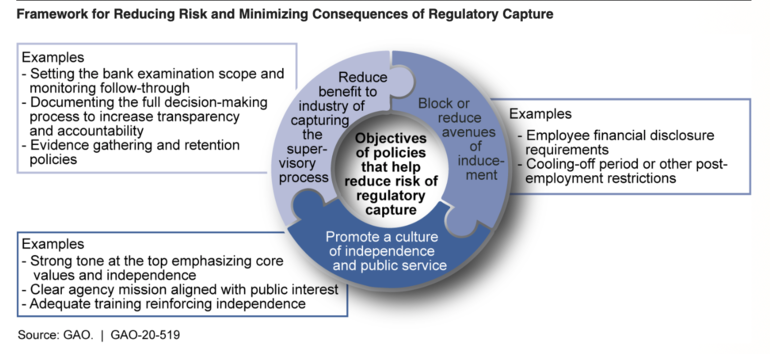
“FDIC has several policies for documenting bank examination decisions that help promote transparent decision-making and assign responsibility for decisions,” the GAO said. “Such policies are likely to help reduce benefits to industry of capturing the examination process. However, GAO found that some examinations were not implemented consistent with FDIC policies and that gaps in FDIC policies limited their effectiveness. For example, GAO found that managers sometimes did not clearly document how they concluded that banks had addressed recommendations. By improving adherence to agency policies, FDIC management could better address threats to capture in the examination process.”
Conflicts of Interest
GAO said if further found that the FDIC has policies to address potential conflicts of interest that could help block or reduce avenues of inducement.
“For example, FDIC has post-employment conflict-of-interest policies designed to prevent former employees from exerting undue influence on FDIC and to reduce industry's ability to induce current FDIC employees with prospective employment arrangements,” the GAO said. “One such policy requires the agency to review the workpapers of examiners-in-charge who accept employment with banks they examined in the prior 18 months. However, FDIC has not fully implemented a process for identifying when to review the workpapers of departing examiners to assess whether independence has been compromised. In particular, FDIC does not have a process for collecting information about departing employees' future employment. By revising its examiner-departure processes, the agency could better identify when to initiate workpaper reviews.”
The GAO report notes the FDIC has identified regulatory capture as a risk as part of its enterprise risk management process, and has documented 11 mitigation strategies that could help address that risk. Identified mitigation strategies include rotating examiners-in-charge, national examination training, and ethics requirements.
Reason for the Study
The FDIC supervises about 3,300 financial institutions to evaluate their safety and soundness, explained GAO.
“Some analyses by academic researchers have identified regulatory capture in supervision as one potential factor contributing to the 2007–2009 financial crisis. Regulatory capture is defined as a regulator acting in the interest of the regulated industry rather than in the public interest,” the GAO said.
What GAO Recommends
The GAO has made four recommendations to FDIC related to managing the risk of regulatory capture, including improving documentation of banks' progress at addressing FDIC recommendations and revising examiner-departure processes. The GAO said the FDIC neither agreed nor disagreed with these recommendations, but described actions it would take in response to them. FDIC's actions, if fully implemented, would address two of the four recommendations.