

WASHINGTON–A breakout session that is annually designed to scare the wits out of attendees was once again widely attended sessions during America’s Credit Unions GAC here, where three attorneys offering updated on all the litigation threats faced by CUs.
The session, titled “What’s New on the Litigation Front?” included as panelists Cristina Miller, of SW&M, LLP; Brandy Bruyere of Honigman, LLP, and Christopher Pippett of Fox Rothschild, LLP.
Miller: Miller addressed a much-discussed issue at GAC, junk fees. She noted the administration is targeting fees that:
- Unexpected fees for a product or service
- That consumers believed were covered by a product or service’s baseline price that seem high for the product or service
- That are unclear on why they are charged
“I personally think these are not junk fees, but we have a very active CFPB,” Miller said.
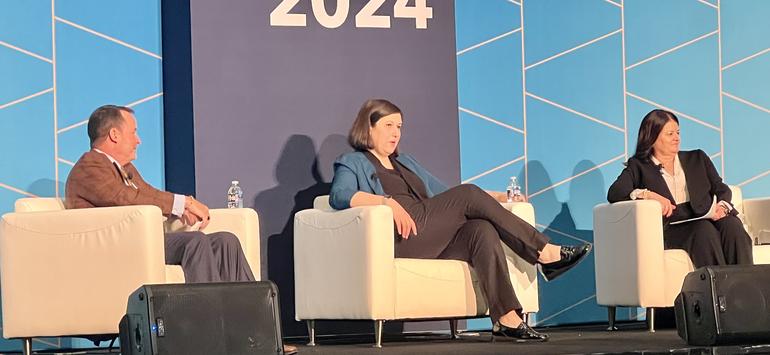
From left, Christopher Pippett, Brady Bruyere and Cristina Miller.
Miller noted the Bureau has actually stated that even when a credit union is in compliance with the rules, it can still not be in compliance.
Miller, who is based in California, pointed to the extra scrutiny in that state on fees, including a recent announcement by its attorney general.
“Don’t be surprised if President Biden in his State of the Union brings up junk fees,” Miller said.
Overdraft Fees
Overdraft fees, which was the subject of similar discussion at GAC in 2023, remain the subject of much litigation, especially so-called “authorized positive, settled negative” transactions,
Miller cautioned that with NCUA is now requiring large credit unions to report overdraft fee income on their 5300s that plaintiffs’ attorneys are going to “mine the data being collected” to determine how much in fees is coming from how many members. Lawsuits may then follow.
“It really is about your disclosures. The words on the page matter,” said Miller. “But even if you disclose it properly, it may not be legal in the eyes of the CFPB.”
She further urged attention be paid to Represented Items Fees, where transactions are returned unpaid due to insufficient available funds and a merchant resubmits, the funds are still unavailable, and the consumer is hit with a second fee.
“It’s another area to be very mindful of your practices,” said Miller.
Pay to Pay, or Convenience Fees
Miller said this potential risk and issue is being seen especially in auto loans, which have been the subject of so-called “convenience fees” that are assessed when a payment is made over the phone.
“Financial institutions should look at the value of the service compared to its cost of the service,” said Miller, noting there must be specific laws related to this particular fee must be in place, or it may not be permissible.
Returned Deposited Item Fees
Miller said actions around these fees, such as bounced check fees, have grown significantly.
“The CFPB stated that blanket policies that charge that fee no matter what are not fair,” said Miller. “We’re all being put on notice now that a blanket policy is going to be the subject of scrutiny.”
According to Miler, the FPB has stated it is unlikely that FIs will violate the prohibition or unfair practices under the CFPA if the method in which RDI fees are assessed is tailored to only charge consumers who could reasonably avoid injury.
Miller said she has spoken with a class action firm that says it plans to be particularly active this year on RDI fees.
Zelle Class Actions
As CUToday.info reported, there have been numerous lawsuits filed related to fraud on Zelle, even in cases where the consumer has initiated the transaction. What is key, said Miller, is the definition of “unauthorized transaction” is key. A law firm well known for bringing similar class actions has also brought a case related to such fraud on Zelle.
“The facts are going to be really important on these types of transactions. You are going to want to really look at your Zelle and account disclosures and really spell out what an unauthorized transaction is, and maybe even give an example.”
Employment Law Hot Topics
Miller touched on numerous issues related to employment, including new issues involving artificial intelligence that she said credit unions should watch.
One 55-year-old person, for instance, who applied for a job where AI reviewed applications, was rejected. She then refiled the same resume and just changed her age, and was accepted.
This led to a lawsuit related to “algorithmic discrimination.”
“You need to be mindful of what’s in the software,” said Miller. “You can’t say it’s the vendor’s fault.”
Additional Threats
Among the issues Bruyere cautioned credit unions to be aware of:
Services to Immigrants
Bruyere said there have been multiple lawsuits against CUs alleging discrimination against immigrants on Deferred Action for Childhood Arrivals (DACA) status.
“Blanket policies to not end to these borrowers is what is being targeted,” Bruyere said. “I think something to think about here is we are usually talking about greedy class action attorneys. These people are not. These are being filed by the Mexican-American Defense Fund. They are trying to change the market and they are actively building more lawsuits in this space with the plaintiffs’ attorneys.”
Bruyere pointed credit unions to sites like TopClassActions.org to review the kinds of plaintiffs these firms are seeking and the cases they are making.
Not Just About Lending
Bruyere also reminded the cases are not just about lending, as these are not ECOA claims.
“General civil rights statutes prohibit discrimination in contracting based on alienage,” said Bruyere. “Make sure limits are rooted in business purposes and creditworthiness. But there’s still risk.”
Suit Against Citibank Over Electronic Fraud
Bruyere said an important case is being overlooked, and that is the case the New York attorney general filed against Citibank on Jan. 30. It alleges the bank failed to properly implement security measures to prevent fraud or reimburse consumers for fraud clams. The suit states that when losses occur by wire transfers that are initiated from online banking, Citi employees “say nothing abut the Electronic Fund Transfer Act.” Consumers are required to fill out affidavits.
The suit alleges not following the EFTA and the UCC, under what Bruyere said are “contracts of adhesion,’ meaning not negotiable by consumers, which is in violation of the EFTA’s anti-waiver provision and clear contract rule.
The AG said Citibank has deceived consumers about the level of security provided for their accounts.
“This almost boils down to, if you can be hacked you don’t have a reasonable cybersecurity program,” Bruyere said.
What Bruyere said is most concerning is interpretation of Reg E vs. EFTA and how the type of transaction is interpreted.
“The NY AG argues that wire transfers conducted online are not single instantaneous wires, but account debits then used to facilitate a wire,” Bruyere said.
Arbitration Clauses
Bruyere said there have been big issues around arbitration clauses and class action lawsuits, which are often too expensive for a CU to defend itself.
“Some state courts, in cases involving credit unions, have taken positions that ‘new’ provisions are not enforceable the opt-out may not be sufficient,” Bruyere said. “Courts are looking for ‘mutual assent,’ meaning the parties both truly agreed to arbitrate.”
Bruyere also urged CUs to pay attention to vehicle repossession notices and data breaches as sources of growing litigation.
Smaller CUs Targeted
Pippett pointed his audience to the growing number of class action lawsuits, including against smaller credit unions.
He noted the issues to be aware of include:
- On ODs/NSFs: APSN; available vs. Ledger balance, and multiple NSF fees on one item
- Repossessions: Repossession notices and deficiency balance notices
- Data security breaches. Chris said one CU got a notice of class action literally the day after the breach.
- Solar panel lending: Vendor due diligence and contract review is a must, he said. A shoddy vendor that is using financing from the credit union can lead to becoming a defendant, he cautioned.
The Best Takeaways
“The best takeaways for avoiding class action suits are review all your standard correspondence by people in default. You very seldom get sued by your good members,” said Pippett.
Government Investigations
Pippett said in the event of government investigation, a credit union should proceed with auction, even if the CU is not being investigated.
He further urged CUs to:
- Reach out to counsel
- Request a subpoena
- If it’s the credit union that is being investigated, follow counsel’s instructions regarding internal communications
- Always keep privacy and other legal requirements regarding members in mind when responding or providing information.
Now With Free Shipping! The CUToday.info Daily News Email Keeps Getting Better!
The biggest, best and freshest news reporting in credit unions remains free, and now has an added bonus---free shipping to your email address! That’s right. Each morning CUToday.info delivers its daily Fresh Today news update offering the latest headlines and breaking news right to your email, with the easy-to-read headlines format allowing you to click on the stories that interest you most in order to learn more. So stop paying those bank-fee-like subscription prices from other so-called “news” publications!
If you haven’t yet signed up for the new email solution on which CUToday.info has partnered with ResponseGenius, you can do so here. Signing up requires less than one minute of your time—and it’s free!
Please note that after signing up you may need to go to your Spam/Junk folder and mark the morning headlines email as safe. CUToday.info does not provide its list of readers and emails to outside parties, and we will not be contacting you to sell you an extended warranty or sending you any links so you may cash in on an inheritance you didn’t know was coming.
And did we mention it’s free?