

WASHINGTON–One expert on artificial intelligence (AI) offered some insights on the technology to a credit union audience here, including what to fear (bias built into models) and what not to (loss of jobs).
Speaking to America’s Credit Unions’ GAC, Jennifer Goldbeck, a computer scientist who is director of the Social Intelligence Lab at the University of Maryland, said the technology certainly promises to be transformative, even if there is some “over-promising” taking place right now.
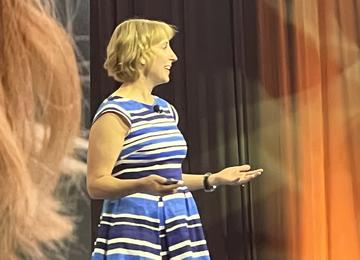
Jennifer Goldbeck
Noting AI is a broad term, Goldbeck focused on predictive and generative AI, the former being tech that does things like make movie recommendations on Netflix; the latter being tech like Chat GPT.
‘Useless Moments’
While the former can have its “useless” moments, such as recommending items again and again that someone isn’t interested in, it can also develop effective user profiles that have value, such as recommending a song someone might not have otherwise listened to that they find they enjoy.
“Sometimes we have these moments… of serendipity where you discover a thing that you didn't know existed and you weren't searching for, but it's like exactly what you want,” Goldbeck said. “Those are the moments that we're really trying to build with this.”
The Biggest Risk
The biggest risk with predictive AI, according to Goldbeck, is in making mistakes and bad forecasts.
“When trust is lost it’s profoundly damaging and can happen with a single text message,” said Goldbeck, sharing a text she received from CVS that addressed her dog. “People feel their data isn’t protected.”
She cautioned that many of the algorithms that identify personality traits, often drawn from social media profiles, and predict behavior can draw faulty conclusions and even underlie illegal practices.
Goldbeck further cautioned, “If you are building AI you want to keep in mind what are the ways people could misuse this.
“Think about all the applications where you could use AI, such as figuring out someone’s credit worthiness,” she continued. “And people have done this. One company…built a model that analyzed purchases and could tell when someone was going to get divorced. When that was detected it lowered the credit limit on cards. This is one of those things where people lost a lot of trust.”
Lesson From Wells Fargo
She recalled how Wells Fargo had built out a model that directed African American and Hispanic borrowers into subprime mortgages, even when their credit profile was the same as a white borrower, because the algorithm was based on previous mortgage approvals made by humans, who were biased.
That model didn’t factor in race, but instead used zip codes, which often closely match with race.
Race was not an input. But zip code was, and zip code often closely matches to race.
“If you show it a bunch of human decisions in the past, it will replicate the way humans did it,” said Goldbeck. “AI has a veneer of objectivity, because it’s math, but because it replicates our decision-making, it replicates our biases, as well. This is probably going to be one of the first areas of regulation of AI, to require bias auditing. The problem is we don’t quite know how to do that yet.”
No Way to Know
Goldbeck cautioned credit unions they have no way of knowing whether their AI has any bias, and the companies credit unions are buying AI from are not going to do it for the CU.
“Trust really needs to be at the top of your head with not just the AI you adopt internally, but the AI where you are going to be somehow involved in those transactions,” she said.
Generative AI
When it comes to generative AI, Goldbeck acknowledged there are great fears over job losses.
But she shared the example of how companies once had pools of typists, a job that no longer exists and yet there is not a glut of unemployed typists in the market.
People who previously worked in information-related positions whose jobs were eliminated by the Internet, have also moved to other careers, she said.
“That has changed the way business happens, but it has not made it so people have nothing to do, and I think that’s what will happen with Generative AI,” she predicted.
Goldbeck said she believes the best use-case for generative AI is customer/member service, but it’s not just about buying a chatbot and letting it handle the member service inquiries.
Need for Guardrails
“You have to put up guardrails,” she said, adding their will be a shift in workers overseeing those guardrails.
Goldbeck emphasized AI’s effect, however, should not be underappreciated.
“It’s powerful. It’s going to be transformative,” she told the GAC meeting. “But you are absolutely going to be facing regulation. You have to keep trust with your members at the forefront of what you do.”
Now With Free Shipping! The CUToday.info Daily News Email Keeps Getting Better!
The biggest, best and freshest news reporting in credit unions remains free, and now has an added bonus---free shipping to your email address! That’s right. Each morning CUToday.info delivers its daily Fresh Today news update offering the latest headlines and breaking news right to your email, with the easy-to-read headlines format allowing you to click on the stories that interest you most in order to learn more. So stop paying those bank-fee-like subscription prices from other so-called “news” publications!
If you haven’t yet signed up for the new email solution on which CUToday.info has partnered with ResponseGenius, you can do so here. Signing up requires less than one minute of your time—and it’s free!
Please note that after signing up you may need to go to your Spam/Junk folder and mark the morning headlines email as safe. CUToday.info does not provide its list of readers and emails to outside parties, and we will not be contacting you to sell you an extended warranty or sending you any links so you may cash in on an inheritance you didn’t know was coming.
And did we mention it’s free?