

WASHINGTON—Overdraft lawsuit firms are not “sheltering in place” during the pandemic. In fact, they have become more aggressive and creative, and are driving up the price tag on their demand letters—into six figures—reports one expert.
During CUNA’s virtual GAC, Cristina Miller, partner at Styskal, Wiese & Melchione, LLP and who works with CUs on overdraft cases, provided an outlook on what credit unions can expect this year from OD lawsuits, and what they can do to protect themselves in what is a quickly changing legal environment.
“The class action lawyers have not sheltered in place,” Miller said. “They are innovative and are finding ways to get their plaintiffs to court. In fact, they have gotten more innovative during the shutdown. Too, we used to see demand letters asking for settlements in the $20,000 to $30,000 range. Now we are seeing letters demanding six figures.”
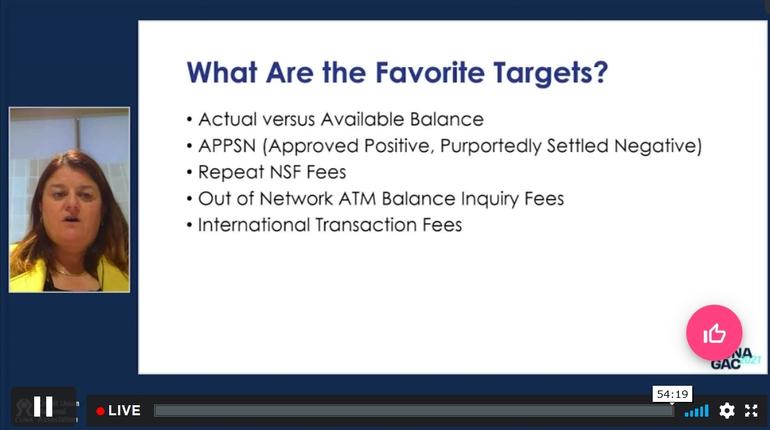
Christina Miller outlines key reasons for OD suits
4-5 Firms Filing the Suits
Miller said there are four to five legal firms across the country that are accounting for the majority of these cases. She explained they often follow each other, and can often target the same financial institution one firm is already suing.
“They tend to start in California and New York, and then they blanket the rest of the country,” Miller explained. “I have one client who is facing dueling class action overdraft suits, one in state court and another in federal court.”
Miller said when a financial institution receives a compliant, they often come to Miller asking what they did wrong.
Miller said she explains that it is often not what the FI is doing wrong in its overdraft processes, but more so how its overdraft contract language is worded that causes problems.
‘Words Matter’
“Your words matter,” said Miller. “It is the failure to actually disclose what you are doing that gets a credit union in trouble.”
A big issue driving demand letters, said Miller, is actual versus available balances. This is a situation in which the FI is not clear in its overdraft language that an NSF fee will be charged on the actual balance, not what is available. Often, available balances do not include pending charges, and consumers believe they have more in their account and overdraw. She added, however, FIs have been working hard to address this matter in their OD language.
Another issue OD lawyers are attacking, according to Miller, is approved positive, purportedly settled negative (APPSN) cases, where the FI first approves a transaction and then afterward finds the transaction caused the account to go negative.
Repeat NSF fees, where the financial institution charges a second NSF fee for essentially the same transaction is becoming a focus for OD lawyers, Miller said.
Wrong Number
“You have instances where a member pays their cell phone bill directly from their checking account and the bill comes in electronically and they don’t have enough money, which triggers an NSF charge,” she said. “Well, what happens when Verizon tries to resend that charge a few days later and there still is not enough money in the account? A second fee is charged.”
Miller said credit unions are at risk here if their overdraft language says the CU will charge an NSF “per item.” To address this issue credit unions should have in their language they will charge an NSF fee “per presentment.”
“Because, in the instance I just described with the phone bill, this is actually only one item,” Miller explained.
A Larger Problem
What is also becoming a larger problem is international transaction fees, explained Miller. She said more consumers—as they sit at home and buy items over the Internet—are unknowingly buying from a vendor outside the U.S., are getting hit with these fees that reduce their balances and then face an unexpected overdraft charge. Miller urged credit unions to be very clear with members about what these fees are and how they are charged.
Miller warned credit unions that the overdraft lawyers are working hard to find plaintiffs. She said they are aggressively advertising, often targeting a financial institution and in their ads asking consumers if they have faced overdraft charges from the FI and to contact the law firm. Miller added the legal firms are also scouring the CFPB compliant database to learn what consumers are complaining about.
“And there is the website, illegalbankfees.com,” said Miller, which actually asks consumers to click on a button to see “if you qualify” for a class action OD lawsuit. “Go there. Click on the button and you get a pop-up window, fill out your name, list the bank or credit union name and hit submit. They say they will call you back.”