

WASHINGTON–The former prime minister of the United Kingdom shared her insights on her experiences in the job, the state of politics today and more.
Theresa May served as prime minister from 2016-19 and remains a member of Parliament (MP) in a seat she has held for 20 years.
May participated in a Q&A during America’s Credit Unions GAC with the trade group’s CEO, Jim Nussle.
Here is what was discussed:
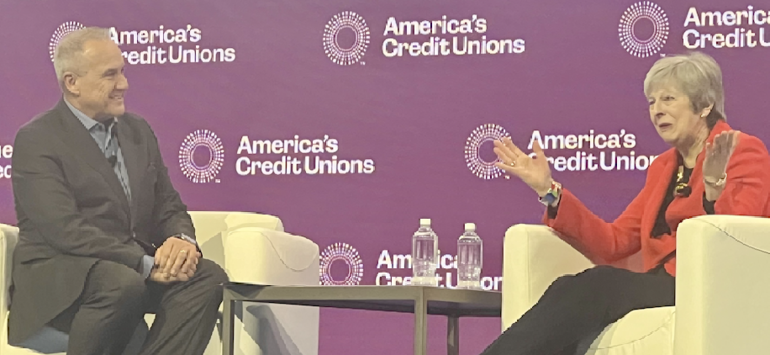
Jim Nussle, left, with Theresa May.
Nussle: How do you think about positions of power vs. positions of service?
May: I made this point to a journalist as I was stepping down as PM, that it’s not about power, it’s about service, and he said don’t’ be ridiculous, it’s about power. But it isn’t.
The position of a politician is a position of service to the people they represent. I worry about the politics we see now, where sadly in so many places there are too many people who see it about them and not about the people they are there to serve.
Nussle: How did you come to politics?
May: I am the daughter of a clergyman. I saw service to the community and church through my mother and father. I first had the idea of becoming a MP when I was 12 or 13. I knew it was difficult to get there. I wanted to make a difference to improve people’s lives.
Nussle: How does one become an MP? How do you rise to become PM in the UK?
May: First of all, you have to be selected by your party as a candidate. In the Conservative Party we have a process for assessing people. It’s a bit like applying for a job, and you go through a series of interviews.
The process of becoming prime minister, as we say, is you are first among equals. You lead your cabinet, but it is very much a cabinet government. The person who leads the largest party becomes PM. I had been home secretary for six years.
Nussle: What is the home secretary job and how it prepared you for PM?
May: The home secretary is responsible for crime, counterterrorism and immigration. In American terms, my opposite numbers were the Homeland Security secretary and the attorney general.
The process in our party is people put themselves forward and the MPs in the party vote for several rounds until they get two names, and then it goes to a vote of the membership of the party. That can be a lengthy process. In my case, at an early stage in the process the other candidate decided to drop out.
Nussle: is there a component, as we see in the United States, of celebrity in politics, of how well known you are?
May: It’s a mixture. It’s partly people looking at what you’ve done. I think being home secretary was a key grounding to be prime minister. I do worry that in our politics these days there is an element of celebrity and grabbing the headlines.
I think what the public wants is politicians to listen to them and then get on and do the job.
Nussle: As a woman, are you a role model for other women to go into politics?
May: I never think of myself as a role model, but I think it’s important for women to be seen in these positions. It’s that old adage, if you can see it, you can be it.
There are some aspects of being a woman in politics that are different from being a man. One example: in the last speech I gave outside 10 Downing St., just at the end of my speech my voice cracked. If a woman shows emotions, it’s considered a weakness. If a man shows emotions, it’s wonderful, he’s showing his other side.
And women see such abuse in social abuse. Old Joe used to sit at the end of the bar and mutter into his beer, and no one paid any attention to him. Now, he mutters into social media and it becomes a world view.
Nussle: What are you proudest of in your term as prime minister?
May: I set up a racial disparity unit at 10 Downing St. to see how the public sector treats all our communities in the U.K. It came back with some quite difficult results. I started work on the Domestic Abuse Act.
I think the thing what is probably going to have the most impact for the future and for younger people is getting to net zero for carbon emissions by 2050. Preserving our planet is so important for future generations.
Nussle: What was the Brexit experience like? Anything you would do differently?
May: I had voted to remain in the EU. But I said right at beginning of the referendum that if we left, the sky would not fall in. It was a 52/48 vote to leave. I felt it was important we get a deal that reflected some of the concerns of the 48%, too.
I wasn’t able to get that through. As we got further down in negotiations, that division became even more sharply seen in Parliament.
I probably should have spent more time with colleagues on the vision of what it was I was trying to do. Sometimes sitting down with people is what gets overlooked.
Nussle: What is path forward, where is this going, in Ukraine?
May: It’s difficult to see where resolution comes. I think it’s very critical we in the West continue to support Ukraine. I very much hope the U.S. can come to an agreement on providing the support.
I think Putin thought we were focused on China and saw and opportunity, that we wouldn’t defend our values and had become complacent about democracy.
He hasn’t achieved what he thought the would achieve. He thought it would divide NATO. It hasn’t. We’ve seen a Russia that was not the magnificent fighting force that it was claimed to be.
It is very difficult for the Ukrainians. They need our support, not just political and practical support, but military support. It is so important that we in the West hold fast to our support.
If Putin succeeds, then Ukraine will not be the only place he will look.
Nussle: Can you offer a general comment on U.S. politics?
May: I worry about the polarization. I worry about the lack of willingness to compromise and work together. In the House of Commons we represent different parties; everybody there wants to make a difference and improve people’s lives.
We need to find ways where people recognize the power of compromise. The polarization in politics and media is detrimental. I worry that here in the U.S. and in the U.K there is an increasing percentage of people who do not think democracy is the right way to run a government. I think we need to educate on the importance of democracy.