

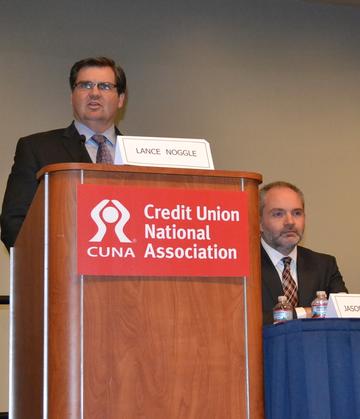
L-R: Lamce Noggle, Jason Kratovil
WASHINGTON—Will legislation to help to stop data breaches in the U.S. pass Congress this year?
Jason Kratovil, VP of government affairs for the Financial Services Roundtable, said that for the first time in a while he is hopeful it will, noting that congressional committees typically at loggerheads may now be ready to move.
“It is entirely possible,” Kratovil told CUToday.info during a CUNA GAC breakout session on payments legislation. “The climate is right. Historically that has not been the case, but now folks are starting to come out on the same page and work constructively toward an outcome that everyone can agree on.”
Kratovil is referring to the House Financial Services Committee and House Energy and Commerce Committee, which now appear to be amenable to moving data breach legislation forward.
“But in terms of when, I think everyone’s crystal balls are focused on that,” said Kratovil. “Things are still murky.”
Kratovil noted that the House Financial Services Committee has many large issues that are front-loading its agenda, which may slow movement on data breach legislation.
“There is the CHOICE Act, flood insurance. . . a number of things that the committee will have to chew on in the foreseeable future,” he said.
A positive sign is that both committees made progress on data breach legislation at the close of last year, said Kratovil.
“It’s incremental progress but critically important progress,” he explained. “I think it has set a good stage to move things forward this year.”
Kratovil said it has been about ten years since two House committees have been able to agree to move forward on cyber rules, each advancing separate bills.
“But I think we have brought together sides now that typically have not worked together,” said Kratovil, referring to the committees and even retailers and financial services associations. “We have brought a bunch of folks under one big tent and we all agree this matter is important and needs to get done. Congress should see this as what it is—a consumer protection issue, because that is how we have always seen it, and we expect Congress to see this as a high priority.”