

WASHINGTON–That the future is changing rapidly and unpredictably is the one certainty—and to get better at what could occur and how a credit union can be as prepared as it can be, one person has four questions every CU can ask itself.
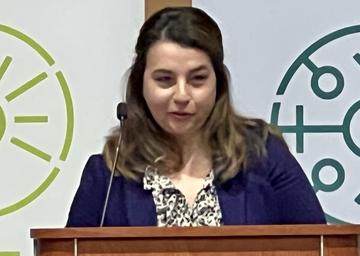
Yas Arikan
In remarks to a Filene Research breakfast as part of GAC, Yas Arikan, a futurist and foresight consultant with Next Generation Consulting, said professional futurists have ideas ant use tools to make the forecasting challenge more of a natural process, more systematic, more collaborative, more inclusive and more robust.
“The point of professional foresight is absolutely never to predict the future; nobody can do that,” said Arikan. “Rather, the point is to develop insight into how the future could be different and use those insights to form your decisions, your actions today.”
How can a credit union leader sharpen or refine foresight? According to Arikan, by using “strategic foresight,” which she described as a mindset, a set of techniques and a process.
To that end, she recommended leaders focus on the process by asking four questions.
What’s coming that we need to pay attention to now so that we can be ready?
Arikan described this as the “sensing phrase, and said it should be broken down with four other questions:
- What trends or signals may affect us over the next decade?
- How certain are we that these things will affect us?
- How much impact do we think this trend or signal will have on our organization?
- How ready are we?
The difference between trends and signals, said Arikan, is that a signal of change is like a random drop of water that might be felt while taking a walk. Is it a one-time thing or the start of a pattern? A signal of change is something that isn’t yet mainstream, but aspects of the future are being actively tested. A trend is when more and more people know about it and it becomes a pattern—but it could fizzle out, she said.
What Could Happen?
This question is a little broad, so Arikan recommended it be broken down into “three flavors”:
- Expectable futures: What happens if you stick to business as usual?
- Challenging futures: What is a plausible future, what about multiple disruptions?
- Visionary futures: What is a plausible, surprisingly successful future? What if things happen at the right times and in the right ways? How could this actually happen?
The goal is to come up with multiple meaningfully different futures to be discussed.
What Do We Want to Happen and What will it Take to Get There?
“This is a lot about strategy development,” explained Arikan. “Based on the forecasts and alternative stories of the future, what strategies would help you to just to survive but thrive? We can’t predict the future. Which of these strategies that make sense in multiple futures do we absolutely have to get right? And what does surprising success look like? How would a person know in 2040 that we have successfully pursued this strategy?”
This step, she said, is much like filling out a Ven diagram.
How Can We Get Started and Keep Momentum?
This is the “what are you going to do about it” stage after the strategic planning, she said.
Arikan calls this “strategic doing, and it involves asking what could we do, what should we do, what will we do, and what is our 30/30, or when are we meeting again to review process and adjust path.
How to Avoid One Tendency
The tendency in organizations is to look shorter and to focus on one preferred future, she said.
“That’s strategic planning. Strategic foresight is about approaching the future based on the future,” she said. “Walking through these four questions with others gives you the ability to consider a broader range of opportunities and challenges and to stress-test your scenarios under different conditions.”
It’s Called Fresh for a Reason. And We Offer Home Delivery. For Free!
The biggest, best and freshest news reporting in credit unions remains free in ’23! Each morning CUToday.info delivers its daily Fresh Today news update offering the latest headlines and breaking news right to your email, with the easy-to-read headlines format allowing you to click on the stories that interest you most in order to learn more.
If you haven’t yet signed up for the new email solution on which CUToday.info has partnered with ResponseGenius, you can do so here. Signing up requires less than one minute of your time—and it’s free!
Please note that after signing up you may need to go to your Spam/Junk folder and mark the morning headlines email as safe. CUToday.info does not provide its list of readers and emails to outside parties, and we will not be contacting you to sell you an extended warranty or sending you any links so you may cash in on an inheritance you didn’t know was coming.
And did we mention it’s free?
Please note and/or make your IT department or email administrator aware the emails will be coming from the domains CUTodayinfo.com and CUTodayinfoReply.com