

WASHINGTON—One CEO fears that if credit unions don’t start finding younger people to staff their boards, the result will be both a failure of the DEI efforts and perhaps even the failure of credit unions themselves.
Monica Belz, CEO of $150-million Kaua’i FCU in Lihue, Hawaii, told attendees during a breakout session at CUNA’s GAC that when credit union boards are comprised of older people only, it is a diversity issue and a business problem. It’s a diversity, equity and inclusion where CUs are “missing the mark,” she said.
Belz’s comments came during the first-ever DEI Tuesday at GAC and were part of a panel discussion at the meeting.
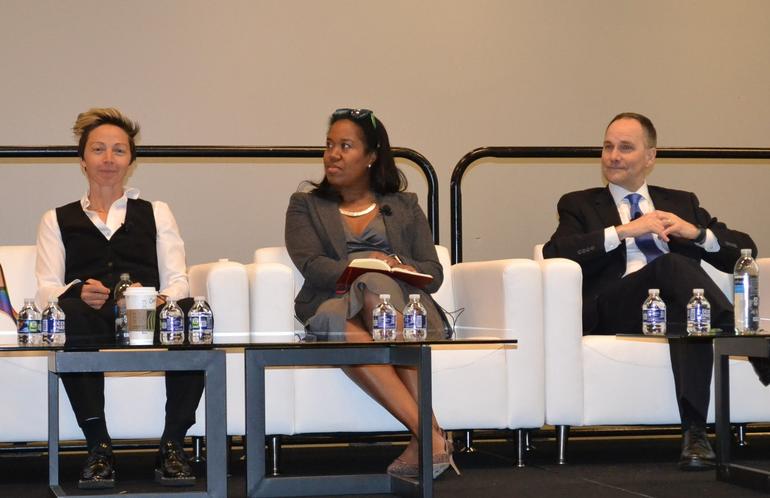
L-R: Monica Belz, Dr. Quinetta Roberson, John Bissell
“The future of our industry is dependent on our leaders, and a big wave of leaders are retiring now,” said Belz. “Who is choosing your next CEO? If your answer is your board, that answer is probably right for just about everyone in this room. Our boards are choosing our next leaders and setting the course for the future of our industry.”
Belz said she is concerned the that with the average CU board member being older those boards are less likely to choose a candidate who is not just younger but diverse in other ways, too.
When Belz asked attendees for a show of hands if they had one Millennial on their board, about one-third did so. She then asked how many have a board comprised of 50% Millennials, and no hands were lifted.
“We have a small set of people dictating the fate of our industry in the next decade,” said Belz, adding that when it comes to the question of what is the next big step to take to more effectively address DEI, “this is a good place to start.”
One CU’s Story
At the $1.6-billion Greylock FCU in Pittsfield, Mass., that step has already been taken, beginning in 2015 when the credit union first began to make DEI a core part of its culture and business strategy.
“Prior to our DEI journey in 2015, we were growing membership at about 1,000 net new members each year in a region where the population is shrinking,” explained CEO John Bissell. “Once we began our DEI journey, we became more interested in diversity and more welcoming with people across our community. As a result, we are now averaging 3,300 net new members a year. Our earnings and annual net income have more than doubled since we made these changes.”
For Greylock, DEI is core to its strategic plan, and not a “bolt on.”
“If recession hits our intention is to double-down on DEI. We see that as an opportunity as we know banks will pull back in a recession,” Bissell said. “It’s the right thing to do and the right thing for our business.”
What the Data Show
Filene Research Fellow Dr. Quinetta Roberson shared data that backs up what Bissell asserted, that a strong DEI program can be a business advantage.
“Two years ago we asked credit unions about their DEI practices in 31 areas,” explained Roberson. “We had 204 credit unions respond. And across those practices, over 75% of respondents pointed to staffing and training processes, which are usually the top DEI areas cited.”
And yet while those two areas were a focus for many credit union DEI efforts, Roberson said they are not the most impactful, data show.
Moving Forward
Roberson said that when credit unions followed some specific practices they not only gain an effective DEI program for employees, but also a program that moves the business forward.
As CUToday.info has reported and as Roberson noted, the Filene analysis of the the data shows three “bundles” of DEI practices are needed to have an effective DEI program, She emphasized those CUs that have implemented the bundles are also seeing improved 5300s.
Those bundles center on strategy, accountability and DEI-related goals, and tracking progress toward those goals.
“These credit unions actually have higher performance,” Roberson said. “The most impact was on return on assets and income. So, you can take away from the research there is also a business benefit from a strong DEI program.”
Roberson said Filene plans to share more information from its newest DEI study this summer.
At the Heart of Strategy
Meanwhile, Greylock FCU’s Bissell emphasized what he said is the importance of making DEI part of the credit union’s internal culture.
“Like I said, at Greylock DEI is at the heart of our financial strategies, but most important, it’s at the center of our employee culture,” he explained. “We know if we get the employee culture right it drives everything else.”
Kaua’I FCU’s Belz offered her own overall assessment.
“We have made changes, there is momentum,” she said. “But there is not enough change yet. We are all riding this wave together, let’s not roll off.”