

WASHINGTON–CUNA’s new chairman, a former CFO who admits he “loves” Excel, told credit unions gathered here that while he may hate to admit it, the value of CUs can’t be found on a spreadsheet.
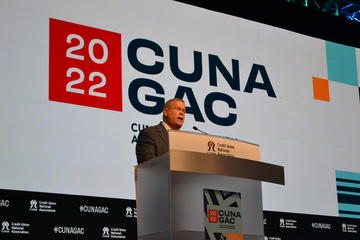
Tony Budet addresses GAC.
“There is something all of us in the credit union movement need to explore further,” said Tony Budet, president and CEO of University FCU in Austin, Texas. “If we have DNA for social impact, then what is yours? What is mine? Perhaps like other CEOs here I see myself first as a community leader who happens to be the CEO of University Federal.”
Budet told CUNA’s GAC in his first remarks as chairman that he previously served as chair of the Greater Austin Chamber of Commerce, where he discovered all kinds of things he never knew existed in his hometown.
“Austin is a boom town. Yet that city has huge problems. If Austin as a boom town has problems, your communities probably have similar problems,” Budet stated. “Our board asked what can a not-for-profit cooperative do? We found we have some core competencies that align beautifully with these challenges.”
Areas of Alignment
Among the areas where University FCU has found that alignment, he said, are:
- Quality post-secondary education. “Ours is a very high immigration state. One of our executives who meets regularly with college presidents asked about their top priorities. Inevitably, getting first generation college students educated was the top priority. That became a big deal for us. We have the name University in our name.”
- Workforce development and jobs skills. “A good job solves a host of social ills,” said Budet. “In Austin we have 80,000 jobs open and 38,000 unemployed. On the surface you think we would just match them up. Unfortunately, 80% of the unemployed don’t have the education and skills certification for the kinds of jobs we create, so we in Austin tend to import the talent we need. That stresses the infrastructure. We have focused very intensely on this.”
- Boosting affordable housing. “Our city is quickly becoming very expensive. Buying a home is the number-one way families build wealth. You get a family in a home you have changed the rest of their lives.”
Not a Right or Left Issue
Budet said University FCU has gone back and redefined itself by becoming externally focused around its vision, “A financially healthy community.”
“We are trying by year 2030 to impact one-million lives. We are now up to about 300,000 people, and I am confident we will hit that one million by 2030,” said Budet. “This is not a Democratic issue. It’s not a Republican issue. I know we have a tendency to politicize every issue around us. Let’s not do that. This is what credit unions do. This is people helping people. We can do it, but I don’t think we are tracking what we do.”
Tracking what credit unions do in their communities—a frequently discussed issue during GAC—means thinking differently about the work done, he said.
In other words, “Did you make 100 mortgages and put them on your books? Or did you put 100 families in homes to help them build financial wealth.”
Most importantly, said Budet, the issue isn’t about data points.
“I am a former CFO. I know the numbers and I love Excel. But with all due respect to accounting and finance, which are critical, we are in the people business,” he said. “We are not in the numbers business. We have to focus on the human impact we are having through these not-for-profit platforms we are leading. Perhaps you’ve heard the expression, ‘No margin no mission.’ I suggest we reverse that: ‘No mission, no margin.’”
All About Influence
Budet, who has served on the CUNA board for nine years, told the meeting he is becoming chairman after being influenced by many people who have been leaders during his career.
Among those he credited with being the “most influential” were former Georgia league President Mike Mercer and former Cornerstone league president Dick Ensweiler, along with others involved with the National Cooperative Bank.
“Mike over many years has opened up many opportunities through experiential learning,” Budet said. “I have made many trips that have opened eyes to the power of cooperatives and the touching of human life.”
Budet also cited examples of credit union work done outside the U.S., such as by the Secredi movement in Brazil and Vancity Credit Union in Vancouver, B.C.
Informally at University CU, Budet said its efforts to improve communities and members fall under the umbrella of what it calls “social impact.” Another way to think about it, he said, quoting another person, and that is as “personal cash flow.”