

WASHINGTON–NCUA Board Chairman Rodney Hood used his appearance before CUNA’s GAC to defend the agency’s decision to sell its portfolio of taxi medallion loans to a hedge fund.
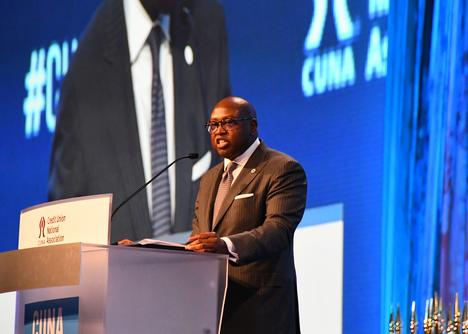
Rodney Hood shares additional details around process leading up to the medallion portfolio sale
Hood also provided additional details around the process leading up to the sale, and responded to some of the specific issues that have been raised.
Separately, Hood noted new grants will soon be available for smaller CUs and the agency will also conduct a comprehensive review of all the NCUA’s guidance letters and legal opinions to determine if they are still relevant in today’s regulatory climate.
As CUToday.info has reported extensively, the agency has come under significant criticism from one of its former executives, several members of Congress and the CU trade groups for its announcement last week that it was selling a portfolio of more than 3,500 taxi medallion loans to Marblegate Asset Management for $350 million, or about one-third of the portfolio’s outstanding loans.
Many had been hopeful the agency would join in some type of public-private partnership that would allow for the loans to be reworked. Many of the borrowers are significantly upside down in the loans for taxi medallions, which have sunk from their one-time seven-figure value to less than a fifth of that. NCUA took over the loans following the failure of a half-dozen credit unions, primarily in New York.
As CUToday.info reported here, NCUA Board Member J. Mark McWatters also dedicated a portion of his remarks one day earlier at GAC to the same issue.
600 Loans Refinanced
“For nearly six years, the taxi medallion crisis has placed enormous financial and emotional strain on taxi medallion holders and their families,” said Hood. “The NCUA has been working to resolve the collapse of several federally insured credit unions that supported the taxi industry for nearly a century. These efforts included protecting member deposits, ensuring that former members could continue to use a credit union for their financial needs, and working with borrowers on an individual basis to keep drivers in their vehicles and to provide relief where we could. This included restructuring loans to reduce payments and interest rates, resulting in more than 600 loans refinanced or modified.”
Hood said he “firmly believes” the sale will help borrowers and their families by providing “greater certainty over the management of their loans.”
“I understand this decision may not be popular or satisfy everyone. But to quote Aristotle, ‘There is only one way to avoid criticism: do nothing, say nothing, and be nothing’,” said Hood. “Additionally, the collapse of the taxi medallion market, and the failure of several credit unions that supported the taxi industry has already cost the Share Insurance Fund approximately $750 million dollars.”
‘Made Without Knowledge’
Hood said he received a Jan. 22 letter that asserted disposing of the assets in a sale to a single buyer would yield lower asset values.
“However, this assertion was made without knowing the portfolio’s size, characteristics, or condition of the assets,” Hood said. “Instead, it suggested NCUA should hold the assets until some future date and allow credit unions to purchase the distressed assets.”
Hood said the agency evaluated a variety of options, including holding and servicing the loans and of asset sales structures including structured sales and securitization.
“But after careful consideration, investor outreach, and consultation with an independent financial advisor, we determined a singular bulk sale would be the best vehicle to resolve these specific cases and yields the best feasible recovery,” said Hood. “While the agency preferred a bulk sale offer, we also advised interested bidders that we would take subset bids on a portion of the portfolio. The sum of the subset bids submitted were not greater than the bids for the overall portfolio.”
Repeating comments he made during the most recent NCUA board meeting, Hood said the agency vetted bidders and only accepted an offer from Marblegate after it agreed to work in a “good-faith manner” with borrowers.
In all, Hood said NCUA reached out to 23 qualified firms with experience in handling distressed commercial assets, and six of those submitted bids. Two firms went through to the final due diligence bid round and submitted two independent offers.
“Holding these medallion assets beyond a reasonable period could have the NCUA repeat these mistakes of the past,” Hood said. “Moreover, a financial advisor team built a comprehensive record as to why we needed to sell these assets in bulk to maximize the value of the assets while treating the borrowers in good faith…We have a duty to protect the Share Insurance Fund, and it is a duty I take seriously. I firmly believe this decision balances our duties and responsibilities to minimize potential losses to the fund with borrowers’ needs for certainty, compassion, and flexibility.”
Other Issues Addressed
Hood, who last appeared before GAC a decade ago during his first term on the NCUA board, praised credit unions for their financial health and the recovery from the financial crisis of a decade ago, as well as for their work in promoting financial well-being of consumers.
But Hood said he also wants credit unions to ask themselves a number of questions, including:
- How can credit unions continue to expand access to affordable, quality financial services to more members, while ensuring the industry’s ongoing safety and soundness?
- What are the challenges the industry is facing?
- What can the NCUA do to support credit unions in the pursuit of those goals and best prepare them for the changes that lie ahead?
“Since becoming NCUA chairman 10 months ago, I have tried to be both innovative and forward thinking,” Hood told the meeting. “To make good on that effort, I’d like to consider these questions more closely and talk about what the industry can do, and what the NCUA can do, to address the challenges credit unions face — and the opportunities available to them — in the coming years.
Help for Rural America
Looking forward, Hood said in the coming weeks NCUA will be announcing a set of initiatives aimed at improving financial services in under-served, rural communities.
“As we all know, these communities have experienced a collapse in the availability of banking services over the last couple of decades as a Federal Reserve report detailed in November,” said Hood.
Separately:
- Hood said the agency will continue to explore ways to make its operations more efficient. To that end, he said NCUA will also conduct a comprehensive review of all its guidance letters and legal opinions to determine if they are still relevant in today’s regulatory climate. “We can make a significant dent in our regulatory burden by removing outdated or duplicative guidance,” he said.
- Announced that effective May 1, $1.5 million in grants for smaller CUs will be available.
CU Trades Respond
Following Hood’s remarks, NAFCU thanked the NCUA chairman “for making changes today that will be well-received by the industry across multiple fronts,” said NAFCU President and CEO Dan Berger. “From updating important guidance, archiving outdated and duplicative guidance, to improving the agency’s overall website functionality, these updates are a testament to NCUA’s commitment to transparent and timely communication with the industry. Credit unions work hard on behalf of their members each and every day, and clear rules of the road will help ensure they can work quickly and confidently in providing safe and suitable services to their communities.”
CUNA President and CEO Jim Nussle applauded NCUA’s attention to reducing regulatory burden.
“Chairman Hood’s announcement today at the CUNA GAC that the agency would conduct a comprehensive review of all NCUA’s guidance letters and legal opinions is an important step toward helping reduce the burden that credit unions face in delivering on their mission to promote thrift and provide access to credit for provident services,” Nussle said. “Consumers turning to credit unions stand to benefit when resources are focused on their needs rather than onerous, repetitive hurdles.”