

WASHINGTON—Although they face other issues, NCUA Chairman Todd Harper is urging credit unions to remain focused on interest rate, liquidity, cybersecurity, and consumer compliance risks.
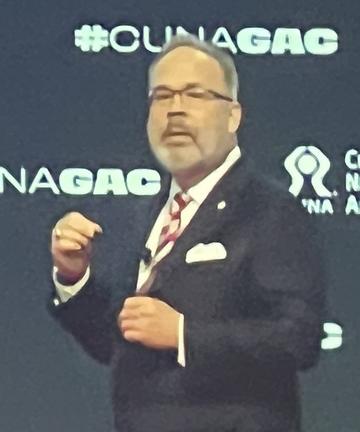
Todd Harper addresses GAC.
Harper also told attendees of CUNA’s GAC that examiners will be zeroing in on overdrafts—especially at FCUs with assets above $500 million.
“During my four years on the NCUA board, the agency has made some strides like increasing its fair lending exams and reviews,” Harper said, reminding attendees he has a strong interest in consumer protections. “And, it’s why we are now creating consumer compliance specialist positions in the field, and starting the process to build out an enhanced consumer compliance exam program. And, as part of its supervisory priorities this year, the NCUA continues to focus on overdraft programs and will dive more deeply into certain features.”
Harper said NCUA examiners will review website advertising related to overdraft programs, balance calculation methods, and settlement processes. For FCUs of more than $500 million in assets, agency examiners will be digging into authorize positive/ settle negative transactions, as well as some other “problematic fees,” according to Harper.
‘More Equitable Financial System’
“Our supervisory efforts here are aimed at creating a more equitable financial system that enables financial security for credit union members, especially those of modest means,” he said.
Harper said CUs’ ability to manage interest rate risk will be a crucial performance factor in 2023.
“Interest rates rose across the yield curve last year. As rates increase in the current economic environment, so does the associated risk that makes short-term liquidity events possible,” he told the meeting. “The potential for sudden changes in either inflation, the rate environment, or the economy mean that you must remain nimble.”
Monitoring the Balance Sheet
Harper said the industry’s collaborative spirit is needed as the rise in rates has also heightened liquidity risks.
“As such, your credit union must closely monitor its risk levels and balance sheet,” Harper told GAC.
In addition, he said the current economic environment also underscores the value of the NCUA’s Central Liquidity Facility, for which he and other board members have been lobbying Congress for an extension of the CLF’s expanded authorities.
When that temporary authority expired at the end of last year, more than 3,300 credit unions lost access to the CLF, he said.
“Without this provision, most small credit unions no longer have access to a critical liquidity resource. And, the CLF’s liquidity capacity contracted by nearly $10 billion. Now is not the time to cut a liquidity lifeline,” Harper said.
Cybersecurity Risks
Turning to risks from cybersecurity, Harper said this year NCUA will deploying its new Information Security Examination procedures.
“This new supervisory initiative is tailored to your credit union’s size and complexity, to help you prepare for, withstand, and recover from cybersecurity threats,” he said. The NCUA also encourages your credit union to use the Automated Cybersecurity Evaluation Toolbox. This free tool can help all credit unions, especially smaller credit unions, determine their level of cybersecurity readiness, and prepare them for the Information Security Examination.”
Third-Party Oversight
Harper also touched on a theme he and the other board members also frequently address; their belief NCUA should have the ability to supervise third-party vendors, including CUSOs.
“If you still have doubts about the need for vendor authority, consider that the Government Accountability Office, the Financial Stability Oversight Council, and the NCUA’s Inspector General have all recommended congressional action to fix this blind spot. We should listen to these experts and close this gap,” stated Harper.
Harper then pointed to “good news” that Congress has appropriated $3.5 million for this year’s Community Development Revolving Loan Fund grant round.
“That’s more than double last year’s amount. With this additional funding, the NCUA can now make more grants and bigger grants," he said.
It’s Called Fresh for a Reason. And We Offer Home Delivery. For Free!
The biggest, best and freshest news reporting in credit unions remains free in ’23! Each morning CUToday.info delivers its daily Fresh Today news update offering the latest headlines and breaking news right to your email, with the easy-to-read headlines format allowing you to click on the stories that interest you most in order to learn more.
If you haven’t yet signed up for the new email solution on which CUToday.info has partnered with ResponseGenius, you can do so here. Signing up requires less than one minute of your time—and it’s free!
Please note that after signing up you may need to go to your Spam/Junk folder and mark the morning headlines email as safe. CUToday.info does not provide its list of readers and emails to outside parties, and we will not be contacting you to sell you an extended warranty or sending you any links so you may cash in on an inheritance you didn’t know was coming.
And did we mention it’s free?
Please note and/or make your IT department or email administrator aware the emails will be coming from the domains CUTodayinfo.com and CUTodayinfoReply.com