

WASHINGTON–Pointing to shorter term threats—cyberattacks as a result of the war between Russia and Ukraine—and longer-term issues—plans for more thorough reviews of credit union overdraft practices this year and next—NCUA Chairman Todd Harper touched on numerous issues in remarks to CUNA’s GAC.
In the short term, Harper reminded NCUA has circulated an alert from the Department of Homeland Security, the FBI, and the National Security Agency related to cybersecurity.
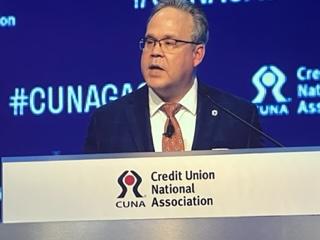
Todd Harper speaks to GAC.
“I cannot stress this enough: All credit unions and vendors, regardless of size, are vulnerable to cyberattacks,” Harper told the meeting. “Given the events over the last few days, attacks on financial institutions are potentially imminent. So, all parties within the system must maintain the highest level of alertness.”
Harper urged any CU or CU-related entity to report cyber-incidents to the NCUA, the FBI, and the Cybersecurity and Infrastructure Security Agency (more info is available at www.ncua.gov/cybersecurity).
The Role of Government
Stepping away from the cybersecurity threat and addressing issues related to the agency’s oversight and plans for what lies ahead, Harper said that as the pandemic enters its third year it is time to assess “what we all — government and credit unions — can do to positively shape the industry’s future.”
Quoting famed columnist Molly Ivins, who said, “I think government is a tool, like a hammer. You can use a hammer to build with or you can use a hammer to destroy with. Whether government is good or bad depends on what you use it for and how well you use it,” Harper said he believes “prudent use of government is critical to creating frameworks that establish the rules of the road and a fair playing field for all involved."
But NCUA, said Harper, cannot and should not do it all.
“And, if you think about it, Molly’s observation also applies to the cooperative movement. Leaders of this industry, like all of you gathered here today, should prudently use your hammers to positively affect the financial prospects of all your members,” Harper said.
The NCUA Agenda
To that end, Harper addressed numerous issues, including what he said is coming next.
Those issues include:
Pending Reg Actions
In 2002, Harper said the NCUA board has planned regulatory initiatives on reporting cyber incidents, “sensibly” growing the field of membership of federal credit unions, supporting the long-term work of community development credit unions, and increasing the threshold for large credit union supervision.
Resolution of Failed
Speaking on the same day NCUA announced approximately $595 million in payouts to certain CUs from the estates of the five failed corporate credit unions, Harper said, “The success of the corporate resolution is a testament to the leadership shown by previous NCUA boards and the diligent efforts of the agency’s staff.”
To date, he noted NCUA has now recovered and returned nearly $2 billion to federally insured credit unions, and “we appear likely to make more distributions in the future.”
“I encourage you to use the financial well-being of your members and member businesses by offering safe, fair, and affordable loan products, especially in communities of color, underserved areas, and rural districts,” he said.
Succession Planning
Pointing to the pace of mergers in credit unions and the fact many have cited a lack of a succession plan as the reason they are closing their doors, Harper noted the NCUA board recently proposed a flexible rule requiring succession planning.
“Although the proposal would only apply to federal credit unions, this rulemaking at its core would help ensure that credit unions of all sizes have strategies in place to fill crucial positions and remain viable for generations to come,” he said.
Harper added that slowing the pace of consolidation among small credit unions is “not just the NCUA’s responsibility,” saying success will require the commitment and assistance from credit union leaders.
“I, therefore, encourage you to partner with and mentor one another. Through these relationships, small credit unions can benefit from greater economies of scale, better technology and infrastructure, and increased access to executive training, strategic consulting, and staff development,” he said.
Consumer Protection
Harper noted that since joining the board he has focused on strengthening the NCUA’s consumer financial protection and fair lending resources and repeated a call he has made in the past for more CUs to be subject to consumer compliance examinations.
“I understand this is not a popular opinion in this room,” he told GAC. “Many within the industry maintain that the NCUA should primarily focus on its safety-and-soundness mission or that the agency has not demonstrated a significant rationale for a stronger consumer compliance program. Some also contend that the cooperative nature of credit unions prevents their lending practices from being discriminatory because their primary purpose is to serve their members’ needs.
“However, the logic that credit unions do not discriminate because they are owned by their members is a dangerous myth and one that should end,” he continued.
Harper said NCUA’s 2021 examinations found violations of consumer compliance rules in nearly 15% of federal credit unions, the most common violations being related to credit reporting, truth in lending, electronic fund transfers, and equal credit opportunity rules.
“Last year, the NCUA only completed 29 fair lending examinations, less than 1% of all federal credit unions,” he stated. “Yet, the NCUA also resolved violations involving 64,000 credit union members subjected to unfair practices, leading to approximately $185,000 in restitution and remediation.”
Reevaluating Overdrafts
Harper described the debate about credit unions and banks charging abusive overdraft and related fees as being at a “tipping point.”
Saying such fees disproportionately harm Black and Hispanic consumers, Harper added, “In my view, the overdraft fees charged by some federal credit unions are fundamentally detrimental to members and inconsistent with the system’s mission. Moreover, the Consumer Financial Protection Bureau estimates that overdrafts and related fees took $2.4 billion from the pockets of credit union members in 2019. That amounted to one-fourth of all fee income for federally insured credit unions.”
For that reason, Harper said NCUA has included a review of credit union overdraft programs as a supervisory priority and that this year examiners will be requesting information about overdraft policies and procedures.
“We anticipate using the information gathered this year for a more thorough review of credit unions’ overdraft programs in 2023,” he said.