

WASHINGTON–In the wake of recent criticism by the agency by at least one member of Congress, a trade group and a long-time CU leader, an NCUA board member addressed the recent sale of the taxi medallion portfolio as well as other issues during remarks to CUNA’s GAC here.
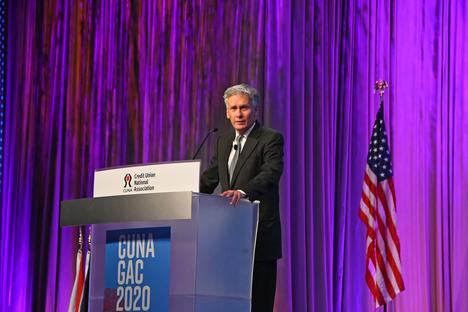
Mark McWatters addresses sale of medallion portfolio during GAC.
McWatters largely repeated a theme he touched on during the most recent NCUA board meeting on the morning after announcing the sale, saying the agency’s statutory requirement to limit losses to the National Credit Union Share Insurance Fund was the primary factor in the decision to sell its portfolio of taxi medallion loans.
McWatters added consumer protection was a major consideration in choosing the winning bidder.
“The NCUA was charged under the Federal Credit Union Act with developing a plan that would yield the least long-term cost to the Share Insurance Fund,” McWatters told the meeting. “We made it very clear to those interested in acquiring the portfolio that the winning bidder must work with the taxi medallion loan borrowers in a transparent, good-faith manner and in full compliance with all applicable consumer protection laws.”
McWatters said NCUA carefully considered a proposal for a public-private partnership to purchase the loans, but said the firm offer already in-hand trumped the fact there was not even a proposed partnership in place, meaning the agency had to act so as not to lose a qualified bidder.
As CUToday.info reported, NCUA sold the taxi medallion portfolio of more than 4,000 loans for approximately $350 million to Connecticut-based Marblegate Asset Management.
$750 Million Loss
McWatters reminded the meeting the NCUSIF has already taken an approximately $750 million loss on the portfolio, and further suggested additional losses would certainly delay future possible Share Insurance Fund distributions to credit unions.
“It is critically important to note we would not have permitted the sale unless we sincerely believed the winning bidder would treat taxi medallion borrowers in a transparent, good-faith manner,” McWatters said. “If we were to have delayed the disposition of the medallion loan portfolio, there is a substantial likelihood the agency would have to forego distributions to credit unions for the immediate future, if not longer.”
Other Points
Other points touched on by McWatters during his remarks:
- McWatters said NCUA has worked to become more transparent and active in reducing regulatory burdens. “We have enacted thoughtfully tailored and targeted rules aimed at the actual risks present by the credit union system to the Share Insurance Fund,” McWatters said. “I am pleased to report we have made substantial progress as an agency in a spirit of collegiality and collaboration.”
- McWatters spoke to the issue of credit unions purchasing the assets of community banks, saying, “It is worth considering whether credit unions and community banks could benefit from a ‘Come now, and let us reason together’ approach.’”
McWatters said a number of misperceptions have arisen, in large part over bankers’ objections to the credit unions’ statutory federal tax exemption, about the purpose and the result of the relatively small number of transactions each year where credit unions acquire bank assets or liabilities.
“We should remain mindful that it is not intellectually possible to discuss the credit union tax exemption in a fair-minded and objective manner without acknowledging the additional statutory restrictions placed on credit unions and the absence of such restrictions on community banks, notwithstanding their ability to avoid corporate-level taxation by making a taxpayer-subsidized Subchapter S election,” McWatters said. “These transactions reflect market forces and are negotiated in an arm’s-length manner. The NCUA should respect the independent, market-driven decisions of the interested parties, unless safety and soundness, consumer protection, and related matters indicate to the contrary.”
- McWatters noted that during his 40-year career he has seen several financial crises, which is why adequate liquidity and capital and the necessity of avoiding concentration risk remain paramount to him.