

WASHINGTON—When it comes to litigation threats, credit unions are facing more of the same, some very new threats related to COVID-19, and a somewhat forgotten legal threat that has returned to threaten again.
That’s according to a number of experts who told a session during CUNA’s GAC that not only has the pandemic created a new way of living and working, it has also brought new types of lawsuits employers’ way.
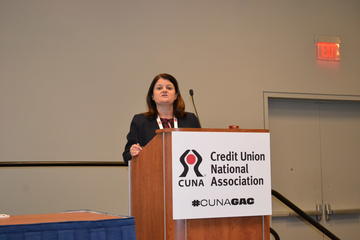
Cristina Miller
While that threat is new, an ongoing issue for credit unions remains, lawsuits related to overdraft policies (given new life by recent media and regulatory attention to overdraft pricing), as does another issue that remains very much a risk, litigation related to the Americans With Disabilities Acts (ADA), according to lawyers who addressed GAC attendees.
David Jolly, partner at Reed & Jolly, PLLC, described what is happening with lawsuits against employers related to COVID-19 as an “explosion.”
“There has been a lot of attention here,” Jolly said, calling the threat to employers, including credit unions, a “latent risk.”
“March 12th of 2020 was the first COVID-related lawsuit filed and that was only days after everybody in the U.S. knew what this was,” noted Jolly.
According to Jolly, since that date more than 5,290 lawsuits related to COVID matters have been filed against employers, among which are 600 class actions.
Jolly reminded how class-action suits present a very large, expansive threat, compared to a suit from individuals.
“Class-action suits are designed to bring in as many people as possible,” he reminded.
The Top 4
Jolly said the state with the highest number of COVID-related suits is California, with New Jersey, Florida and Ohio rounding out the top four.
Jolly explained that at the heart of the COVID-related cases are issues related to working from home and, now, employers bringing employees back on site.
“There are many landmines related to bringing people back,” he said, adding that much of the COVID-related litigation alleges employer retaliation.
Jolly advised CUs to conduct quality assurance in this area, understand clearly what they are telling employees to do, and carefully review employee handbooks.
Overdraft Litigation
While the threat is not new, overdraft lawsuits are also not slowing down, said Cristina Miller, partner at Styskal, Wiese & Melchione, LLP.
“Litigation, here, for the most part has really turned into what we call cases alleging consumer deception and abusive practices,” said Miller. “It’s about not really telling consumers what you're doing, not disclosing accurately what you are doing…Make sure that all your disclosures accurately describe what your systems and process say, and that's going to require your compliance team and your marketing team to review them. Just tell your members what you are doing and then do that.”
ADA & Websites
Before Miller handed off her part of the session she added that lawsuits that have plagued credit unions in recent years, specifically related to access to websites and alleging ADA violations, have returned.
“Yes, they unfortunately are back,” she said. “I don't know what happened, maybe during the pandemic they just took some time off. But some of my clients have had complaints filed against them in the last two weeks…And since November there have been 100 of these lawsuits filed in California. Again, they appear to be coming back.”
Miller urged credit unions to make sure their websites are compliant with updated ADA website guidelines, some of which focus on readability of pages.