

WASHINGTON–After presenting a picture of a future that may be intimidating and even frightening to many people, one person who is making some big investments in that future told a credit union audience they should instead be excited about what is to come.
Peter Diamandis, the founder of the X Prize, cofounder of Bold Capital Partners, co-founder and vice chair of Cellularity, Inc., and the author of numerous books told CUNA’s GAC people should be “excited” over what is just around the corner in his view.
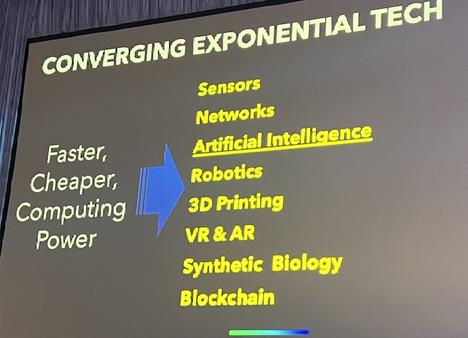
Diamandis specifically focused on two areas he said are passions (and investments) of his: AI and human longevity. He said the world is undergoing “exponential steps” in both areas, and he urged attention to AI robotics, 3D printing, AR/VR blockchain, genetics and more.
“Today, it's the convergence of two, three or four of these that is reinventing our future, it's transforming business models…The technology we're using and creating and funding is either disruptive stress or a disruptive opportunity.”

Peter Diamandis addresses GAC
Taking a Picture Doesn’t Always Last Longer
As a reminder to credit unions about company that didn’t embrace change while staying true to a core mission, he cited the oft-quoted example of Kodak, once one of the dominant brands in the country. “Kodak’s failure was it thought it was in the paper and chemicals business, and not as its founder had intended, in the preservation of memories business,” he said. “This is the question you have to ask yourself. What business are you really in?”
As a more contemporary example he pointed to Amazon, which is in the very simple business of anything that is cheaper, faster and/or offers more variety.”
The Meta Trends
Diamandis urged CU leaders to pay attention to several meta-trends:
- Abundance Mindset. “Technology is the force that turns whatever was scarce in the past and makes it abundant, he said, citing energy as an example by noting the sun provides 8,000 times the sunlight earth needs every day. Solar and battery storage are soaring, he said.
- Abundance of food. “It turns out one-third of the non-ice land mass of the planet is used for chickens and pigs and cows. Can we continue to increase land and feedstock for protein?” The future, he said, is lab-grown meat. Lab grown chicken breasts are $3.90 each, with 10x higher yields with 80% less greenhouse gas emissions. He also pointed to vertical farming as another example, including farms inside urban areas and cities.
- Robots. He cited a recent X Prize Foundation competition that featured a robotic avatar being driven at some distance by a person in a VR helmet and haptic suit. That kind of tech will help people to assist aging parents, go into nuclear facilities and work in labs without actually being there, he said.
The Coming AI Revolution
Diamandis said the AI transformation that is coming is not 20 years or even five years away; in the next two to three years the world is going to see a dramatic change in how AI affects our lives.
“There will be two kinds of companies at the end of this decade: those that are fully utilizing AI, and those that are out of business,” he said.
Like several other speakers at GAC and GAC-related events, Diamandis pointed to the revolution being created by ChatGPT, which has scanned and looked at everything on the Internet and built a statistical model of what is likely to come next. He cited one futurist in whom he has great faith who is predicting that by 2039 the world will achieve human-level AI. Already, he added, it is being suggested that every business and profession prepare for having an “AI copilot,” including doctors.
Record Growth
He noted that ChatGPT went from zero to one-million users faster than any other platform or app by hitting the milestone in just five days. It hit 100 million users in two months.
Two months after rollout, ChatGPT passed the U.S. medical licensing exam. It also passed the bar exam and the finals for the Wharton MBA program, he said, noting 7,000 medical journal articles are published every day.
“How many articles has your doctor read today? ChatGPT will read them all,” Diamandis said.
How to think about Generative AI
Diamandis told CU Leaders they should think of Generative AI in three ways:
- Ideate. Use AI to start brainstorming individually or with teams.
- Create: Use Ai to write content, visualize/audio, write code.
- Customize: Use it to create general material for specific uses.
“One of the things we are all bombarded with is too much information,” he said. “Imagine if you had the ability to have an AI that could summarize it and tell you what is useful for you in a video or article.”
Longevity & Health-spans
Half of the investments made by Diamandis and his fund are in biotech and longevity.
“Health is the new wealth. If whales can live to 200 and Greenland sharks to 500 years, why can’t we?” he asked. “We have the same genes when we are born as we do on our 100th birthday. Why do we look different? It’s about epigenetics: which genes are on and which are off, and when? We are heading to a time when we can control that.”
Among Diamandis’ investments is a company called FountainLife that is invested in aging and disease. It offers full-body MRIs that look for any sign of disease at all.
While Diamandis said his goal is to de-monetize and democratize healthcare, access to FountainLife is $19,000 a year. For that reason he has also created Fountain Health Insurance, which at the same price companies pay today for health care will give employees an “annual upload” at no additional cost.
Life is Short, Until…
“Fire insurance pays you after the fire. Life insurance pays you after you’re dead. Health insurance pays after you’re sick,” he said. “The goal here is to prevent disease in the first place and to massively disrupt health insurance.
“To me, the world’s biggest problems are the world’s biggest opportunities. Remember, life is short—until you extend it.”
It’s Called Fresh for a Reason. And We Offer Home Delivery. For Free!
The biggest, best and freshest news reporting in credit unions remains free in ’23! Each morning CUToday.info delivers its daily Fresh Today news update offering the latest headlines and breaking news right to your email, with the easy-to-read headlines format allowing you to click on the stories that interest you most in order to learn more.
If you haven’t yet signed up for the new email solution on which CUToday.info has partnered with ResponseGenius, you can do so here. Signing up requires less than one minute of your time—and it’s free!
Please note that after signing up you may need to go to your Spam/Junk folder and mark the morning headlines email as safe. CUToday.info does not provide its list of readers and emails to outside parties, and we will not be contacting you to sell you an extended warranty or sending you any links so you may cash in on an inheritance you didn’t know was coming.
And did we mention it’s free?
Please note and/or make your IT department or email administrator aware the emails will be coming from the domains CUTodayinfo.com and CUTodayinfoReply.com