

WASHINGTON–For a lesson on “improving service to women,” CU leaders gathered here were offered an example from 4,100 miles away.
Sophie Romana, lead gender specialist and SME finance consultant for the World Council of Credit Unions’ Gender Lens Investment for Credit Unions Activity in Senegal, shared insights on what has taken place in that country as a concerted effort has been made to offer women financial services and benefits.
WOCCU has been piloting a project in the company.
Financial inclusion is about trying to tackle those who do not have a bank account or a mobile money account, according to Romana. Instead, she said, it’s about helping women to get access to financial services so they can run their businesses, run their households and be better off overall.
It’s no small market globally, according to Romana, who cited data showing that of the 1.7-billion people on earth who are unbanked, 56%, or 980 million, were women as of 2017.
“When the economy does not work for women, the world is leaving $12 trillion worth of growth on the table,” Romana told a session during CUNA’s GAC.
Romana said the benefits flow both ways, stating that having someone involved in both boards and management lowers the risk of bankruptcy among members, leads to increased operational performance, increases attraction and retention of talent, and leads to more money being spent on innovation.
Where to Start
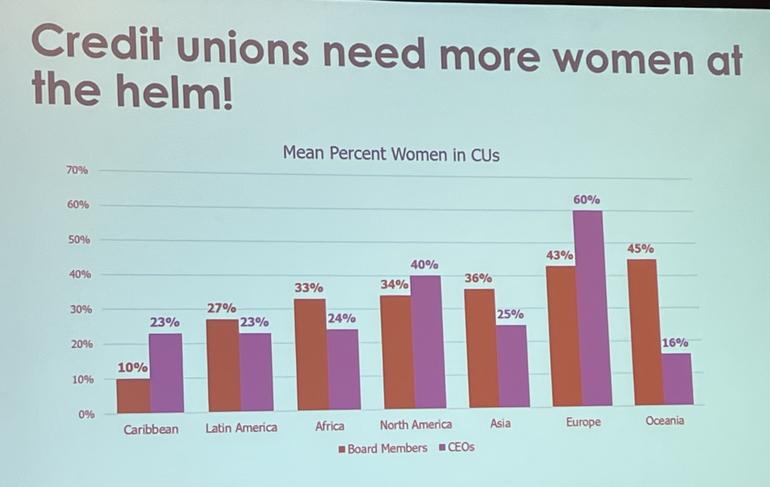
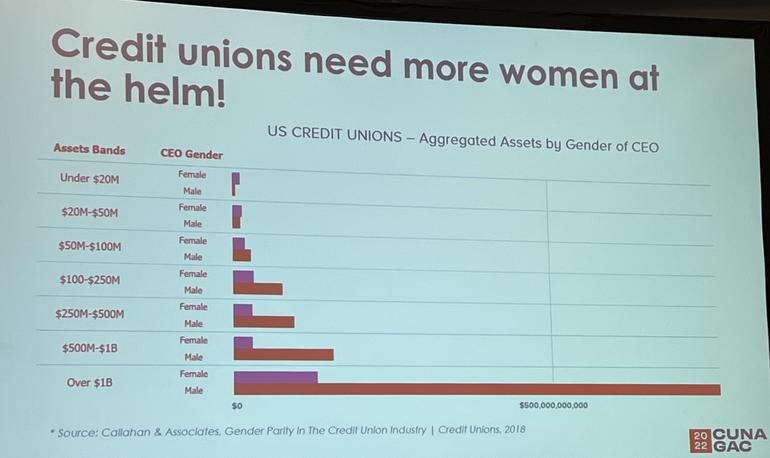
So where to start in making it more equitable for women? First, by recognizing just how little women are represented on the management team, according to Romana
As an example Romana pointed to Senegal, where World Council has a project in place with UM-PAMECAS, an abbreviation from the French for Union des Mutuelles du Partenariat pour la Mobilisation de l'Epargne et du Crédit au Senegal. So-called PAMECAS were created in 1995 as a project implemented as part of the Senegalese government's international cooperative initiative.
Senegal has 2,9870,787 PEMACAS members, a 33.8% penetration rate of the country’s citizens. Seventy-seven percent of those members are entrepreneurs, according to Romana.
Using USAID funds, WOCCU’s project in Senegal has focused on women. Most women in the country lack credit and are stuck in the informal business economy without books or financial records, according to Romana. Most women in Senegal also lack education and training, she added.
In Senegal, WOCCU developed a tool kit that was piloted with four credit unions over two years.
The program sought to use three levers of change, Romana said.
- Improve credit performance, including better credit terms, dedicated loan products and fewer nonperforming loans
- Support for women’s business, which included a formalization kit, trainings and larger loans
- Networking and upskilling, including a Global Women’s Leadership Network sister society, trainings and leadership
Additional Developments
According to Romana, many women didn’t run for the board of the financial co-ops because they didn’t know they were eligible and, further, didn’t believe they were qualified to serve. Yet female members are actually three times less risky than male borrowers in Senegal, according to Romana.
To take advantage of that fact and funnel more money to women, several tools have been developed. Among the tools developed, said Romana, have been marketing surveys, a gender dashboard, a staff engagement survey and credit policy changes.
The gender dashboard made women visible, while credit committees gained an understanding of how much they lend to women, she told the meeting.
The credit unions were able to generate client segmentation data, showing small loans keep families afloat and larger loans create jobs.
The project also led to new credit products that were better adapted to women’s needs, Romana said. Those products had better terms that required less collateral but made larger loans.
Romana said her key takeaway is the project changes the way people talk about women, with a much more positive view and recognition of the critical role of women.
Work to Do, But…
Romana said there is still work to do, especially in changing some regulations and providing more consumer protection.
“To me, the gender lens investment translates the G20 pledge on financial inclusion into something tangible,” she said. “When women do better, our economies all do better.”