

WASHINGTON–Meeting just hours after the CFPB announced its final rule on credit card late fees, a panel here suggested more scrutiny of fees and other consumer issues by the CFPB and other agencies is likely to continue in 2024, given that it’s an election year.
Indeed, panelists, along with others at America’s Credit Unions’ GAC here, suggested it was no accident that CFPB’s new rule was released during the same week as the president’s State of the Union address.
Credit unions were urged to pay attention to not just what is taking place at the federal level, but the state level as well.
Moderated by James Akin of America’s Credit Union, panelists included Jim Hunsanger, chief risk officer with MSUFCU; Leah Dempsey, shareholder and financial services practices chair with Brownstein Hyatt Farber Shreck, and former attorney with CUNA; and John Coleman, a partner at Orrick who spent more than a decade at the CFPB.
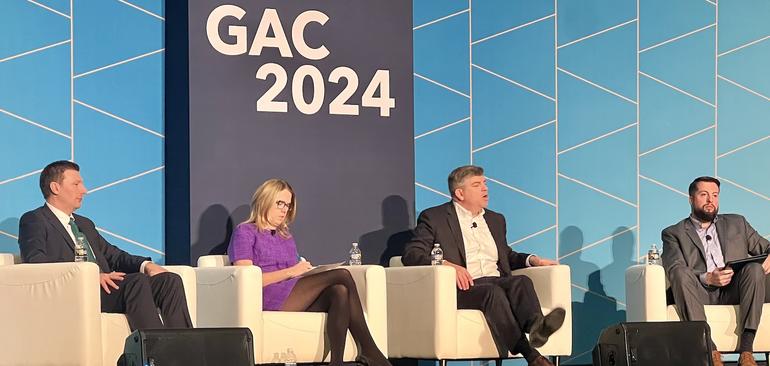
From left, Jim Hunsanger, Leah Dempsey, John Coleman and James Akin.
Here is a look at what was discussed:
Q: What is a junk fee?
Coleman: The White House says a junk fee is a mandatory fee that is not disclosed, which does not describe a credit card fee or an overdraft fee. I think really what a junk fee is whatever the government decides to call a junk fee.
Dempsey: I agree. It depends on the agency, the definition of UDAAP, polling for the next election. One thing to notice is that much of what is called junk fees have been around for decades and have never been called a junk fee until this administration.
Hunsanger: We try to inform our members of all fees. We try to be as transparent as we can and provide options to our members for a great experience from a service perspective.
Q: Why now? What is the impetus?
Hunsanger: I think it’s ideological and pollical motives. I think here are elements of ideology about how much consumers in general should take responsibility for the services (they use). And some financial institutions are not operating in the best interests of consumers. In today’s political environment it’s also an opportunity to speak to some constituencies.
Dempsey: Ever since the Supreme Court decision challenging the CFPB director, who now serves at pleasure of the president, we have seen a shift to a more political agency. We have seen these campaigns that align with election items.
Coleman: I think there is a reasonable policy argument to made about fees that are mandatory but not adequately disclosed. But not in the consumer financial services space. Since 1968 credit unions and FIs have been required to disclose any kind of fee clearly and conspicuously. This strikes me as entirely political.
Q: Having worked at the Bureau, talk about the perspective at the CFPB on fees during your time?
Coleman: I can’t really ever recall an initiative on fees. Anytime consumers have to pay anything in the form of a fee or an interest charge, it was something the Bureau was concerned with. The CFPB was mostly concerned that consumers are not being surprised by those fees. In large part, consumer federal financial law does not allow the agencies to set the price. In fact, it specifically limits setting usury limits.
Q: The federal government has a general perception of junk fees, but what is the purpose of fees in not-for-profit CU industry?
Hunsanger: When it comes to fees, we start with our members first. What services do our members need, and how do we deliver them effectively and transparently? As we develop strategies, we ask how to make this a sustainable offering to our members. As we price out we look at some form of cost recoupment. There is always an element of risk transfer, such as credit risk and storage risk with safe deposit boxes. There are maintenance fees on supporting all of these services, as well. And at the end of the day we don’t want any services we provide to be eroding income and capital.
Q: President Biden’s mention of junk fees in 2023 State of the Union kicked things off. What is the 30,000 foot view of what we’ve seen?
Dempsey: The press releases from the White House and CFPB have been coordinated. There has been a host of activity. We see the CFPB final rule on late fees. We’ve seen guidance and proposal on overdrafts. We’ve seen an opinion on convenience fees in debt collection. There is a new UDAAP proposal that came out that has widened consequences, particularly for state charters. Interchange has been a big issue this year. And there are others, as well.
Q: How are the states looking at this?
Dempsey: The California AG just put out a letter warning any bank or credit union offering overdrafts that it might be subject to a state law similar to ADAAP. I believe in state legislatures right now there are about 12 bills similar to what has happened in California. It’s not an accident. The CFPB pretty much deputized the states a year ago with some of the guidance they put out urging state AGs to get involved.
Q: There are several challenges to the Supreme Court over deference given to agencies. What can you tell us?
Coleman: There is a challenge pending in the Supreme Court on the CFPB’s funding structure. The rainy day news is that most folks who heard the oral arguments think the CFPB is going to survive that challenge. That doesn’t mean it always enacts rules that are within its statutory authority and are reasonable. and the (Administrative Procedures Act) will continue to be the means to challenge those rules.
The court is now considering the legitimacy of the Chevron Doctrine and whether Congress presumed to defer to an agency’s judgement where rules have ambiguity. That ruling could be on the cutting rule floor.
Q: Is the agency looking at credit unions in a different way? What is the perception?
Coleman: I think from the CFPB’s perspective, most credit unions are not subject to its supervisory authority, so it doesn’t really have that opportunity to learn on the ground in the way it does with banks over $10 billion in assets. It is very critical for institutions not above $10 billion to be very active in the rulemaking process, because that is your only opportunity for your voices to be heard.
Dempsey: I think often the Bureau isn’t thinking about some of the unintended consequences. If you can show particularly that members are being harmed, that should catch the attention of the CFPB.
Q: What’s the impact when service charges can no longer be charged?
Hunsanger: If you think of overdraft in particular, it’s probably going to be a reevaluation of who is eligible to take advantage of those services. Today we make everyone eligible. There could be a reduction in the courtesy pay limits available. Our concern is it’s going to drive those members back to riskier financial solutions, like payday lenders.
It's going to be the same on credit card late fees and how that will impact our services.
Ultimately, it comes down to those service charges are paying for programs we are providing to members and providing them with a whole value of experience. They should not be looked at in isolation but in terms of the whole impact they have, and ultimately they may have to be reduced.
Coleman: The Bureau was a little wishy-washy on its proposal on overdrafts in terms of its intentions. It said it will continue to monitor the market. What we see is once the framework is in place, it’s important at the beginning for those institutions that could be subject to it in the future to engage.
Q: Is there more room for the CFPB to go after more fees this year?
Coleman: It depends on how well it polls. I think we should expect the junk fees initiative to run through November. And it’s not just the CFPB. I think through the election we should see the agencies go full-speed ahead in their efforts.
After the election it will depend on a lot of things, including who is in some of these top seats at the agencies, and what happens in the economy.
One thing that has become really noticeable over the last couple of years is that the Democratic administration’s policies have a way of being farmed out very effectively to states with like-minded attorneys general and governors. So, for those of you in those states there is a likelihood they will continue, even under a Republican administration.
I think it’s important, although tempting, to never give up on the advocacy efforts just because of a change in administrations. I think it’s important to demonstrate why these things are legitimate and how they serve your members.
Now With Free Shipping! The CUToday.info Daily News Email Keeps Getting Better!
The biggest, best and freshest news reporting in credit unions remains free, and now has an added bonus---free shipping to your email address! That’s right. Each morning CUToday.info delivers its daily Fresh Today news update offering the latest headlines and breaking news right to your email, with the easy-to-read headlines format allowing you to click on the stories that interest you most in order to learn more. So stop paying those bank-fee-like subscription prices from other so-called “news” publications!
If you haven’t yet signed up for the new email solution on which CUToday.info has partnered with ResponseGenius, you can do so here. Signing up requires less than one minute of your time—and it’s free!
Please note that after signing up you may need to go to your Spam/Junk folder and mark the morning headlines email as safe. CUToday.info does not provide its list of readers and emails to outside parties, and we will not be contacting you to sell you an extended warranty or sending you any links so you may cash in on an inheritance you didn’t know was coming.
And did we mention it’s free?