

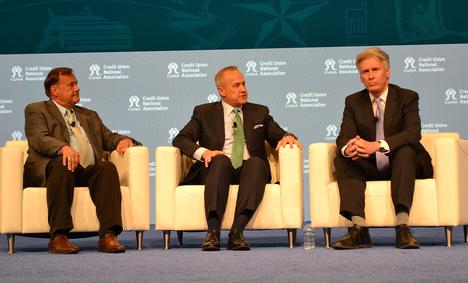
L-R: Rick Metsger, Jim Nussle, Mark McWaters
WASHINGTON—NCUA Board Member Rick Metsger believes there may be a chance to work with Congress to allow federal charters to take advantage of the field of membership rules in place for state charters in their respective states.
During a GAC panel session during CUNA’s Governmental Affairs Conference that also included NCUA Chairman J. Mark McWatters, Metsger told attendees he believes credit unions could get some traction in Washington around a request to adjust the Federal Credit Union Act and allow for a federal CU to also adopt its state’s FOM rules when state guidelines are more advantageous.
He noted many credit unions in recent years have switched from a federal charter to state due to less-restrictive FOM rules.
Metsger emphasized the importance of helping CUs expand their field of membership in order to serve additional underserved areas that are losing access to financial services as banks exit small and remote markets.
“You see more banks leaving these areas, so who is going to serve them?” asked Metsger.
Other Issues Raised
The two board members addressed several topics presented by session moderator Jim Nussle, president and CEO of CUNA, spending a great deal of time discussing how both board members said they have been able to work together cooperatively.
“I wanted to build, with Rick’s help, a culture of respect and professionalism,” said McWatters. “Build a culture in which reasonable minds can differ, but that does not mean anyone is a bad person. We can disagree but go on to collaborate and work through what needs to be done. You don’t just disagree and stop, which is the way it typically is in D.C.”
McWatters said the collaboration has meant striking deals between the two board members, which the two said happened numerous times over the last three years as they worked through their respective chiefs of staff.
Inspired by Aretha Franklin
Metsger, referring to an Aretha Franklin song, said it begins with “R-E-S-P-E-C-T. We have mutual respect for each other. We committed to each other that our responsibility was to the credit union system, to get things done to allow credit unions to serve their members in the ways you need to. And if we failed to do that because we disagreed, then overall we have failed.”
The panel discussion also addressed potential future challenges for the credit union system and for the NCUA. Both board members pointed to increasing cybersecurity risks, fluctuating interest rate risks, changing demographics, growing competition from new financial service providers, and continuing industry consolidation as the most significant challenges for federally insured credit unions going forward.
“All credit unions need to consider whether their product and service mix is consistent with their members’ future needs,” Metsger said. “This will require new ideas and investments in people, processes, and technology. The old ways of doing things will not work in this era of fintechs, mobile banking, and increasing competition. Each one of us, the regulator and the regulated, have a role to play in shaping the future of the credit union movement.”
Investments in Modernization
McWatters added that these challenges mean the NCUA must modernize its examination and supervision program, replace outdated technology and systems, and reduce its regulatory footprint where possible.
“The NCUA has several initiatives in process to improve and modernize how the agency conducts its examination and supervision program,” McWatters said. “This means modifying our processes and procedures, leveraging technology, collaborating with state supervisors, and moving to more off-site supervision. It will take time to develop and implement these improvements and systems, but they will transform how the agency approaches its safety and soundness mission in the future.”
An Example to Follow
Metsger, who will soon leave the NCUA board as Rodney Hood fills his seat and Todd Harper takes the seat vacated by Debbie Matz, said “another” farewell to the GAC.
“At the end of the day, Chairman McWatters and I felt good about our decisions and they were the best ways to go forward,” said Metsger. “I hope going forward this is an example other (NCUA) boards will follow.”