

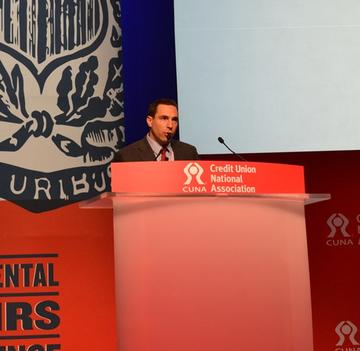
Michael Gottlieb
WASHINGTON—Coordination between CUNA and state leagues in delivering political advocacy messages locally and nationally is making an impact in Washington, according to a new study.
That key finding, from a new study from the National Journal, shows CUNA is ranked No. 1 among financial services associations for political advocacy.
Michael Gottlieb, executive director at National Journal Group, told attendees at CUNA’s GAC that the trade association’s advocacy efforts—thanks in no small part to coordinated efforts among the national and state associations—also has CUNA outperforming other national advocacy groups on the study’s “grassroots” score by 6.7 points.
The study included Republican and Democratic policymakers on Capitol Hill, among them chiefs of staff, and asked questions such as how much how much does an association influence you; is what is shared interesting, helpful and interesting; and what resonates?
Gottlieb said National Journal conducted the study in part through its relationship with policymakers.
He shared a study comment from a Republican House of Representatives’ deputy chief of staff, who said: “CUNA is great. They are regularly in my office. I like how they do their fly-ins. They have fostered a relationship down at the district and those guys contact me.”
Gottlieb told attendees that kind of work, where state level advocacy intertwines with national efforts, is key to influencing policymakers.
Gottlieb shared another study comment, this time from a Democratic House chief of staff: “CUNA is well organized and they hit us from all fronts.”
“This is extraordinary feedback,” said Gottlieb, who said those recognizing CUNA’s efforts on Capitol Hill reside equally on both sides of the aisle.
“Among the financial services association we surveyed, CUNA was the least polarized, and had the highest favorability score among Democrats and the second-highest among Republicans,” explained Gottlieb. “Many trade associations struggle with polarization, CUNA does not.”
Before leaving the stage, Gottlieb said that one of the most important things credit unions can do today is make themselves available at the committee levels in Washington.
“They are hungry for your perspective and your guidance,” said Gottlieb about credit unions telling their own personal stories. “And when you do that in an open spirit of honesty, that is most effective. Policymakers want guidance, but they want factual and truthful guidance. That is what they need.”