

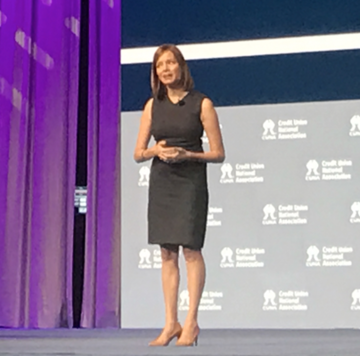
Kristen Soltis Anderson
WASHINGTON–Millennials are much discussed within the credit union community, but one person said the discussion is often off-base or even wrong.
Instead, Kristen Soltis Anderson, author of The Selfie Vote, which analyzed the political habits and leanings of the Millennial generation, told CUNA’s GAC there are five drivers of Millennial thinking to which credit union decision-makers should be paying attention.
She also reminded, “We are not as strange and as alien as you may have been led to believe.”
Indeed, the Millennial generation doesn’t even like being called the Millennial generation, which she defines as anyone born in the 1980s and 1990s. It’s a group of 75 million people that is larger than the Baby Boomers as a share of eligible voters, she said.
What may surprise many about her, she said, is she is a Republican. It certainly surprised her friends, she said, which is why she wrote her master’s thesis on why Republicans were losing young voters.
“I would get a reaction from Republicans that it doesn’t really matter,” she said. “They would say things like, ‘We never get young people and they become Republicans as they get older. Millennials who voted in the last election will vote through 2076. So why would you want to lose out on these voters? This idea that all Millennials are all just one demographic that will wake up one day and become conservatives. And that’s just not true. This is a very diverse generation.”
Soltis Anderson defined the current political divide in the country as one in which there is a “coalition of restoration and a coalition of transformation.” Increasingly, Millennials are in the generation of transformation, she said.
“The coalition that is going to win the future is going to understand these voters who embrace the transformation,” Soltis Anderson suggested. “There are big changes occurring today that are creating winners and losers. We have people with skills very well suited for the future. But there are some who are feeling left behind. They look at technology and economic change and they’re not so sure about it.”
Soltis Anderson urged her credit union audience to pay attention to these five trends:
“As a generation, we don’t really love labels.”
“Why do I have to buy the whole Republican or Democrat album? Why sign up for the whole basket when I am used to picking and choosing? My generation doesn’t feel a need to sign up with anything that has a whole bunch of labels that come with a whole bunch of baggage. Increasingly, Millennials say they are a person of faith, but don’t like a particular denomination. My advice is to be careful with labels and assumptions. My generation doesn’t like ‘isms’.”
“The world in which we grew up has made us risk averse and fearful of commitment.”
“The generation before us and our parents told us to buy a house, the stock market always goes up, and a college degree is the ticket to success. And then we watched the crash; the 401(k) is gone. We took on college debt, but we can’t get the job we wanted. Suddenly, all the things we were told to do weren’t true, and we’re skeptical. It’s why you see a desire among Millennials for home ownership, but also a fear. We have seen the world crumbling around us.”
“Our expectations are all round speed, accountability and transparency.”
“Our world is full of speed. We can now watch the progress of a package and give feedback. Our expectations are enormous. We expect our voice to be heard. If we can make our voice heard about a restaurant or Uber ride, we should have our voice heard in other arenas, as well.”
“Two key values drive us.”
“In all of the data I looked at, there are two key moral taste buds. The way human beings decide what is right and wrong is we ask ourselves a series of questions. What is important to us is care and fairness. We don’t believe marijuana is dangerous, but the Millennial generation is in some ways a Puritan generation with sex, drugs and rock and roll. What they are asking ism ‘Is someone being hurt?’ On other hand, with the environment, they see harm being done and want something to be done about it. Are you taking care of something, and is it fair and just?
“So, what are you doing strategically to address caring and fairness. Millennials want to go work at a place where there is caring and fairness.”
“We want authenticity.”
“Ron Paul (R-KY) and Bernie Sanders (D-VT) have connected the most with Millennials. It’s because of their level of authenticity. The idea someone is being honest goes an enormously long way.”