

WASHINGTON—Stablecoins are quickly moving from the fringes of crypto into the center of the payments conversation, and credit unions are beginning to examine how the technology could reshape both member expectations and competitive dynamics.
That message was shared during a breakout session at America’s Credit Unions Governmental Affairs Conference here. Speakers said stablecoins should be viewed less as speculative digital assets and more as emerging payment infrastructure—potentially offering faster, cheaper and programmable transaction rails that could complement the traditional financial system.
Moderator Andrew Morris framed the discussion around new federal definitions taking shape in Washington, including the concept of a “permitted payment stablecoin” under the GENIUS Act, while noting the National Credit Union Administration is working on a proposed rule that could allow credit unions to engage in certain stablecoin-related activities, potentially through subsidiaries. Panelists said the opportunity for credit unions lies in deploying these new rails in ways that maintain trust, safety and local economic impact for members.
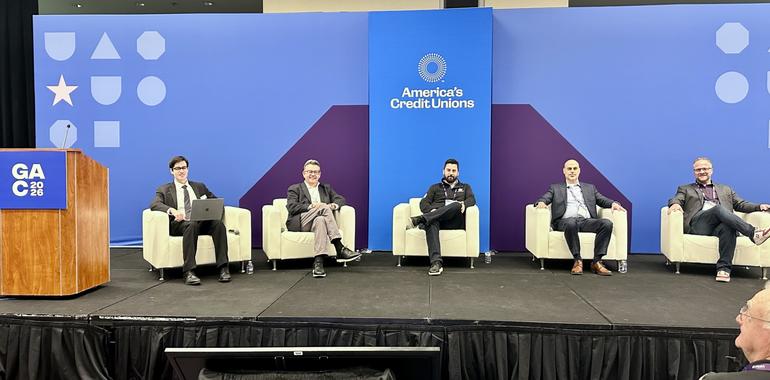
Core Opportunity: Modern Payment Rails + Protecting Member Wealth Locally
Panelists consistently positioned stablecoins not as a niche “crypto product,” but as new payment infrastructure—faster, cheaper, programmable rails that can be deployed in ways that align with credit union trust, safety, and community impact.
Canvas Credit Union CIO David Pierce emphasized practical use cases where tokenized value could reduce merchant fees and strengthen local ecosystems (e.g., closed-loop university/payment communities).
DaLand CUSO CIO/Chief of Staff Jon Ungerland argued stablecoins function as an “off-ramp” from electronic dollars into the broader digital asset world—often a staging point before purchasing other tokens—and stressed the strategic risk of ignoring the broader digital-asset wealth shift.
Metallicus GM John Ainsworth noted that the underlying capability (near-instant, low-cost global value transfer) has existed for years, and the U.S. is now catching up to adoption already underway elsewhere.
St. Cloud Financial Credit Union CEO Jed Meyer anchored the “why” in credit union terms: protecting local wealth and keeping members’ financial lives—and data—inside the cooperative. He shared that his strategic focus began in 2019 as a learning journey, driven by a concern that liquidity leaving for exchanges may not return in a decentralized environment the way it historically did in traditional banking rails. He described credit unions’ advantage as being a trusted, member-owned intermediary. Specifically, one that can provide education, access, and protection while keeping value circulating locally.
Key Risks And Challenges: Education, Interoperability, Regulation, And Consumer Protections
A major theme was the education gap—internally (boards/executives/staff) and externally (members). Panelists cautioned that the conversation is often dominated by “noise” and hype, while real implementation challenges include operational readiness, communications, compliance adaptation, and governance. Pierce underscored that “the tech is easy—operationalizing is hard,” citing the need to rethink how risk concepts like BSA/AML translate in a new rail environment and how to clearly communicate benefits in member-friendly language (faster/cheaper/smoother experiences).
Consumer protection concerns centered on yield marketing (e.g., “4%” on stablecoin accounts) and what consumers may unknowingly give up outside the insured/regulated credit union environment—deposit insurance, established fraud protections, and clarity of ownership. Meyer emphasized “sovereign” ownership concepts (e.g., control of keys/ownership vs. pooled claims on exchanges) and warned credit unions not to outsource this new category of “checking account of the future” to large banks or exchanges in exchange for a fee.
Regulation & Market Structure: Progress, But Speed Matters
On NCUA’s proposed rule and the GENIUS Act implementation, panelists broadly welcomed progress and engagement (and credited NCUA Chair Kyle Hauptman for openness), but argued speed and operational clarity will determine whether credit unions remain competitive. Ungerland warned that large banks are moving quickly beyond stablecoins toward tokenized deposits and custody/lending products, and that fragmentation (many isolated “local coins”) could hinder interoperability and create unnecessary complexity. Panelists encouraged credit unions to engage regulators early rather than waiting for perfect clarity, arguing that “if you wait for regulation to tell you what you can do, you’ll be too far behind.”
Payments Economics: Deposit Outflows And Interchange Pressure
A prominent takeaway was that credit unions should start by measuring what’s already happening: monitor deposit outflows to exchanges and evaluate payments profitability by channel. Pierce noted that for many institutions, debit/credit drive most payments profitability which raises the question of what happens if new rails meaningfully reduce interchange economics. Meyer added a concrete lens: identify top merchant settlement exposure (e.g., major retailers) and consider how retail-driven adoption (discounts/rewards via digital rails) could accelerate member behavior change.
Where The Panel Landed: Act Now, But Act Cooperatively
The panel closed with a call for credit unions to move from “research” to action—starting with education, measurement (outflows/interchange), and a strategy that preserves the member relationship and avoids recreating a “vendor sprawl” problem. Several panelists encouraged a cooperative/network approach (“network effect”) so credit unions can participate at scale, maintain interoperability, and keep the economics inside the movement.
Practical Next Steps
- Educate staff/board first, then build member education pathways
- Monitor deposit outflows to exchanges and quantify interchange exposure
- Evaluate whether your core/architecture can connect to emerging rails without locking into a single “winner”
- Prioritize custody/ownership clarity and consumer protections in any product design
- Engage regulators early and provide informed feedback during comment periods