

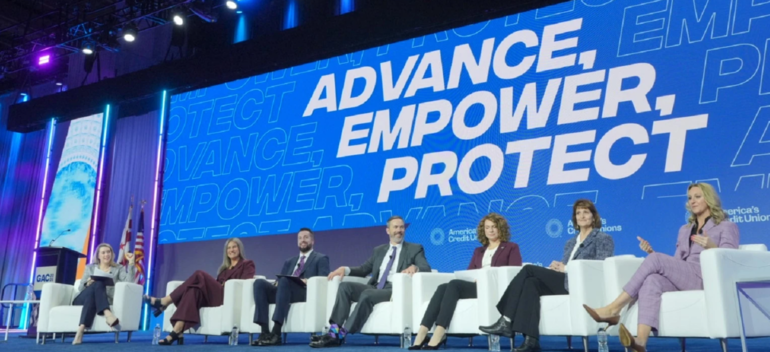
WASHINGTON--Advocacy is not accidental, a panel of America’s Credit Unions, league, and credit union advocates shared with the Governmental Affairs Conference, it is organized, focused, and much-needed, the group emphasized.
The first part of the panel, led by America’s Credit Unions Chief Communications and Marketing Officer Meghan Small, dove into how the national trade association approaches advocacy issues in partnership with leagues and credit unions.
“A major question in advocacy is: what is your relative strength? And the strength of credit unions is in this room,” said America’s Credit Unions Senior Vice President of Advocacy Greg Mesack. “Credit unions have people. They have a mission, a story, grassroots… Every single credit union in this room can walk into a meeting with member of Congress, or to the administration and say: here's what I did this week to make someone's life better. Big banks can’t do that.”
This means advocating in a way to show policymakers that credit unions can achieve policy goals, and America’s Credit Unions Head of Regulatory Advocacy James Akin recalled his experience working with the Administration and how to make meetings stand apart.
“The meetings that stood out were ones that had specific issues that we could fix, and that were framed in a way to show solutions or victories for both sides, the Administration, and for the people asking," Akin said. "Those are the ones that get people to follow up, to get people to say, ‘Hey, that's really interesting, I never thought of that, here are the things I can do about it, please, let's stay in touch and keep this moving.’ If you’re specific, and you make sure that what you are doing is something that can be changed, you're going get a lot further.”
America’s Credit Unions Vice President of Policy Engagement and Credit Union Operations Ann Petros said the key to ensuring a solid grasp on the issues is early engagement.
“The actions that we are asking lawmakers, or regulators, to take or not take today, have a direct connection to the rules that your credit union is going to have to comply with tomorrow. Those specific asks, even if something minor like a reporting requirement, all matter because that's something that your institution has to comply with [...] we want to hear from you about those pain points,” she said. “When we're evaluating a proposed bill or a proposed regulation, getting feedback from you, incorporating those elements early and often, letting us know what you're thinking about a proposal is so valuable. We take that directly to policymakers, directly to lawmakers, and to regulators.”
The credit union-league system is positioned to bring a unified voice directly to policymakers in a way other industries cannot, Ohio Credit Union League Chief Advocacy Officer Emily Leite said.
"The system, America’s Credit Unions, leagues across the states, and then credit unions, we’re all in this together, and the big thing is that we find alignment. We may not be in the same boat, but we’re rowing in the same direction,” she said. “It’s also like a ‘phone-a-friend’ system, we all have emergency contacts, somebody to call if we experience something that looks unique to our state, a credit union, or in Congress. We know we can call each other and have real time support, and that makes us so different. By working together, we're better together, we're stronger together.”
Erin Moore is vice president of community relations at OnPoint Credit Union and head of America’s Credit Unions’ Regulatory Advocacy Committee, a group that recently engaged with multiple members to inform Akin’s recent testimony before the Internal Revenue Service’s auto loan interest deduction.
“Simply put: coordination makes our efforts more powerful. It helps us build a stronger case, and it builds trust, and trust is what sustains advocacy,” she told the panel. “Think about all the incredible change that is happening in financial services, and for our members in terms of what they need from credit unions. And in the midst of all of this, our regulators are still supervising us, one institution at a time, and also taking care of the entire system. Coordination builds the space or the room for all of us to come together, to devise a strategy, and to decide who is best positioned to carry a message forward.”
Amy Broderson, president/CEO of Family Focus Federal Credit Union, urged the audience to keep members in mind during advocacy efforts. Broderson also leads America’s Credit Unions’ Legislative Advocacy Subcommittee.
“Whether you're big or small, or you're a $1 million credit union, or a $2 billion credit union, we all have very similar missions, and our stories are the same. For example, the increase of fraud was brought up backstage, and over and over from colleagues this week. Yesterday it was part of the Small Credit Union Roundtable,” she said. “It's a threat to all of us. It's something we're all engaged in daily with our members. Who better to tell this story than us? We can’t sit this out. We need to be at the table. Your members depend on it.”