

LONDON—Nearly two decades after the 2008 financial crisis rattled households and financial institutions worldwide, a new Gallup survey finds public confidence in banks has not only recovered in the hardest-hit economies but reached a new high.
For institutions that rely on consumer trust to fuel savings and loan growth, the rebound marks a notable shift in sentiment.
The Gallup World Poll, which has tracked public opinion in more than 140 countries since 2006, shows that in 2025 a median 63% of adults across 25 countries most affected by the crisis express confidence in financial institutions and banks. That surpasses the 57% recorded before the crisis and represents a dramatic turnaround from the 40% level in 2009 and the 37% trough reached during the 2012 eurozone crisis.
Gallup defined the 25 countries as those experiencing the largest financial-sector losses between 2006 and 2009, measured by declines in stock-market capitalization relative to GDP and by post-crisis economic contraction. In contrast, countries with smaller financial sectors and less exposure did not see a comparable collapse in trust; in fact, confidence in banks rose in much of the rest of the world between 2008 and 2011. With the latest gains, trust levels in the hardest-hit countries now match those elsewhere for the first time since the crisis.
The survey also finds banks have regained institutional standing. Before the crash, banks ranked among the most trusted national institutions in those 25 countries, second only to the military. After 2009, they fell to levels closer to national governments, often among the least trusted institutions. By 2025, however, banks had climbed back into the ranks of more trusted institutions, alongside electoral systems.
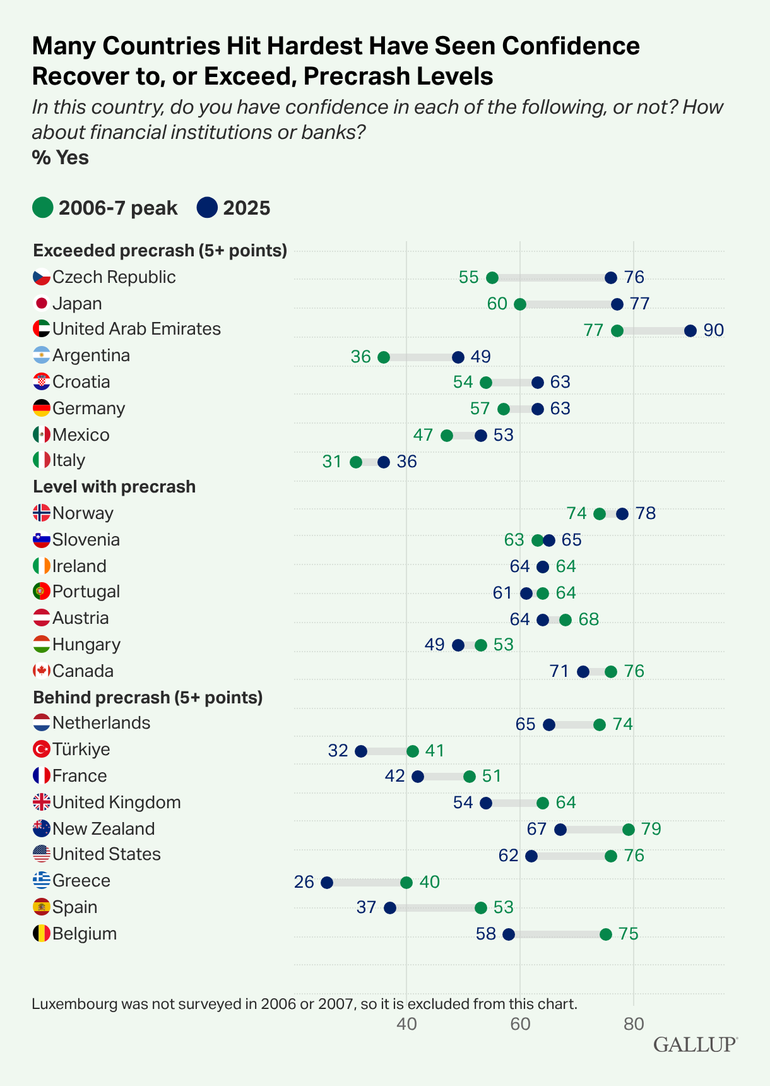
Not Uniform Recovery
Gallup suggests the rebound may reflect more than regulatory reform alone. While many countries introduced tougher capital requirements and supervision — particularly in places such as Ireland, Greece and Portugal — improvements in public confidence appear closely aligned with rising comfort about household income. In other words, as people feel better about their personal finances, trust in banks tends to rise as well.
The recovery has not been uniform. Eight countries — including the Czech Republic, Japan, the United Arab Emirates, Argentina, Croatia, Germany, Italy and Mexico — now post confidence levels at least five percentage points above their precrisis peaks. Seven others, including Ireland and Austria, are broadly back in line with precrash levels. But nine countries remain at least five points below prior highs, among them Belgium, Spain, Greece and the United States, each still at least 14 points under their earlier peaks, the study shows.
Ireland illustrates the volatility of trust. It recorded a 43-point plunge in confidence between 2008 and 2009 and hit a global low of 13% in 2011. Since then, trust has rebounded 51 points to 64%, a striking reversal for a country whose banking sector lost nearly three-quarters of its stock market value and whose economy contracted 9% after the crash.
Gallup underscores why the data matter. Trust underpins the financial system; without it, deposit withdrawals can spark broader instability. The survey finds public confidence in financial institutions is positively associated with GDP growth, particularly in low- and lower-middle-income countries. For banks, the renewed confidence signals a more stable foundation for savings and investment — but Gallup cautions the true test will come during the next economic shock, when it becomes clear whether trust rests on durable reforms or simply on a prolonged period of economic calm.