

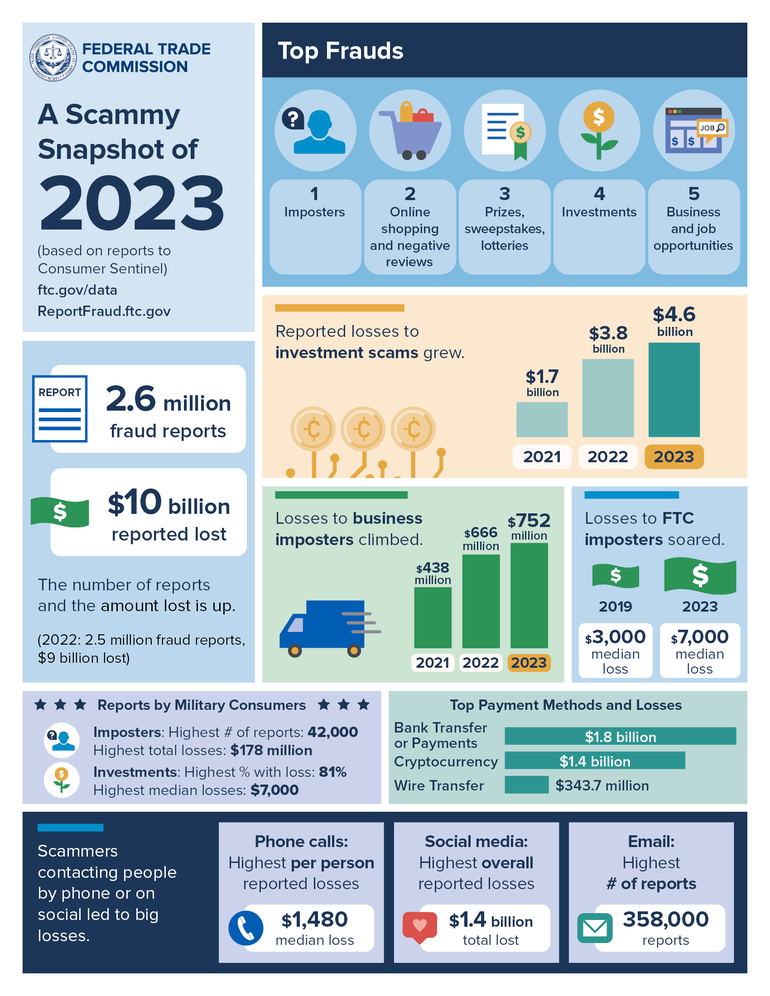
WASHINGTON—Newly released Federal Trade Commission data show consumers reported losing more than $10 billion to fraud in 2023, marking the first time that fraud losses have reached that benchmark.
This marks a 14% increase over reported losses in 2022, the FTC said.
According to the FTC, consumers reported losing more money to investment scams—more than $4.6 billion—than any other category in 2023. That amount represents a 21% increase over 2022.
The second highest reported loss amount came from imposter scams, with losses of nearly $2.7 billion reported. In 2023, consumers reported losing more money to bank transfers and cryptocurrency than all other methods combined.
"Digital tools are making it easier than ever to target hard-working Americans, and we see the effects of that in the data we're releasing today,” said Samuel Levine, director of the FTC’s Bureau of Consumer Protection.
The Most Common Scams
The FTC reportedit received fraud reports from 2.6 million consumers last year, nearly the same amount as 2022. It said:
- The most commonly reported scam category was imposter scams, which saw significant increases in reports of both business and government impersonators.
- Online shopping issues were the second most commonly reported in the fraud category, followed by prizes, sweepstakes, and lotteries; investment-related reports; and business and job opportunity scams, the FTC said.
- Another first is the method scammers reportedly used to reach consumers most commonly in 2023: email. The FTC said e-mail displaced text messages, which held the top spot in 2022 after decades of phone calls being the most common. Phone calls are the second most commonly reported contact method for fraud in 2023, followed by text messages.
Comprehensive Approach
The FTC said it is taking a “comprehensive approach” to detect, halt, and deter consumer fraud, including in 2023 alone:
- Leading the largest-ever crackdown on illegal telemarketing. The FTC joined more than 100 federal and state law enforcement partners nationwide, including the attorneys general from all 50 states and the District of Columbia in Operation Stop Scam Calls, a crackdown on illegal telemarketing calls involving more than 180 actions targeting operations responsible for billions of calls to U.S. consumers
- Proposing a ban on impersonator fraud. The FTC is in the final stages of a rulemaking process targeting business and government impersonation scams
- Cracking Down on Investment Schemes. The FTC has brought multiple cases against investment and business opportunity schemes, including Wealthpress, Blueprint to Wealth, Traffic and Funnels, Automators and Ganadores.
- Confronting Emerging Forms of Fraud. The FTC has taken steps to listen to consumers and build knowledge and tools to fight emerging frauds. “For example, the FTC announced a challenge in 2023 to help promote the development of ideas to protect consumers from the misuse of artificial intelligence-enabled voice cloning for fraud and other harms,” the FTC said
- Stepping up CAN-SPAM Enforcement. “The FTC is using its authority under the CAN-SPAM Act to rein in unlawful actions, including in cases against Publishers Clearing House and Experian, the FTC said
The Best Daily News Email in Credit Unions Remains Free! Don’t Miss Out
The biggest, best and freshest news reporting in credit unions remains free! Each morning CUToday.info delivers its daily Fresh Today news update offering the latest headlines and breaking news right to your email, with the easy-to-read headlines format allowing you to click on the stories that interest you most in order to learn more. So stop paying those bank-fee-like subscription prices from other so-called “news” publications!
If you haven’t yet signed up for the new email solution on which CUToday.info has partnered with ResponseGenius, you can do so here. Signing up requires less than one minute of your time—and it’s free!
Please note that after signing up you may need to go to your Spam/Junk folder and mark the morning headlines email as safe. CUToday.info does not provide its list of readers and emails to outside parties, and we will not be contacting you to sell you an extended warranty or sending you any links so you may cash in on an inheritance you didn’t know was coming.
And did we mention it’s free?