MADISON, Wis.–Capital and liquidity may never be more important to credit unions than they will be during what looks to be a very challenging second half of 2020 and all of 2021, according to one analyst, who said provision for loan losses is going to be a big topic of discussion, as will be negative ROA a year from now.

Steven Rick
Steve Rick, chief economist with CUNA Mutual, who said during a webinar hosted by the CU Leadership Convention observed, “The biggest thing we’re working on as economists is revising down our forecasts every week,” made clear the effects of the coronavirus pandemic mean credit unions are well on their way into one of the most difficult operating environments they have faced in their century-long history.
The webinar was organized to help credit unions plan for the next several years and make adjustments to forecasts that might have been made during planning sessions in late 2019.
If there is any positive news, according to Rick, it’s that credit unions are doing so with some of the highest levels of capital they have ever held. And they are going to need it.
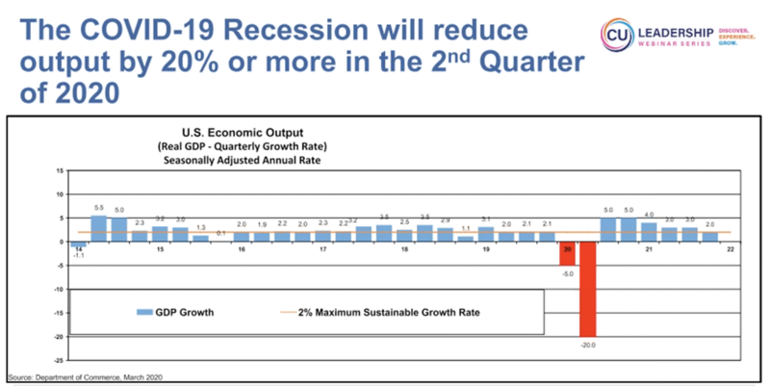
Rick said the best-case scenario is U.S. economic output will be down by 20% in the second quarter, and that figure could be as high as 30%. He is forecasting the economy will grow by 5% in the third and fourth quarters, but the road back is going to be a long one.
The ‘Perfect Storm’
“It’s just not COVID-19, it’s a perfect storm,” said Rick, pointing to four factors affecting the economy:
- Quickly sinking oil prices. “The shale fracking industry is going to be wiped out for a while, as are all the industries that support it,” he said.
- The trade war with China and the European Union.
- Boeing’s massive problems with its 737, which affects numerous suppliers downstream.
- Uncertainty around the presidential election.
The ‘D’ Word
“This is the greatest recession since the Great Depression. If unemployment stays high, we may have to start using the word ‘depression’,” said Rick. “This year we think we could see the economy drop 3.8%, leading to recovery beginning next year. But it’s going to be a slow recovery.”
Rick, who delivered his comments on the same day new figures showed another four-million people had filed jobless claims, told credit unions the unemployment rate is “probably the most important economic indicator right now.”
“We believe the unemployment rate right now could be at 20% and at the end of July it could be at 25%, and it’s going to take a long time to come back down,” said Rick. “We don’t believe it will come back down to 5% for another two to three years. By end of 2021 unemployment could still be around 10%. That means charge-offs will be elevated for the next two to three years. We could see charge-offs roughly doubling from .5% to over 1% and then to 1.5% next year.”
The Hysteresis Forecast
Offering some insights into how the coronavirus pandemic is changing just about everything, Rick offered a “hysteresis”- based forecast. Hysteresis is the degree to which an economic system returns to its original state after an external shock.
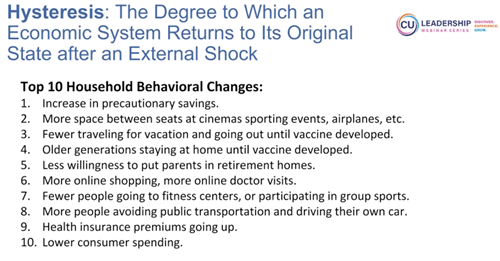
Similarly, he offered a hysteresis-based forecast for the corporate sector.
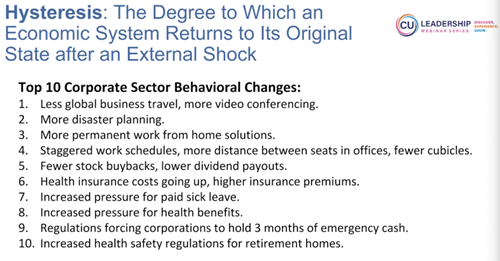
Below is a look at other economic-related issues Rick touched on that will have a strong bearing on credit union operations and profitability in the 18-24 months ahead:
Long-Term Interest Rates
The 10-year Treasury bond, which is a frequently used benchmark and which drives rates on the 30-year mortgage, is currently priced at the “incredibly low” .6%. Why? It’s all due to real interest rates, which are basically at zero, said Rick. “A 10-year bond with inflation means no real return,” said Rick. “Inflation over the next 10 years is projected by bond market to be at .7%. So, that’s why it’s so low.”
Rick is forecasting the 10-year Treasury will remain below 1.5% for the next two years as the Fed works to get unemployment back to 5%.
Short-Term Rates
With the overnight rate at 0.1%, Rick said he sees no movement by the Fed until unemployment is at 5%, “and we don’t think that will happen for three or four years. We expect the one-year CD rate to drop below 1% relatively soon.”
Yield on Assets
Rick said yield-on-assets is the “big item for discussion” right now in credit union. It’s a ratio that has been steadily dropping since 1988, when it was around 10%. It stood at 4% in 2019, and CUNA Mutual is forecasting it will decline to 3.25% at CUs this year, which would be the lowest in credit union history.
That decline is mostly due to the rate effect of falling interest rates, but also to the mix effect (15-20 basis points), said Rick.
In fact, Rick said YOA could fall even further in 2021 as loans reprice.
Auto and Home Lending
CUNA Mutual is forecasting auto sales will decline by 50% during 2020 to approximately eight-million vehicles sold.
“New auto lending at credit unions basically at a standstill,” said Rick. “This would be even worse than what we saw during the Great Recession. Purchase mortgage business will also drop this year by about 30%, but a lot of refi business is still taking place. We don’t expect home prices to drop that much, but both markets are going to take a big hit.”
Loan Growth
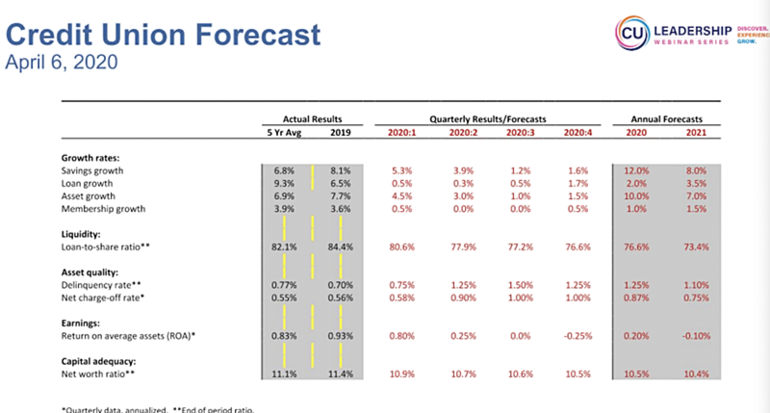
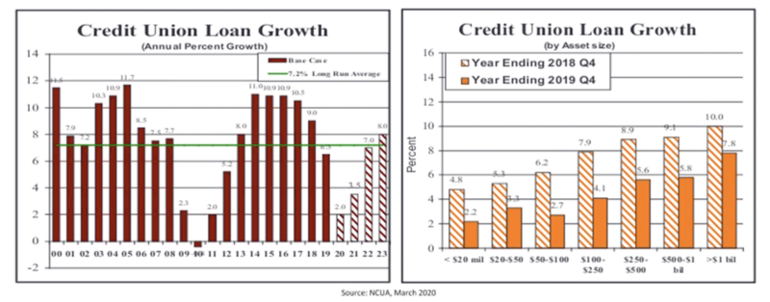
Rick noted credit unions have enjoyed strong loan growth for the past four to five years, when it grew by as much as 11%. Loan growth at credit unions declined to 6.5% in 2019, and CUNA Mutual is forecasting it will sink to just 2% growth in 2020. By 2021, Rick expects loan growth to improve to 3.5%, and then by 2022 to be back to a “normal” 7%.
“Overall, people are going to be saving more and not spending,” he said.
Net Interest Margins/Operating Expenses
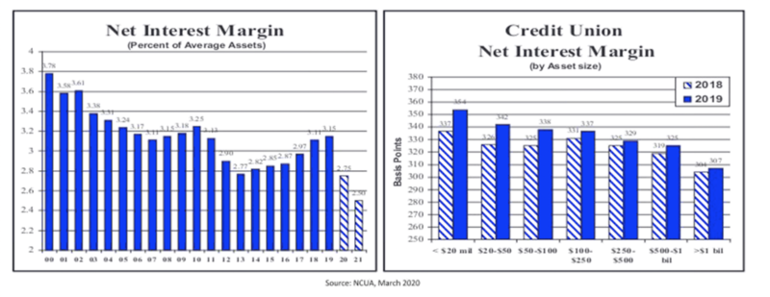
Rick said credit unions should expect their net interest margins to be approximately 2.75% in 2020 and 2.50% in 2021, down from 3.15% in 2019.
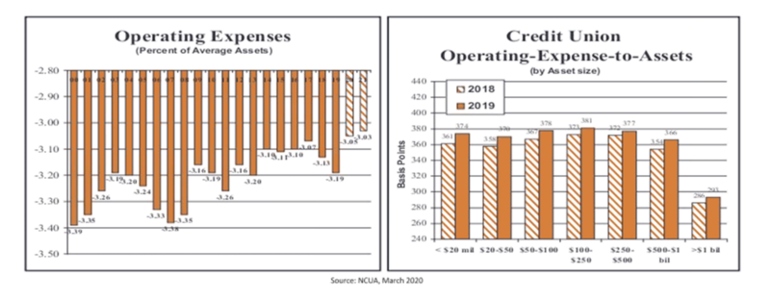
That 2.5% is going to be below credit union operating expenses in 2021, acknowledged Rick, adding, “So, in a sense, credit unions are underwater here.”
Rick said operating expenses at CUs will fall to 3.05% in 2020 due to the denominator effect and then to 3.03% in 2021.
Income
Rick’s forecast calls for the fee income ratio to continue to decline to .58 in 2020, especially as credit unions waive fees. Other income, such as interchange—which was down 35% in Q2—will also decline, as consumer spending remains weak.
“Offsetting the income drop a little bit will be the strong mortgage refi’s that are taking place,” Rick said.
Provision for Loan Losses
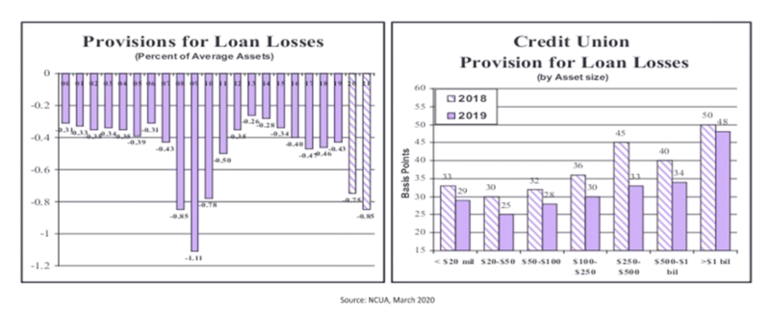
There is a “lot of uncertainty” around provision for loan losses, according to Rick, who expects the subject to be top of mind at many credit unions. He expects the industry average provision to double in 2020 to 0.75% and to increase to 0.83% in 2021.
ROA
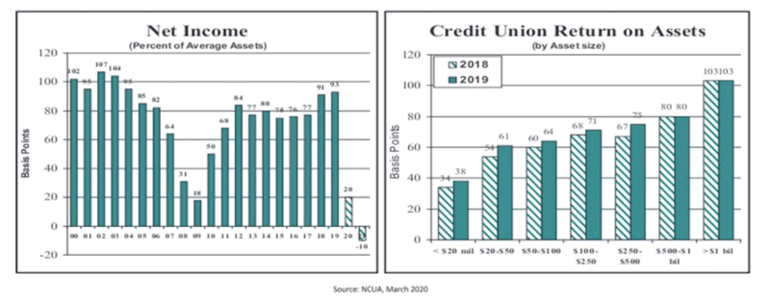
2019 was a “good year,” said Rick, with ROA at .93, the best year since 20024 for credit unions. This year he expects ROA to decline to .20 and in 2021 to be a negative .10 due to loans rolling over and interest rates remaining low in a weak loan market.
“That would be the lowest this industry has ever seen,” said Rick. “This is the most dire chart we are putting together right now.”
Membership Growth
After years of surging new members at credit unions, including 3.6% growth in 2019, Rick expects membership will be up a modest 1% in 2020 and 1.4% during 2021-23.
The reasons have to do with why people join credit unions, said Rick:
- To get a loan
- They got a new job
- An indirect loan from a credit union
“All those indirect auto members we picked up in the last three or four years are going to be paying off their loans, and once they do that they typically close out their account,” said Rick. “It’s going to be weak the next couple of years.”
Capital
If there is one piece of good news, said Rick, it’s that “credit unions are sitting on a lot of capital.”
CUs in the U.S. closed at 2019 with an average capital ratio of 11.4%, which he observed was exactly the same ratio as when credit unions entered into the Great Recession. “We expect it to drop by one percentage point through the end of 2021,” he said.
Economic Recovery
Rick threw some water on those counting on a quick economic rebound.
“This is going to last a lot longer than many expect,” said Rick. “This is not going to be a V-shaped recovery. It’s going to take a lot longer to recover from this.”