NEW YORK–At least 30 banks nationally will earn as much in income from the Paycheck Protection Program as they reported in net revenue for all of 2019, according to one new analysis. But there’s a big caveat: it has been a “massive headache” for many, and bigger problems could be ahead for lenders.
“Policymakers have repeatedly changed the guidance, several small businesses have filed lawsuits alleging banks favored larger clients, technical issues forced long hours, and the forgiveness process remains deeply uncertain — raising financial, legal and reputational risks,” noted S&P Global Market Intelligence in a new report.
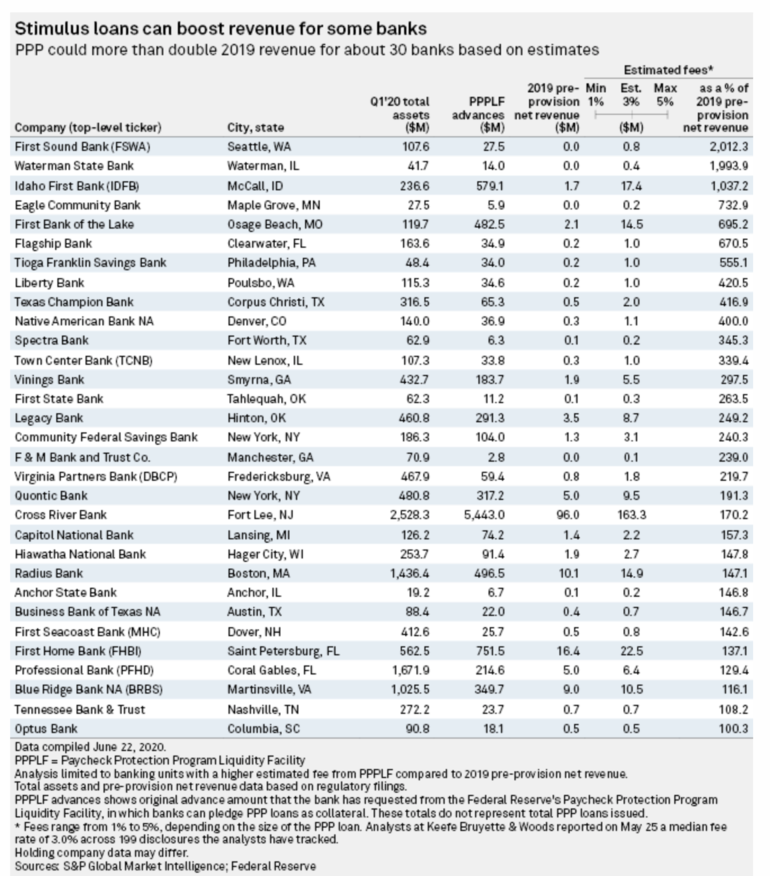
S&P Global noted the PPP fee ranges from 1% to 5% of the loan amount, depending on loan size, and analysts at Keefe Bruyette & Woods who have tracked PPP fees across roughly 200 banks reported a median fee of 3%. “If their fees do fall at the midpoint of the range, dozens of community banks that have been particularly active in PPP could generate total payments from the program that would surpass their pre-provision net revenue in all of 2019,” according to an S&P Global Market Intelligence analysis that examined PPP totals from the Federal Reserve's liquidity facility disclosures.
"It could be enormously profitable for us, maybe the most profitable thing we've done," Rick Wayne, president and CEO of Northeast Bank, which booked a $9.8 million gain from selling its PPP loans, told S&P Global. Northeast could earn as much as $4 million more from the program in additional PPP loans and as a correspondent lender.
Might Not Be Enough
But it might not be enough. S&P Global pointed out the liquidity facility disclosures can include PPP loans that banks have purchased, which would not yield an origination fee that can boost the revenue depositories earn from the loans. Also, the fee estimates in the analysis do not account for other costs incurred by the bank, such as payments to lead-generation companies or technology purchases to handle the process.
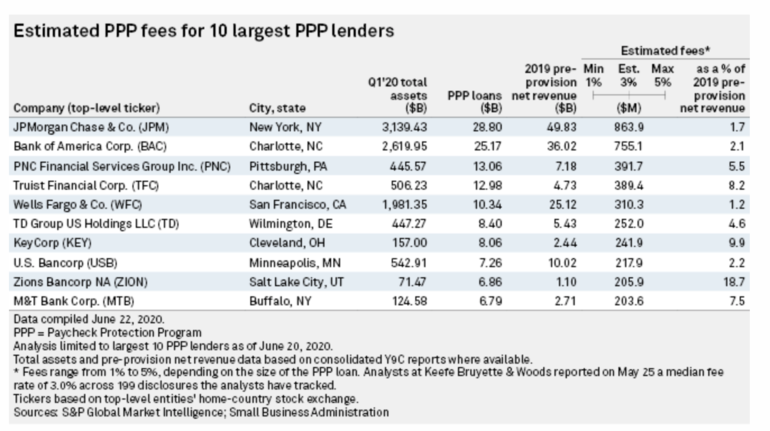
“Still, for many small banks — those with assets under $250 million — the program can be a significant windfall. A handful of banks with more than $1 billion in assets would also surpass their pre-provision net revenue in all of 2019 with just PPP fees,” S&P Global said. “The nation's largest banks have processed significantly more PPP loans, likely yielding hefty fee totals. But with much larger revenue bases, the fees will represent a modest boost to the top line. JPMorgan Chase & Co. issued the most PPP loans out of any bank, processing $28.80 billion of loans as of June 20. That could yield the bank $863.9 million in fees, or roughly 2% of the bank's pre-provision net revenue in 2019.”
Risks & Costs
S&P Global observed that while many banks will book millions in PPP fees, the program carries risk and cost.
“JPMorgan is one of several large banks facing class-action lawsuits over their handling of the program,” S&P Global reported. “Banks are responsible for deciding whether a borrower has met forgiveness qualifications. Guidance from the Treasury Department and the Small Business Administration has changed multiple times, creating work and confusion.”
The report added the Office of the Comptroller of the Currency flagged PPP lending as a potential distraction for compliance with the bevy of regulations banks have to follow on a regular basis.
"I absolutely see liability risk," Rob Klingler, a partner for Bryan Cave Leighton Paisner who advises financial institutions, told S&P Global. "But beyond that, initially it is just the cost of processing the applications. Even if you do it right, it might be too costly."
An Answer in ’24 Months’
In addition, lenders can only recognize the fees as the loan pays off, S&P Global reminded. “If a borrower requests forgiveness in short order, the fees should boost third- or fourth-quarter earnings. But if a borrower views the program as a traditional loan and repays it over the course of two years — or even more, as recently issued loans have five-year terms — the fee presents a much less attractive return. An uncertain payday, extra hours worked and potential legal or reputational risk combine to raise the question: Will the millions in fees be adequate compensation?”
"I'll have to answer that question in 24 months," Stephen Carmack, chairman and CEO of Legacy Bank, a Hinton, Okla.-based bank that could earn nearly $9 million in fees after reporting $3.5 million in net revenue last year, told S&P Global. "Our smallest PPP loan is $100 … we probably won't be adequately compensated on that one."