

SACRAMENTO, Calif.–The first report has been published since California’s state-chartered CUs were required to annually report the amount of revenue earned from overdraft fees and nonsufficient funds fees, revealing wide ranges in both the percentages of total income the fees represent as well as the dollars collected.
As CUToday.info has reported, SB 1415 requires CUs and banks subject to the authority of the California Department of Financial Protection and Innovation (DPFI) to disclose the revenue they earn from overdraft and nonsufficient funds fees. The new report is based on 2022 data.
Federally chartered credit unions and banks do not have to comply with the rule.
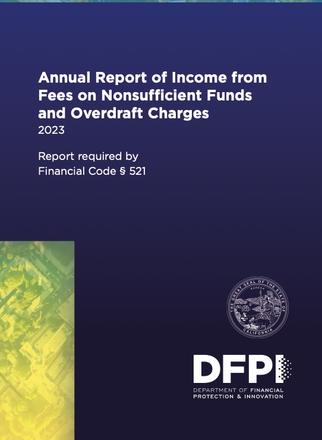
The new report:
- Details income from nonsufficient funds, income from NSF fees as a percentage of net income, and income from NSF fees as a percentage of total income
- Details income from OD fees, income from OD fees as a percentage of net income, and income from OD fees as a percentage of total income
- Details income from NSFs and ODs in total in the same categories
Overall, the report shows state-chartered CUs during 2022 took in $252 million in overdraft and non-sufficient funds fees, and that 30 credit unions earned half or more of their net profit from just overdraft and NSF fees.
ODs/NSFs As Largest Percentage of Income
The report identified the $186-million First Imperial Credit Union in El Centro at as showing ODs + NSFs represented the largest percentage of its total income at 15.37%, followed by the $200-million Priority One Credit Union in South Pasadena at 13.21%, the $1.35-billion Frontwave CU in Oceanside at 12.17%, El Monte Community CU at 10.87%, and the $404-million Cabrillo CU in San Diego at 10.36%.
ODs/NSFs by Largest Dollar Amounts
In terms of dollar amounts, not surprisingly, the leaders are all billion-dollar-plus credit unions. The $20.5-billion The Golden 1 Credit Union in Sacramento led the Golden State with $28.75 million in combined NSF/OD income (4.56% of total income from OD/NSF fees), followed by the $12.9-billion San Diego County CU in San Diego at $17.96 million (5.45%), the $8.2-billion Redwood CU in Santa Rosa at $15.84 million (4.90%), the $4.6-billion Educational Employees in Fresno at $15.41 million (9.22%), the $4.7-billion SAFE CU in Folsom at $13.97 million (7.64%), the $4.66-billion California Credit Union in Glendale at $10.6-million (7.04%), the $9.6-billion Patelco Credit Union in Dublin at $9.26 million (2.98%), the $2.4-billion Arrowhead Central in Rancho Cucamonga at $8.88-million (8.7%), the $2.98-billion Credit Union of Southern California in Anaheim at $8.05 million (6.78%), the $1.3-billion Frontwave in Oceanside at $7.8 million (12.17%), and the $3.3-billion California Coast CU in San Diego at $5.97 million (4.49%).
Little to No Income
Fifteen state-chartered CUs in California reported NSF+OD fees comprised between 0% and 50 basis points as a percentage of total income. Those credit unions reporting zero net income from overdrafts/NSFs almost certainly do not offer formal programs, the report states.
About the Data
The report clarifies that “Financial Code Section 521 requires DFPI to publish the fee income as a percentage of net income. However, net income can vary widely. If a bank or credit union reports a loss, the percentage will be negative. If the income is very small, the percentage will be very high, even if the amount of fee income collected is not very large. Conversely, if the net income is very large, the percentage will be very low.”
For that reason, the DFPI said it chose to also present fee income as a percentage of the bank's or credit union’s total income.
‘More Accurate Look’
“This gives a more accurate look at what portion of a bank or credit union’s revenue is derived from fee income based on nonsufficient funds and overdraft charges, the regulator said. “Moreover, presenting fee income as a percentage of total income is a better indication of those banks and credit unions that may rely heavily on these fees for their operations.”
The full report can be found here.
Just Because It’s Autumn Doesn’t Mean Falling for Schemes to Overcharge You for CU Industry News. Instead, Try This Crisp Offer
The biggest, best and freshest news reporting in credit unions remains free! Each morning CUToday.info delivers its daily Fresh Today news update offering the latest headlines and breaking news right to your email, with the easy-to-read headlines format allowing you to click on the stories that interest you most in order to learn more. So stop paying those bank-fee-like subscription prices from other so-called “news”” publications!
If you haven’t yet signed up for the new email solution on which CUToday.info has partnered with ResponseGenius, you can do so here. Signing up requires less than one minute of your time—and it’s free!
Please note that after signing up you may need to go to your Spam/Junk folder and mark the morning headlines email as safe. CUToday.info does not provide its list of readers and emails to outside parties, and we will not be contacting you to sell you an extended warranty or sending you any links so you may cash in on an inheritance you didn’t know was coming.
And did we mention it’s free?