

LAS VEGAS–A founder and executive of a successful card processing fintech who also had a close relationship with the failed Silicon Valley Bank offered his thoughts on what the bank’s shutdown and reopening has meant, how the fintech market is evolving, and more.
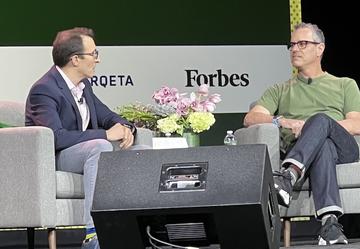
From left, Jeff Kauflin and Jason Gardner.
Jason Gardner, founder and executive chairman of Marqeta, shared his insights during a Q&A as part of the Fintech Meetup event here, which has drawn more than 3,000 people from across the fintech space, with representatives of some 1,400 companies on hand, according to organizers.
Marqeta is a card processing platform that allows institutions to instantly issue and process card payments using an open API platform.
Gardner participated in a Q&A with Jeff Kauflin, senior editor with Forbes. Here is a look at what was discussed:
Kauflin: In terms of Silicon Valley Bank, what do you think is not being sufficiently discussed?
Gardner: You go out and you come up with an idea and you raise money and hire employees and you put that money in the bank, and you expect that money to be safe you expect to be able to pay your employees and pay your bills and build your business—and then there is the stress of not being able to build your business.
I have a lot of friends at Silicon Valley Bank, but what’s not being talked about is the aftermath. We've seen a lot from both sides of the political spectrum. We've seen Treasury and the central bank and the FDIC stepping in and protect depositors. We’ve been talking about the depositors as if somehow they've been bailed out, but this is their money and it's really hard to go build a business and not have access to those funds.
I’ve found over the years that people are more loyal to their money than anything else and when you don't have access to it there is the stress that it causes.
Kauflin: What are the long-term implications?
Gardner: This wasn’t just about Silicon Valley, it was actually felt around the world. It was Tel Aviv, it was New York, it was London, it was Paris. I remember when we raised our first money back in June of 2011. We raised $5.3 million Series A and I thought we were (f’ing) rock stars. I was like, ‘Oh my God, could you believe the evaluation. We got introduced to Silicon Valley Bank and we worked on creating a line of debt and the relationships. Those relationships are paramount now.
Kauflin: What is the effect on Marqeta?
Gardner: We were fortunate. We were already moving to a big bank. Operationally, we were fine. We had an account at SBV, but we were able to operate unfettered. Now we see people again are depending on the large banks. We are a global business, so we have to work with the larger banks to allow us to move money to the 40 countries we work in.
But the mid-market banks work with a lot of entrepreneurs; there is going to be pressure there. The Treasury did the right thing in saying to depositors, ‘You’re going to be OK.’ This gives a lot of confidence in financial institutions.
Kauflin: You founded Marqeta in 2010 and led the company as CEO for almost 13 years. You stepped down as CEO six weeks ago and now you’re executive chairman. Why? And what has changed?
Gardner: I was given a great opportunity with Marqeta to build an amazing business and reach an elite level of entrepreneurship. But I also found a problem in June of last year and that was that I wasn't the right person to lead the business anymore.
Running a public company is incredibly intense and I found that I needed to get on the other side of that. I was very lucky we hired a chief product officer whom I approached and who has been a CEO four times, so he is very connected in the valley. He said ‘I'm going to throw my hat in the ring. I love the culture here. I love the opportunity and I want build this business as CEO.’
It's been six weeks and I find myself tinkering a lot and my brain is finally lifting from the fog of the relentless, day-to-day competitive person that I am and allowing me to think about like what's next for Marqeta, what's next for fintech.
I'm sort of pouring myself into other things. I don't have the desire to break down to go start another business. I have started three companies and would like to move to the next phase of my life.
Kauflin: Marqeta went public in June of 2021. Tech stocks are down. A good number have come back, Marqeta has not. It’s down 30% or so this year. What is driving concerns about Marqeta?
Gardner: I think investors in general are concerned about the market. All stocks are down. Will we see the next bull market go to the heights we saw before? Your guess is as good as mine. The renewal block is an overhang on our stock. That renews in 2024. Now there is a lot of pressure on us.
It’s Called Fresh for a Reason. And We Offer Home Delivery. For Free!
The biggest, best and freshest news reporting in credit unions remains free in ’23! Each morning CUToday.info delivers its daily Fresh Today news update offering the latest headlines and breaking news right to your email, with the easy-to-read headlines format allowing you to click on the stories that interest you most in order to learn more.
If you haven’t yet signed up for the new email solution on which CUToday.info has partnered with ResponseGenius, you can do so here. Signing up requires less than one minute of your time—and it’s free!
Please note that after signing up you may need to go to your Spam/Junk folder and mark the morning headlines email as safe. CUToday.info does not provide its list of readers and emails to outside parties, and we will not be contacting you to sell you an extended warranty or sending you any links so you may cash in on an inheritance you didn’t know was coming.
And did we mention it’s free?
Please note and/or make your IT department or email administrator aware the emails will be coming from the domains CUTodayinfo.com and CUTodayinfoReply.com