

ORLANDO–With pressure to find more non-interest income, especially with market pressures on overdraft fees, three credit union finance professionals shared what they are doing to add to the bottom line.
Their views and insights were shared during a panel discussion at the Finance Council’s annual meeting here.
Participating in the panel were Jeremy Zager, CFO with the $2.3-billion Dort Financial Credit Union in Michigan; Heather Morris, AVP-accounting with the $1.6-billion CapEd FCU in Idaho, and Brittni Terry, AVP-finance and business intelligence with the $483-million OUCU Financial in Ohio.
Here is a look at some of what was discussed.
Q: Tell us about your fees and approach to non-interest income?
Morris: Historically, we have been very fee adverse. We have approached this with the mindset of how can help promote financial wellness and education. So, every single thing we do has to be justified according to how it promotes member well-being and how it actually provides a service.
Every single fee has to be justified. Last year we implemented an entirely new fee structure. We added approximately 30 new fees. Every single fee matched our vision of financial well-being for our members. We want to offer new services, but those bring new costs. If a member is utilizing the service they should be able to help offset part of that cost, because otherwise it's unfair burden on the whole membership.
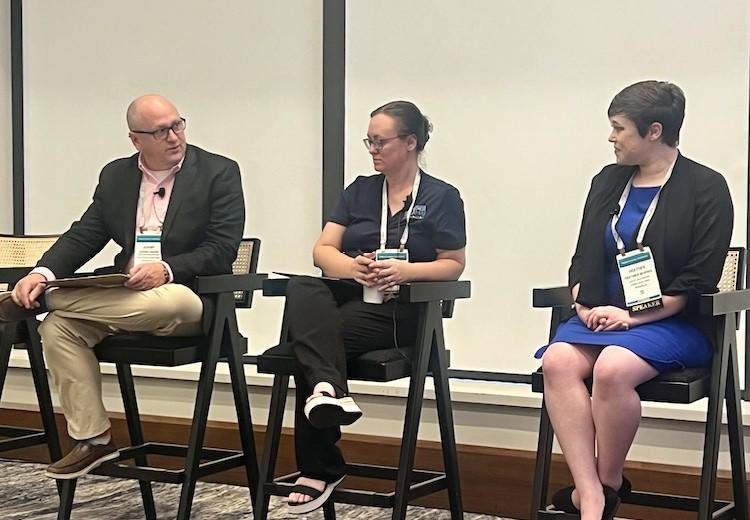
From left, Jeremy Zager, Brittni Terry and Heather Morris.
We also train our all of our employees to help them understand that so they can help pass that information along to members.
Perry: We have a pretty standard fee schedule. We recently had a fee committee review all of our fees and one thing we discussed was overdrafts. Those fees help us to cover those members who don’t pay us back. It’s about loss mitigation.
Zager: Dort’s board is very fee averse. So, we have put a lot of our emphasis on generating fees from third parties and other income sources rather than going back and feeing the membership, even when based on their behavior.
One thing we do is we really focus on transparency on fees with clear and concise documentation for members so they understand why a fee is being charged. Front-line staff has the knowledge to explain how that fee is determined and what it is.
Overdraft fees are very controversial. We have our staff with information on why the fee is what it is and what the member can do to not incur the fee or even opt out. We really make sure we try to keep our fees as simple as possible.
We recently purchased a bank and went through this exercise of reviewing fees. The bank had three different types of fees for remote deposit capture. We changed to one fee. It’s much easier for staff to explain.
Q: How do you keep the focus on members?
Terry: At a certain (minimal revenue) point it makes no sense to charge the member a fee. Another piece we focused on was while one member may be very negatively affected by what we’re doing, paying that fee is about the whole membership.
Morris: We keep our staff informed so they can pass along information. One way we did that with our new fees is I made branch visits to every single branch and explained why we were doing it and then solicited questions. They had a lot of questions. I also did a 10 minute training video that’s available on demand that explains the why behind it. It explains that without fees we would not exist. We walked them through the math of it.
We approach it with mentality of members first and education is power. Our front line staff can empower members.
Q: You have talked about fee assessments and reviews. What has worked for you?
Morris: I think is one of the biggest benefits of having (a third party) come in has been to fine tune it, as it helps keep our fees in line with what our peers are doing. It helps us understand where we are and helps justify those changes. That way we're still taking care of our members and making people feel good that we're still lower than all of our competitors.
Terry: We offer investment services and tax prep services that really help with getting our NII up.
Q: In assessing the viability of your program, do you price it out compared to say, an H&R Block?
Terry: Our manager over tax services is reassessing that. We have been severely underpriced compared to the market to the point it is almost a detriment. Because we do have investment services, where people don’t have the simplest of tax returns, we have been targeting that group because they would generate more revenue.
Zager: At Dort, one thing looked at is interchange on credit cards. We have used our rewards vendor to help us incentivize certain categories where we feel we aren’t getting our share. We upped rewards on online subscriptions and online purchases to (get members to) use their debit and credit cards in those categories.
Visa gives us a lot of good analytic data on where our interchange is coming from, as well as where we overperform and underperform. We have expanded that program for seasonal spending to offer extra rewards. One that has jumped out is we noticed a lot of members having EV charging on their cards. We decided if we are going to promote gas purchases, we might as well promote EV charging.
Another one, and it’s a little scarier so talk to your risk people, is that Michigan is also the capital of online gambling. We found out very quickly if we don’t allow members to use their plastics that way, they will use other cards.
Q: Talk about how you have used relationship pricing and strategies to increase NII?
Morris. That is very top of mind for us right now. We are fine-tuning it. We have worked to build our commercial deposits and lending, and our VP of Treasury management and VP of commercial lending work hand in hand to offer additional services to generate that additional income.
Zager: We don’t participate in a true relationship banking program. We made a strategic decision to provide the same products to everyone and to try to get everyone to use as many products as possible.
We do have a high-rate checking program paying 6.5% on balances to $10,000. To get that interest rate have to have direct deposit of greater than $800, which we set based on the average Social Security deposit that comes in. You have to hit transaction minimums with debit and credit. The average high-rate checking account has more than 35 combined debit credit swipes per month, vs. the traditional product. which has about 13.
There are no fees associated with the product. If they don’t hit the goals, they just don’t earn the dividend that month. It’s a win win for the member and the credit union.
Morris: We have a similar product in high-rate checking. The only difference is you have to have at least six wipes of $5 or more to make sure they are using those cards.
Q: Where are you with overdrafts?
Terry: Currently, we have what we call Privilege Pay. Members can OD up to $750 if they are approved. If they have opted in they pay $30 for each transaction, with a maximum of $150 in fees. You can transfer (funds) out of savings to cover. We also have a $500 line of credit at 18% if you do not incur fees.
Morris: Ours is similar. We did add a new vendor that has an intelligent limiting system. There is a limit on how much they can overdraft that is not a hard cap. The (solution) re-underwrites almost daily based on a number of factors. It assesses risk with each member. Members have other options, such as a payday assistance loan.
Zager: We are at $25 an item with a $500 limit, with the option of a $3 transfer (for funds from another) funding account. The one difference is a long time ago we got rid of the OD line of credit, and now given all the regulatory uncertainty we are thinking of brining those back.
Strategically, we talk about overdraft a lot in terms of where it’s going to go, and one thing we noticed is prepandemic—and we are low income credit union---the opt-in rate for OD protection was about 83%. We did nothing special. But as we kept offering we’ve noticed our opt-in rate is declining. There has been a lot of negative press. Now, only about 63% have opted in. Most of the opt-ins have occurred after they have had something rejected.
We did realize that our limit is too low at $500 and we are currently in the middle of a project to increase limit to $1,000. One thing we’re trying to gauge is how much will that increase the income, now that we have to disclose that (to NCUA). We don’t want to see OD income spike. We’re trying to figure out how can we increase the limit, lower the fee and keep it revenue neutral.
Terry: Our fee committee discussed if we turned off overdraft option a lot of members could have their mortgage hit and they are $100 short and now their mortgage isn’t paid. If we turned it off, they will incur fees on the other side.
Morris: A lot of members use it as a liquidity tool. Many need it for their cash flow. That’s where the education comes in on how to use appropriately. It’s much better to pay $27 OD fee and have mortgage payment made.
Q: How do you make sure it is appropriately administered?
Morris: A lot of it is front line communication. We send out all the appropriate communications that no members open and no members read. So, most of how we communicate it is through our branches.
Terry: We are also very focused on training. We have meetings with the front-line staff so they understand what the program entails.
Zager: We don’t get into fights with members. We refund fees very generously. We do ask our people to gauge when refunding fees if this the right product for the member.
Morris: We have a team that will reach out to members to help adjust their products.
Q: What else are you doing?
Zager: One of our big NII initiatives is that in Michigan cannabis is legal and we have made the decision to serve the cannabis industry with deposit and loan products. We have a new fee structure that applies strictly to those businesses so that we are adequately compensated for the risk we are taking on. It’s almost built out as a separate business from the credit union. We have turned away more people than we are serving if they are not willing to provide us with information during account opening. We have priced the risk into loans, including the costs of site visits.
Q: Is there any low hanging fruit?
Morris: For us, it was adjusting our fees to be closer to market.
Q: What are your longer-term strategies?
Terry: Long term, our focus is on the investment services piece. Our next two years going to be busy with some other projects with a new core. We are also opening a new branch mid next year in a new market.
Morris: Our biggest focus long term is our new branches to build brand awareness and also to identify new community partners. We sponsored the new downtown YMCA where we have a branch. A lot of our approach right now is expanding our footprint in a way that is strategic.
Zager: One of the departments we inherited with the bank was a money service business. We are looking to take that model and train our compliance staff in Michigan so we can begin to offer that business line in Michigan. The fees make it a very attractive business line to serve.
We have also started to make CUSO investments in CUSOs we’ve partnered with, such as Nook. They offer content for the 50-plus market. We were so impressed by their long-term plan we decided to make an equity investment. And if they sell we could be looking at a potential gain down the road.